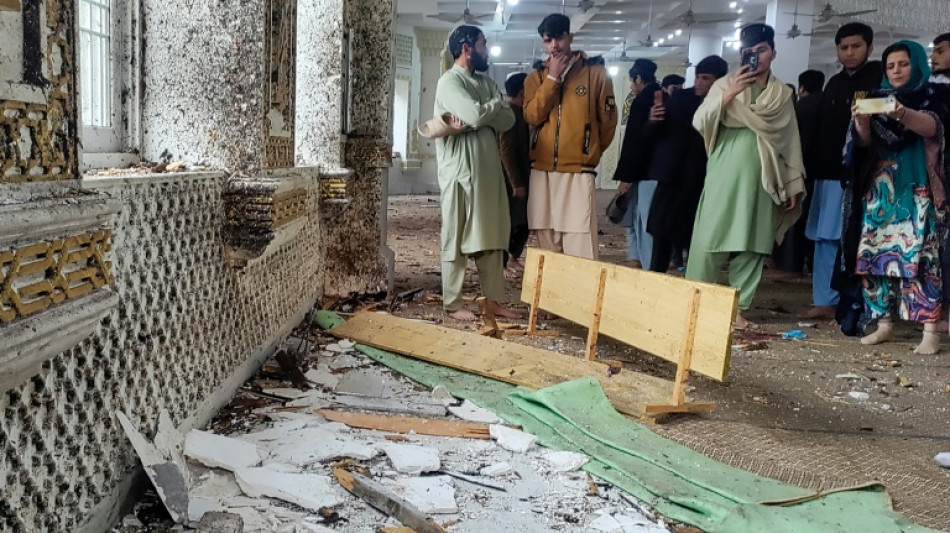
Suicide blast at Taliban religious school in Pakistan kills 4 / Photo: © AFP

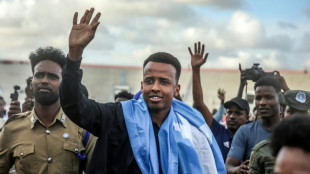 Somali referee denied World Cup 'proud' to oversee UEFA Super Cup

 French newspapers target Google over AI summaries
 Ebola death toll in DR Congo outbreak rises to more than 2,000

 PrimeXBT Launches MT5 Cent Account for Beginners and Risk-Conscious Traders
 British sprinter Hunt chasing three more golds after winning 100m

 Ethiopia's Tigray rebel authorities condemn army drone strikes
 Too hot to live? French buyers rethink housing choices after heatwaves
 Ukraine says Russia fired N. Korean missiles in deadly attack
 Oil prices jump further as hopes for Hormuz deal fade
 Trump says would be 'terrible mistake' to oust embattled Infantino

 Charity races to raise millions to buy historic English estate
 Hungary parliament to elect Orban-critic judge as president
 Wallabies lock Amatosero given three-match ban for Japan red card

 Swiatek races into Toronto semis as Svitolina battles through

 'Big Four' bowlers back as ageing Australia begin gruelling run
 AI's hunger for power sparks US private gas plant boom
 Memphis AI data center fuels pollution fight in Black neighborhood

 Ceuta leader wants migrant detention centre after influx
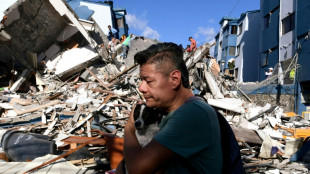
 Colombia scrambles to find survivors as quake kills 111

 Rain postponements wreck Montreal Masters schedule
 ePropelled to Increase Manufacturing Footprint with $60 Million in U.S. Government Funding to Strengthen U.S. Drone Propulsion Supply Chain

 Power to Hydrogen Delivers First-of-a-Kind Industrial-Scale AEM Electrolyzer to the Port of Antwerp-Bruges
 Notts Forest owner Marinakis sues Palace over gun banner - reports
 Koech gets three-year ban, stripped of US 1,500m title

 Sensational Ingebrigtsen back with more European gold
A suicide attack at an Islamic religious school in Pakistan known as the "University of Jihad" -- where key Taliban leaders have studied -- killed four people on Friday, police said.
Among those who died was Hamid ul Haq Haqqani, the head of the Dar-ul-Uloom Haqqania school, in Akora Khattak, about 60 kilometres (35 miles) east of Peshawar.
"Initial reports suggest the blast occurred after Friday prayers as people were gathering to greet Hamid ul Haq. It appears to be a suicide attack," Abdul Rasheed, the district police chief, told AFP, adding that four people were killed and 13 wounded in the blast.
Rasheed said that Haqqani, the head of a local rightwing Islamist party, appeared to be the target of the bomber.
He was the son of Sami ul Haq Haqqani, who was assassinated in 2018 and known as the "father of the Taliban" for teaching the insurgent group's founder Mullah Omar at the same religious school.
The explosion happened as people gathered for weekly Friday prayers, the most important day of the week.
The sprawling campus in Pakistan's Akora Khattak is home to roughly 4,000 students who are fed, clothed and educated for free.
It became known as the "University of Jihad" for its fiery ideology and the number of Taliban fighters it has produced.
Omar, who led an insurgency against the United States and NATO troops in Afghanistan before his death in 2013, graduated from the school along with Jalaluddin Haqqani, the founder of the feared Haqqani network which took its name from the school.
The Haqqani network is responsible for some of the worst attacks in Afghanistan.
Jalaluddin Haqqani was the father of Sirajuddin Haqqani, the current interior minister for the Taliban government in Afghanistan, himself also a student of the school.
Abdul Mateen Qani, the spokesman for the interior ministry in Kabul, said the government "strongly condemn the attack" and blamed it on the jihadist Islamic State group.
IS, a rival of the Taliban movement but with which it shares a similar hardline Islamic ideology, has been responsible for several attacks against the Taliban government since it retook power in 2021.
No group has yet claimed the bombing.
- Incubators for militancy -
The school has sat at the crossroads of regional militant violence for years, educating many Pakistanis and Afghan refugees -- some of whom returned home to wage war against the Russians and Americans or preach jihad.
For decades, Pakistani madrassas have served as incubators for militancy, indoctrinating tens of thousands of refugees who have few other options for education than the fire-breathing lectures from hardline clerics.
Rather than crack down on the institutions, successive governments in Islamabad -- which rely on the support of Islamist parties in coalition governments -- have largely given the madrassas a free hand.
The Taliban surged back to power in Kabul in August 2021 after foreign forces withdrew and the former government collapsed.
Militancy has since rebounded in the border regions with Afghanistan.
Last year was the deadliest in a decade for Pakistan, with a surge in attacks that killed more than 1,600 people, according to Islamabad-based analysis group the Center for Research and Security Studies.
Islamabad accuses Kabul's rulers of failing to root out militants sheltering on Afghan soil as they prepare to stage assaults on Pakistan, a charge the Taliban government denies.
M.Ouellet--BTB