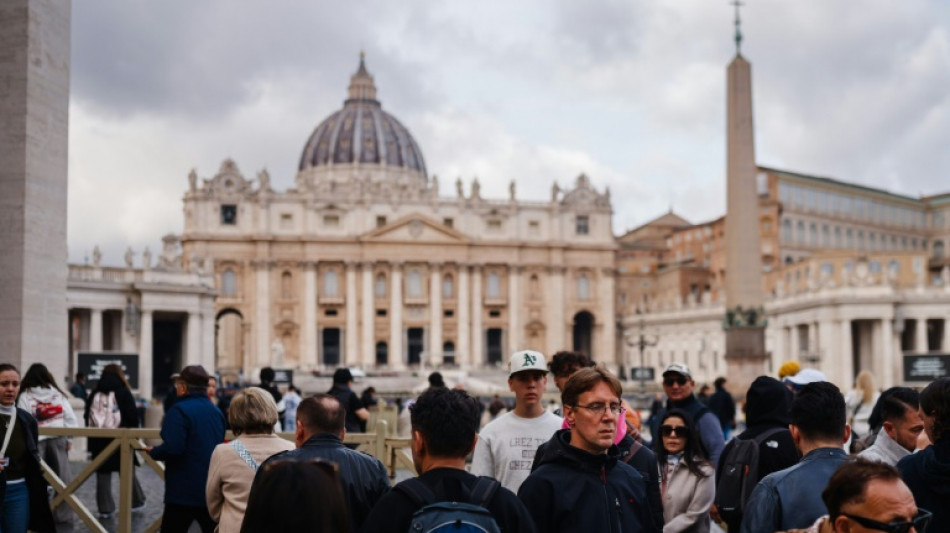
Pope 'stable' after 'calm night': Vatican / Photo: © AFP

 GTA 6 Advertising Strategy and Disc Version Controversy

 From First Date to Wedding Day: How a TV Quote Sparked a Lifetime Commitment

 Malta Stuns Sweden with Late Penalty Comeback in Rugby Europe Trophy

 BingX: Major Announcement of Far-Reaching Significance

 Élan Opens as Late-Night Wine Bar in Honolulu

 Shiv Sena (UBT) Criticizes NCP Merger Talks as 'Ridiculous Laughing Stock'

 Dell Announces AI-Integrated PC Lineup for 2026 with Wi-Fi 7 Support
Pope Francis, who has been in hospital for more than two weeks with double pneumonia, is in a "stable" condition after spending a "calm night", the Vatican said on Sunday.
"The pope is still resting," the Holy See said in its latest health update on the 88-year-old head of the Catholic Church.
On Saturday evening, it said the pope was still receiving oxygen, but had no fever, had been eating, was alert and praying.
His haemodynamic parameters -- those relating to the flow of blood -- were also stable, and he did not have the high white-blood-cell count that often indicates an infection, the Vatican said, adding that the prognosis, as in previous days, remained "reserved".
Francis, leader of the world's almost 1.4 billion Catholics, was admitted to Rome's Gemelli hospital on February 14 with bronchitis that soon developed into pneumonia in both lungs.
Last weekend, the Vatican reported he was in a "critical" condition, suffering a major respiratory attack and requiring blood transfusions, prompting widespread concern.
After a series of incremental improvements, there was more alarming news on Friday when the Vatican said Francis "presented an isolated crisis of bronchospasm which led to an episode of vomiting with inhalation and a sudden worsening of the respiratory picture".
"It will take doctors 24 to 48 hours to evaluate the impact" of Friday's breathing crisis, a Vatican source said.
Andrea Ungar, professor of geriatrics at the University of Florence, told AFP on Saturday that it appeared vomit had entered the pope's lungs, which "aggravated the pneumonia".
Such an issue normally required a strengthening of antibiotics, ventilation and respiratory exercises, he said.
He also agreed that the first 24 to 48 hours after an incident were crucial, adding the pontiff would likely stay in hospital for some time -- "at least 10 days" in the most optimistic scenario.
- Worried world -
Catholics and other well-wishers around the world have been praying for the Argentine pope, a liberal reformer who has led the Church for almost 12 years.
Pilgrims have flocked to the Gemelli hospital, praying for the pontiff and leaving handwritten messages, including posters illustrated by children, and balloons bearing his image.
Francis has continued to work from the special papal suite on the hospital's 10th floor, but his absence has sparked fresh speculation about his ability to lead the Church.
He has not been seen in public since the morning of his hospital admission, which is the fourth since 2021 and the longest of his papacy.
Francis was set to miss his weekly Angelus prayer on Sunday for the third weekend in a row, with the Vatican saying it would publish a text instead.
The Jesuit, who had part of one of his lungs removed as a young man, has suffered increasing health problems in recent years.
In 2021, he underwent colon surgery. Two years later, he had a hernia operation. He is also prone to bronchitis and suffers from hip and knee pain which has made him reliant on a wheelchair.
Francis has always left open the option of resigning if his health declined, following the example set by his predecessor, German theologian Benedict XVI, who quit in 2013.
Before his hospitalisation, Francis had repeatedly said it was not yet the time -- and may never be.
Francis maintains a packed schedule, particularly with the Church celebrating a Jubilee holy year this year, an event predicted to draw tens of millions of pilgrims to Rome and the Vatican.
L.Dubois--BTB