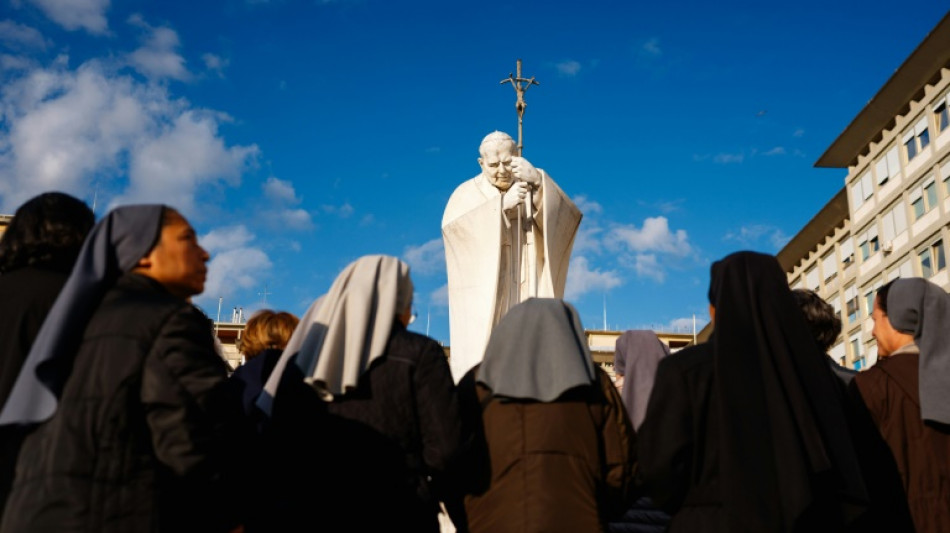
What we know about the health of Pope Francis / Photo: © AFP

 GTA 6 Advertising Strategy and Disc Version Controversy

 From First Date to Wedding Day: How a TV Quote Sparked a Lifetime Commitment

 Malta Stuns Sweden with Late Penalty Comeback in Rugby Europe Trophy

 BingX: Major Announcement of Far-Reaching Significance

 Élan Opens as Late-Night Wine Bar in Honolulu

 Shiv Sena (UBT) Criticizes NCP Merger Talks as 'Ridiculous Laughing Stock'

 Dell Announces AI-Integrated PC Lineup for 2026 with Wi-Fi 7 Support
Pope Francis, 88, has been in hospital in Rome since February 14, suffering two respiratory crises but reported by the Vatican on Sunday evening to be in a "stable" condition.
Here is what we know about the health of the Argentine pontiff, head of the Catholic Church and its almost 1.4 billion followers since 2013.
- Stable but complex condition -
Francis was admitted to the Gemelli hospital initially for bronchitis, but this then developed into pneumonia in both lungs.
On February 22 the Vatican revealed he had suffered a "prolonged asthmatic attack" which required him to receive "high-flow" oxygen via a nasal cannula.
Francis also required blood transfusions for thrombocytopenia, a condition that occurs when the platelet count in the blood is too low, which can prevent clotting and lead to continued bleeding.
Over the following days, the Vatican reported an incrementally more positive picture, but there was another major issue on February 28.
The pope suffered "an isolated crisis of bronchospasm" -- a tightening of the muscles that line the airways in the lungs -- which caused "an episode of vomiting with inhalation", the Holy See said.
He began "non-invasive mechanical ventilation" -- receiving oxygen through a mask, according to a Vatican source -- and was nevertheless reported to be "in good spirits".
On March 2, a Vatican source revealed that more than 48 hours after the crisis, it appeared there had been "no further consequences" from the episode.
The pope's condition "remained stable", the Holy See said in its official update that day, saying he had no fever and had on Sunday morning participated in mass.
However, "in view of the complexity of the clinical picture, the prognosis remains reserved".
- Work continues -
The pope has been staying in a special papal suite on the 10th floor of the Gemelli hospital, praying and performing some work, according to a Vatican source.
He has been reading and signing documents, notably appointments of bishops around the world, as well as making telephone calls.
Francis has twice received Italian Cardinal Pietro Parolin, the Vatican's secretary of state, and Edgar Pena Parra, a Venezuelan archbishop who is Parolin's number two.
But he has not yet been seen in public, notably missing his Sunday Angelus prayers, which in previous hospital stays he delivered from the Gemelli balcony.
Instead, the Vatican has published his written texts each week.
- Well-oiled communication -
In a notable shift towards transparency compared to previous papacies, the Vatican has been providing twice daily updates on Francis's health.
The morning statement, normally one line shortly after 0700 GMT on his night's sleep and whether he has eaten breakfast, arrives to accredited reporters via Telegram and then is sent via email.
A more detailed medical bulletin arrives around 1800 GMT, describing the Jesuit's clinical progress.
Doctors said Francis himself had requested they be frank about his medical state.
- Longest hospital stay -
This is Francis's fourth hospital stay since he became pope on March 13, 2013, and is the longest and the most fraught.
He has, in recent years, suffered a number of health issues, even while maintaining a packed schedule, including many overseas trips.
Francis was admitted to the Gemelli between July 4 and July 14, 2021, for surgery on a type of diverticulitis, an inflammation of pockets that develop in the lining of the intestine.
In March 2023, he was an inpatient for three days for bronchitis and between June 7 and June 16 that year was admitted for a hernia operation.
As a young man, he had part of his right lung removed, making him more susceptible to respiratory infections.
Knee and hip pain have forced him to use a wheelchair since 2022, he underwent cataract surgery in 2019 and recently began wearing a hearing aid.
Y.Bouchard--BTB