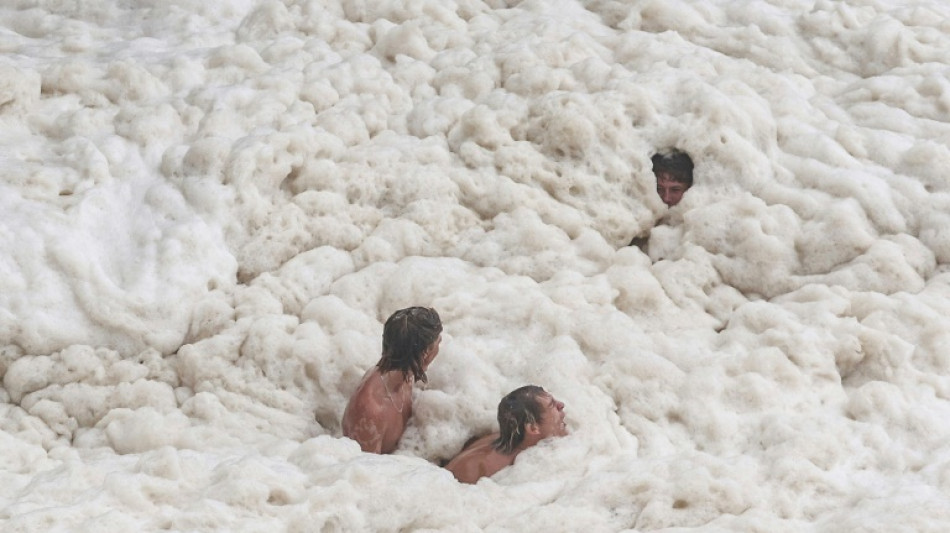
Australians told 'prepare for worst' as tropical cyclone nears / Photo: © AFP

 St Francis School Leads €60,000 EU Project to Transform Early Childhood Education

 South Africa's Universal Health Coverage Depends on Tackling Poverty and Inequality

 Rare Siberian Rubythroat Dies in UK Garden After Cat Attack

 Go Kyung-pyo Drunk Driving Incident Prompts Heavy Editing Across Multiple TV Shows

 KFF Health News Reporters Discuss ACA Enrollment Challenges, Rising Costs, and Measles Risks

 Alberta Unveils New High School Graduation Requirements to Increase Student Choice

Violent winds toppled power lines Friday as a tropical cyclone inched towards Australia's eastern coast, sparking evacuation orders and leaving more than 50,000 homes without electricity.
Tropical Cyclone Alfred was 165 kilometres (100 miles) east of Brisbane city on Friday morning, crawling towards the densely populated coastline at "walking speed", government forecasts said.
Some four million people were in the firing line along a 400-kilometre (250-mile) stretch of coastline straddling the border of Queensland state and New South Wales.
It is a region rarely troubled by typhoons -- it has been more than 50 years since a tropical cyclone made landfall in that part of Queensland.
More than 50,000 homes were without power on Friday morning as damaging winds brought down power lines, officials and utility companies said.
Queensland Premier David Crisafulli said the storm already "packed a punch", warning conditions would get worse as it approached land late on Friday or early Saturday.
Emergency response officials said they had issued evacuation orders for some 10,000 people in the flood-prone northern rivers region of New South Wales.
There was particular concern for the town of Lismore, which was engulfed by record 14-metre (45-feet) floodwaters after heavy rains in 2022.
Many residents have spent the past three days fortifying their homes with sandbags, tying down loose furniture and stocking up on food and water.
"A lot of people are feeling a bit anxious, for sure, because we don't know what's going to happen," said Paul Farrow from Coolangatta, a coastal suburb better known for its sun-splashed beaches.
"Yeah, we could all lose our houses. Who knows," the 62-year-old told AFP.
"The pubs might be shut for a week or two. Who knows."
Farrow said he had stashed a "couple of peaches", a "couple of cartons of beer", and "a bag of grapes" to get him through.
"So I'll be right," he said.
- 'Prepare for the worst' -
Prime Minister Anthony Albanese said the region should "hope for the best, but prepare for the worst".
"When nature does its worst, Australians are at our best. We rally. We lift each other up. We look out for our neighbours," he told reporters.
Tropical Cyclone Alfred would likely cross the coast "early Saturday morning", the Bureau of Meteorology said, although its path was becoming difficult to predict.
It was forecast to make landfall around 60 kilometres (40 miles) north of Brisbane.
Drenching rains, "destructive" wind gusts, and "abnormally high tides" would pummel the coast as it crept nearer, the bureau said.
More than 900 schools across Queensland state and neighbouring parts of northern New South Wales were closed on Friday, education department officials said.
While cyclones are common in the warm tropical waters lapping Australia's northern flank, it is rarer for them to form in cooler waters further south.
Alfred would be the first to make landfall in that part of Australia since 1974, the Bureau of Meteorology said.
Researchers have repeatedly warned that climate change amplifies the risk of natural disasters such as bushfires, floods and cyclones.
P.Anderson--BTB