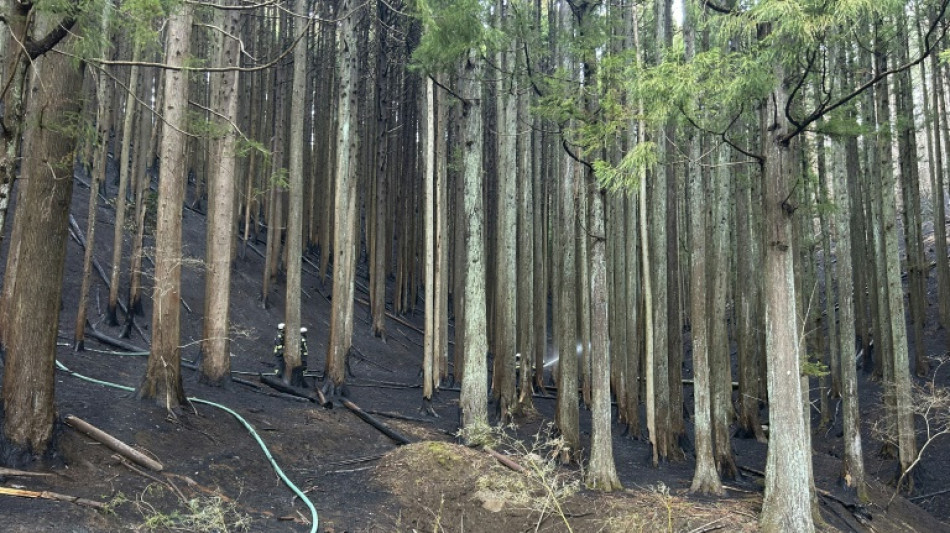
Japan wildfire evacution orders partially lifted / Photo: © Fire and Disaster Management Agency/AFP

 St Francis School Leads €60,000 EU Project to Transform Early Childhood Education

 South Africa's Universal Health Coverage Depends on Tackling Poverty and Inequality

 Rare Siberian Rubythroat Dies in UK Garden After Cat Attack

 Go Kyung-pyo Drunk Driving Incident Prompts Heavy Editing Across Multiple TV Shows

 KFF Health News Reporters Discuss ACA Enrollment Challenges, Rising Costs, and Measles Risks

 Alberta Unveils New High School Graduation Requirements to Increase Student Choice

Japan partially lifted wildfire evacuation orders on Friday after rain helped stop the country's worst blaze in more than half a century from spreading.
The fire had raged in the mountains around the northern city of Ofunato for over a week, killing one person and forcing more than 4,200 residents to flee their homes.
But wet weather, which began Wednesday following a record dry period, helped firefighting efforts.
"Aerial reconnaissance this morning has not confirmed any spread of fire, fire reaching buildings or white smoke," Toshifumi Onoda, from the local fire department, said Friday.
Firefighters were planning to enter forests to check that the fire was out, he said.
City official Shinichi Matsukawa told reporters that an evacuation order for nearly 1,000 residents had been lifted.
The wildfire engulfed about 2,900 hectares (7,170 acres) -- around half the size of Manhattan -- making it Japan's largest in more than 50 years.
It surpassed the 2,700 hectares burnt by a 1975 fire on Hokkaido island.
Japan endured its hottest summer on record last year, as climate change pushes up temperatures worldwide.
Then in February, Ofunato received just 2.5 millimetres (0.1 inches) of rainfall -- breaking the previous record low for the month of 4.4 millimetres in 1967, and far below the average of 41 millimetres.
At least 78 buildings are believed to have been damaged, although details are still being assessed, according to the fire agency.
The number of wildfires in Japan has declined since a peak in the 1970s.
In Japan, wildfires tend to occur between February and May, when the air dries out and winds pick up. There have been around 1,300 a year in recent years.
F.Pavlenko--BTB