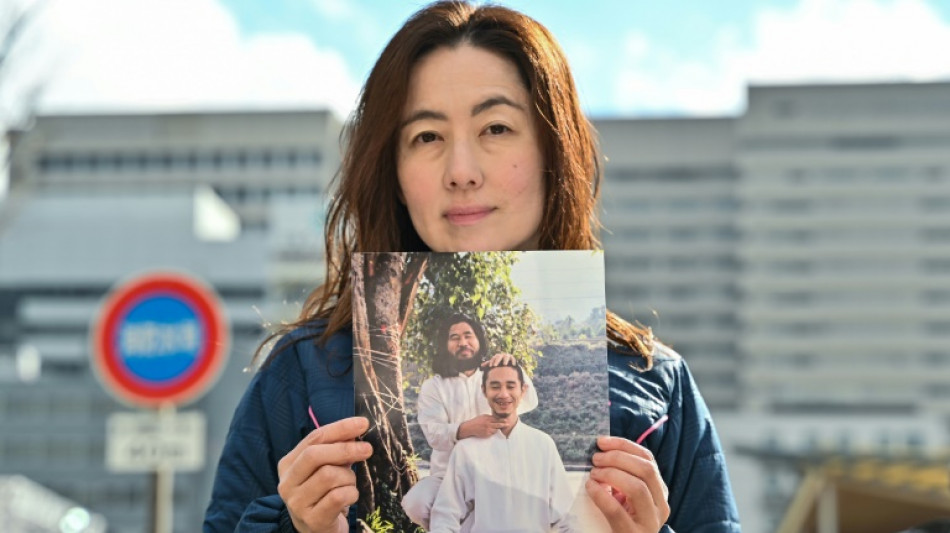
Japan cult widow speaks 30 years after subway attack / Photo: © AFP

 Singapore says AI-related demand lifting economy

 Demeter Tactical Investments (ME) Limited bolsters governance with two board appointments

 Russian barrage on Ukraine kills 9, wounds dozens
 Schools closed as Indonesia battles wildfires

 Swiatek dominates Shnaider to set up Toronto semi with Svitolina

 Oil prices rise further as hopes for Hormuz deal fade

 One year after Putin-Trump summit, 'spirit of Anchorage' dissipated

 Farage vs Count Binface: What to know about UK snap poll

 Torment of Afghan fathers as daughters deprived of education

 Return of displaced Syrian Kurds to hometown suspended after violence

 Swiatek races past Shnaider into Toronto semi-finals

 Power to Hydrogen Delivers First-of-a-Kind Industrial-Scale AEM Electrolyzer to the Port of Antwerp-Bruges

 Notts Forest owner Marinakis sues Palace over gun banner - reports

 Koech gets three-year ban, stripped of US 1,500m title

 Sensational Ingebrigtsen back with more European gold

 'A scare': Brazil player leaps into tunnel in joy over goal

 USA Swimming CFO Hilliard arrested for alleged theft

 Trump insists Netanyahu relationship 'very good' despite Gaza rift

 Ingebrigtsen delivers masterclass for seventh European athletics gold

 Colombia declares state of emergency after quake kills 111

 Golden relay double for Britain at Europeans as Marchand takes silver

 Barcelona's Araujo heads to Liverpool on loan

 Tupac Shakur murder trial begins 30 years after rapper's death

 Russia bars only anti-war party from elections

 Boeing to divest tech ventures for stake in air-taxi startup

Only seven years into her marriage did Yuki Niimi first touch her husband -- at a morgue where she collected his body after he was executed and kissed him in a coffin.
Before that a glass screen had always separated her from her death-row spouse Tomomitsu Niimi, a notorious member of the Aum Shinrikyo doomsday cult that 30 years ago orchestrated a nerve agent attack on Japan's capital.
On March 20, 1995, Aum members released sarin on five Tokyo subway trains, killing 14 people and sickening thousands more.
"Until the very end, he gave no apology to those who died. He didn't regret what he did. He just followed the path he believed in," Yuki, 47, told AFP in an interview.
Yuki herself is a former member of an Aum successor group who despite her denials was once convicted for using intimidation to try to recruit an acquaintance for the sect.
Given the magnitude of her husband's crimes, she believes the death penalty was "unavoidable", and that "paying restitution" is the only way Aum cultists can atone.
Under the thrall of the wild-haired, near-blind guru Shoko Asahara, Aum devotees believed Armageddon was coming and saw massacres as an altruistic way to elevate souls to a higher realm.
Disaffected young people in Japan, including doctors and engineers who later manufactured toxins, took solace in Asahara's doctrines.
Among his most loyal mentees was Tomomitsu, who was behind bars when he met Yuki, and when they married in 2011.
Their relationship consisted of letters and 15 to 30 minutes of conversation, almost every day, under a guard's supervision.
But it ended abruptly with his execution in summer 2018, along with 12 other Aum members including Asahara.
After his hanging, the widowed Yuki caressed the still-warm body of Tomomitsu, whose neck was wrapped in a bandage to conceal the mark left by the noose.
She then spent the next three days until his cremation lying alongside him at home.
"He didn't look like he suffered at all. He might as well have been asleep," she said.
- 'Blood-stained' -
Tomomitsu, who died aged 54, is sometimes called Aum's "most blood-stained" disciple -- having helped perpetrate all of the group's seven deadly attacks, including the subway strike in which he acted as a driver.
He also fatally suffocated a sleeping one-year-old in the 1989 slaying of an anti-Aum lawyer and his family.
The Aum cultists, who shut themselves away incommunicado in the pre-internet era, "believed everything" Asahara said and "honestly thought they were helping his act of salvation", Yuki said.
She showed AFP a photo of a youthful, smiling Tomomitsu, sitting cross-legged with the cult leader behind him, both dressed in loose, bright white robes.
However, around a month before Tomomitsu's execution, she sensed his allegiance to his leader finally crumbling.
"He called him just 'Asahara' -- that had never happened before in the 12 or so years we were together. It was unthinkable, after all these years of referring to him as 'guru' or 'master'," she said.
Then, in his diary, "in the final days of his life, he expressed clearly that 'I am not following him any more'."
He wrote that he had come to realise that Asahara's teachings about karma were a fallacy, Yuki said.
Also, despite Tomomitsu's lack of remorse, "I asked why Aum carried out the subway gas attack, and my husband clearly told me that the guru was sick, mentally ill," she added.
"Followers still say the guru had profound thoughts to justify it, but, no way. He was mentally sick."
- 'Love at first sight' -
The 1995 subway poisonings shocked the world and prompted a reckoning on extremism in Japan, with a crackdown on Asahara's empire that once counted more than10,000 followers.
Its successor groups continue to operate and recruit today, with their numbers estimated at 1,600 domestically.
Two of these groups, Aleph and Hikarinowa, operate openly in Japan, which some experts say make them easier to monitor.
Yuki joined Aleph in 2002, with her curiosity about mysticism eclipsing her fears of Aum, she said.
For her, the cult's key allure was the idea that through its training, including chanting and intense spiritual meditation sessions, she could be reborn into a "celestial world" where there is "no suffering from disease or love".
One day she went to see Tomomitsu behind bars to seek his "top-tier" advice, only to "fall in love at first sight".
"My feelings towards him were not only romantic, but akin to worship," she said.
The lovestruck Yuki gradually lost interest in Aleph and quit in 2012.
But little has since changed about Aleph, whose altars are still adorned with framed pictures of Asahara.
"There is no way they will ever change," Yuki said.
Asahara's death has "done nothing to weaken their faith, the way Jesus in Christianity is immortalised", she said.
Japanese authorities say Aleph members routinely chant allegiance to their demised master and wear special headgear said to be imbued with his brain waves.
Yuki believes that the failure of family relationships is the main reason some young people lose themselves in spirituality, recalling her own sometimes controlling mother.
"Had they built a good relationship with their parents, I don't think they would've sought solace in cults," she said.
Yet with her husband gone, the family she once struggled with is now what anchors her life.
"Aleph and Aum deny everything about your family or friends, but now, these people are what I live for."
K.Thomson--BTB