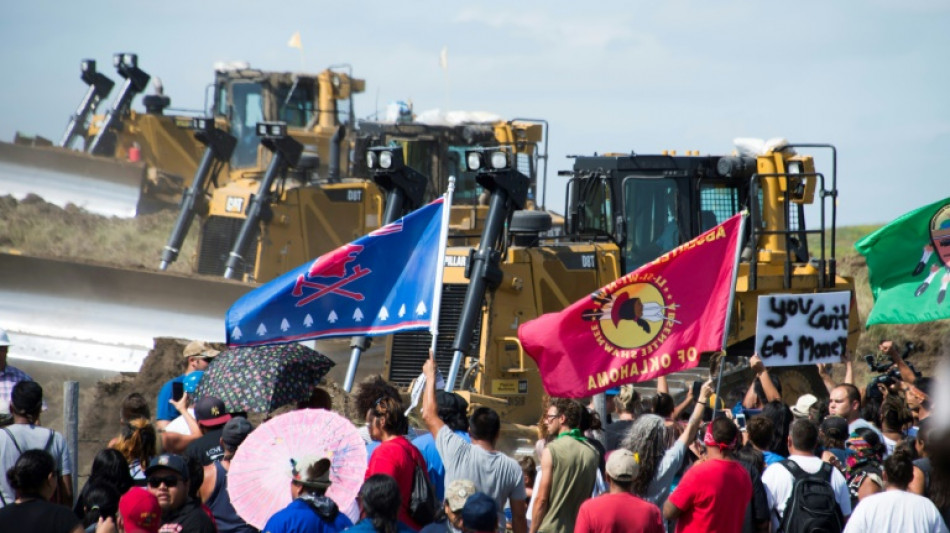
Jury finds Greenpeace liable for hundreds of millions in pipeline case / Photo: © AFP/File

 Malta Stuns Sweden with Late Penalty Comeback in Rugby Europe Trophy

 BingX: Major Announcement of Far-Reaching Significance

 Élan Opens as Late-Night Wine Bar in Honolulu

 Shiv Sena (UBT) Criticizes NCP Merger Talks as 'Ridiculous Laughing Stock'

 Dell Announces AI-Integrated PC Lineup for 2026 with Wi-Fi 7 Support

 Rocky Fans Break Guinness World Record at Philadelphia Museum Steps

 FAA Grounds All US Flights Amid Nationwide Air Traffic Control Communication Failure

 Argentina vs Uruguay Kick-off Time, TV Channels & Free Streaming Guide

A jury in North Dakota on Wednesday ordered Greenpeace to pay hundreds of millions of dollars in damages in a case brought by a US pipeline operator that had been closely watched for its far-reaching free speech implications.
The verdict dealt a massive blow to the prominent environmental advocacy group, which was accused by the operator of the Dakota Access Pipeline, Energy Transfer (ET), of orchestrating a campaign of violence and defamation.
"We would like to thank the judge and the jury for the incredible amount of time and effort they dedicated to this trial," said ET.
"While we are pleased that Greenpeace will be held accountable for their actions, this win is really for the people of Mandan and throughout North Dakota who had to live through the daily harassment and disruptions caused by the protesters who were funded and trained by Greenpeace."
Nearly a decade ago, the Standing Rock Sioux tribe led one of the largest anti-fossil fuel protests in US history against the project's construction.
Hundreds were arrested and injured, prompting concerns from the United Nations over violations of Indigenous sovereignty.
The pipeline, which transports fracked crude oil to refineries and global markets, has been operational since 2017.
But Energy Transfer continued to pursue legal action against three Greenpeace entities -- first in a federal lawsuit seeking $300 million, which was dismissed, and then at the state level in North Dakota.
A trial began in late February in Mandan, North Dakota, and the jury deliberated for nearly three days before returning their verdict.
"We should all be concerned about the future of the First Amendment, and lawsuits like this aimed at destroying our rights to peaceful protest and free speech," Deepa Padmanabha, senior legal advisor of Greenpeace USA said in a statement.
"Greenpeace will continue to do its part to fight for the protection of these fundamental rights for everyone."
Critics had called the case a clear example of a Strategic Lawsuit Against Public Participation (SLAPP), designed to silence dissent and drain financial resources.
Notably, North Dakota is among the minority of US states without anti-SLAPP protections.
Greenpeace also maintained that it played only a small role in the protest movement, which was led by Native Americans.
More than 400 organizations, along with public figures such as singer Billie Eilish and actors Jane Fonda and Susan Sarandon, had signed an open letter in support of Greenpeace, as had hundreds of thousands of individuals globally.
E.Schubert--BTB