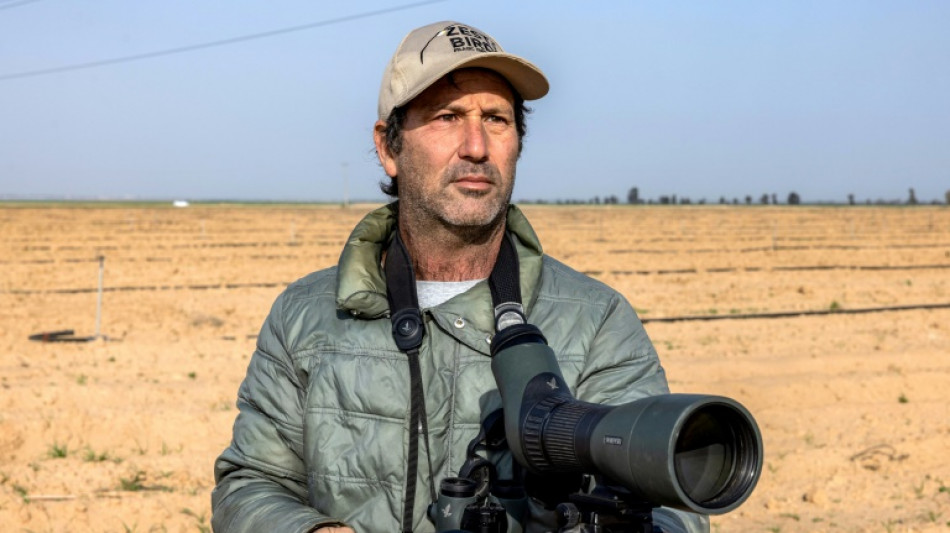
The watchers who prey on Israel's falcon poachers / Photo: © AFP

 Schools closed as Indonesia battles wildfires

 Swiatek dominates Shnaider to set up Toronto semi with Svitolina

 Oil prices rise further as hopes for Hormuz deal fade

 One year after Putin-Trump summit, 'spirit of Anchorage' dissipated

 Farage vs Count Binface: What to know about UK snap poll

 Torment of Afghan fathers as daughters deprived of education

 Return of displaced Syrian Kurds to hometown suspended after violence

 Swiatek races past Shnaider into Toronto semi-finals

 Meta pushes global AI vision amid race with OpenAI, Anthropic and China

 US judge ends graft case against India's Adani

 Anderson retires after 10 MLB seasons after 'too much pain'

 Colombia in state of emergency as quake kills 111

 Britain's Amy Hunt wins European women's 100m gold

 Trump order pushes for overhaul of childhood vaccine schedule

 Global stocks mixed while oil prices jump on Hormuz

 Turkey MPs back historic law on reintegrating Kurdish militants

 'Dreams disappear' as Gaza students await evacuation to Italy

 Third European gold for Schilder in women's shot put

 Golden relay double for Britain at Europeans as Marchand settles for silver

 US had hottest month on record in July

 Colombia quake leaves 69 dead, with more trapped under rubble

 Bookmap Announces Partnership with Plus500 to Expand Futures Trading Access

 Barcelona turn down PSG offer for Torres

 Buildings collapse as major quake rocks Colombia and neighbors
 Meta releases new AI model as Zuckerberg lays out vision

For the volunteer watchers scanning southern Israel's wheatfields, protecting migratory falcons from poachers is a highly coordinated security operation.
The raptors may top the food chain in the wild, but here the predators can themselves become the prey.
Many protected species of migratory birds spend their winters in this agricultural area close to the Gaza Strip.
And some species are big business. A single falcon can fetch up to tens of thousands of dollars on the black market, especially in Gulf countries where falconry is a treasured tradition.
Meidad Goren, director of the Ramat Hanegev Birding Center, told AFP that poaching has soared in recent years.
Falcons are captured alive by Bedouin Arabs living in Israel's Negev desert to be domesticated or smuggled to neighbouring countries, he said.
Using binoculars to observe one bird perched on a nearby pylon, Goren noted: "It has a ring. It's a peregrine falcon that was captured and escaped."
The raptors feed on small birds attracted to the wheat, waiting motionless and watching from power lines that cross the fields.
The number of cases of birds of prey, especially falcons, found with ties around their legs, sometimes tangled in power lines, led Goren to set up groups of volunteer watchers.
The area is also patrolled by rangers from the Israel Nature and Parks Authority.
- 'Like watching a child' -
This winter, a saker falcon took up residence around Kibbutz Urim.
The saker falcon is an endangered species popular with falconers in eastern Europe, Central Asia and Arab states.
After observing several attempts by poachers to capture the bird, Goren put in place what he calls a "special surveillance system".
"Dozens of people, ornithologists, nature lovers, retirees, guides, farmers," responded to his appeal for help to reinforce regular volunteer patrols, said Goren.
His centre operates under both the Israel Nature and Parks Authority and the Society for the Protection of Nature in Israel.
Mirit Keshales is 47 and a regular "falcon guardian" volunteer.
"It's really like watching a child, a very methodical organisation with a well-defined schedule... we make sure someone is always there during the day," she said.
The poachers come mostly from Bedouin villages, said Ofir Bruckenstein, a ranger with the Israel Nature and Parks Authority.
"For them, hunting with falcons and owning falcons are cultural practices rooted in their traditions," he said.
"Owning a falcon and displaying it in their living space is a symbol of status and prestige."
- Sold for $19,000 -
Bruckenstein criticised what he called lenient penalties for poaching, in particular of falcons, saying fines were of "a few thousand shekels", even if repeat offenders faced jail terms.
The especially lucrative black market for falcons smuggled via Jordan and Egypt to the Gulf encourages the illegal trade, he added.
"Saker falcons and peregrine falcons are easily sold for 50,000 or 70,000 shekels ($14,000 to $19,000)," he said.
Falconry is inscribed on UNESCO's list of Intangible Cultural Heritage, and is hugely popular in the Gulf.
In the United Arab Emirates, passports for falcons were introduced in 2002 in an effort to combat smuggling, and tens of thousands have since been issued.
But poaching remains a regional problem in the Middle East, and the demand for falcons captured from the wild has exploded in recent years, with the growth in clubs which stage contests for beauty and falconry.
While falcons are farmed, especially in the UAE which permits only captive-bred and registered birds to be used in sport falconry, wild falcons are considered better hunters and are thus more desirable.
"They lack falcons because those that arrive (in the Gulf region) in winter have nearly all been caught. That's why they are now trying to capture them elsewhere," said Goren.
AFP contacted several international falconry organisations based in Europe, but they declined to comment on the illegal trade to Gulf countries, citing the "sensitivity of the issue".
Meanwhile, the watchers in southern Israel do what they can to prevent more of these beautiful birds from falling into human hands.
P.Anderson--BTB