Black Americans bear the brunt of fentanyl 'epidemic' in Washington / Photo: © AFP Photo

 Alarm at German airport after drone found near Ukrainian plane, mid-air incident
 Salah arrives in Turkey for Trabzonspor talks

 Embattled FIFA chief Infantino holds emergency talks with directors

 Russian barrage on Kyiv kills 17 as Ukraine fails to down single missile
 'Lost': Migrants despair after Britain expels them back to France

 Cathay Pacific's profit soars 71% despite Iran war driving up fuel costs
 Russian barrage on Ukraine kills 15, wounds dozens more

 South Korea police raid Starbucks HQ over 'Tank Day' fiasco

 Tech back in fashion as Asian markets extend rebound

 Total eclipse gives scientists chance to probe Sun's mysteries
 What to know about the total solar eclipse on August 12
 'Like the end of the world': the eclipse chasers flocking to Spain

 Taiwan begins military drills as China pressure grows

 UK mansion where 'listeners' spied on Nazi generals becomes museum

 Sabalenka tops Uchijima in WTA Toronto opener

 Alcaraz withdraws from Cincinnati Masters with wrist injury

 SpaceX revenue jumps 92% in first earnings report, but shares slide

 US eyes Hormuz deal 'today or tomorrow' as ship sinks in Red Sea
 SpaceX revenue jumps 92% in first earnings report
 New commissioner Berg wants to take MLS to 'next level'

 Colombian ex-guerrillas fear for future under hardline president

 Tsitsipas comeback continues with Montreal first-round win
 Swiatek fends off Bejlek to reach Toronto third round

 Reusser romps to overall lead at Tour de France Femmes
 McDonald's reports slower US sales in 2nd quarter

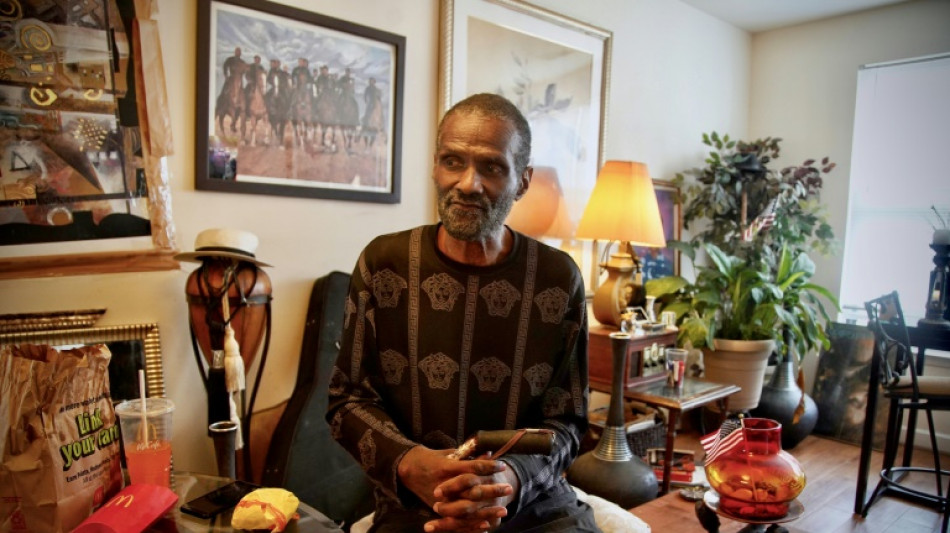
Lorando Duncan wears long-sleeved shirts because his arms bear scars he doesn't like to show: those of the drugs he has been injecting into his veins for decades.
Born in the US capital Washington 65 years ago, the slender African American has been using heroin almost all his adult life.
But the advent of fentanyl, an ultra-powerful and addictive synthetic opioid, changed everything.
"Fentanyl killed a lot of my friends," he tells AFP beneath a picture of America's first Black vice president, Kamala Harris, that he has hung in his apartment in Anacostia, one of the poorest neighborhoods in the city.
"Almost every two weeks, I hear about somebody overdosing on fentanyl."
He fears he will be next. "I need to stop... because eventually I'm going to kill myself. And I know it."
Fentanyl -- sold in powder form and cheap to manufacture, so often used as an additive in other drugs such as heroin -- began flooding the market in 2014.
In 2021, 426 people died of opioid overdoses in Washington -- five times as many as in 2014. Of them, 95 percent were fentanyl-related, and 85 percent were Black people. Like Lorando, the majority were between 50 and 69 years old.
Heroin users have been at the forefront of this "poisoning" of supply, as experts call it.
"One day I bought some drug from a guy I know, but I didn't know it was fentanyl," says Lorando, a former prisoner now living on disability benefits.
He passed out, he says, falling on his hip. Now he walks with a cane.
"When I fell, it was day, and when I woke up, it was nighttime. God woke me up this day," he says.
But now he takes fentanyl up to three times a day to feel "normal" and avoid the illness and nausea of withdrawal.
"Now they use fentanyl to cut heroin. So you basically gonna get fentanyl in everything you buy. Everybody uses fentanyl to cut the dope. Make it potent," he says.
The problem, he adds, is that users never know what they are going to get. "You're playing Russian roulette."
- Building trust -
In Washington, long dubbed "Chocolate City" because of its large African American population, Black people were already dying from overdoses at twice the rate of white people in 2010, according to one study.
By 2019, it was 10 times more. For both periods, this disparity was higher than in any state in the country. Experts say one reason is because of how much more vulnerable Black people are -- lower income, less likely to own a home, less likely to have access to resources that can keep them stable and supported.
A few grassroots organizations are doing their best to combat the ravages of the drugs.
Tyrone Pinkney has been working for one of them, the Family and Medical Counseling Service, for 10 years. The 33-year-old travels around the city, especially what he describes as "the crime areas," in a recreational vehicle.
On the RV's floor is a box containing dirty syringes, collected from visitors who are then given clean ones.
And on the seats are cartons of Narcan, the brand name of naloxone, an antidote capable of blocking the effect of opioids -- and thus saving a person in the process of overdosing.
With a tablet in hand, Pinkney questions the few dozen people who turn up each day, checking for example whether they have been tested for the AIDS virus.
"It's not going to keep them from doing what they're doing. But it'll keep them safe," he explains.
Little by little, bonds of trust are created. On his phone, he scrolls through the names of dozens of "clients," as he calls them, who can call him in case of need.
- 'Perfect storm' -
The association helped more than 2,500 people in 2021, and distributed more than 200,000 syringes, according to regional coordinator Mark Robinson.
"It's an emergency. It's endemic," he tells AFP.
"It's an opioid epidemic, layered beneath a (Covid-19) pandemic, layered beneath a health emergency that was already pre-existing amongst Black and brown people," he continues, listing the ways in which Washington's residents are made vulnerable.
"You have multiple epidemics upgrading simultaneously, it's like a perfect storm. And we're right in the midst of it."
For many, the steps needed to access treatment, such as opioid substitutes methadone or buprenorphine, remain too complex -- making it often easier to get drugs than help.
"We've really worked hard on access," Barbara Bazron, who heads Washington's department of behavioral health, tells AFP.
For example, users no longer need to go through a dispatch center to receive prescriptions -- 70 approved entities can directly receive new patients, she explained.
More than 5,000 people are currently enrolled in these care programs.
The city has also prioritized the free distribution of naloxone, giving away 56,000 kits in 2021, and tests to detect whether drugs contain fentanyl.
City Hall is also "gathering information" on safe injection sites, such as those recently set up in New York, says Bazron, who admits she is willing to look at any option.
"Nothing is off the table," she says.
J.Horn--BTB