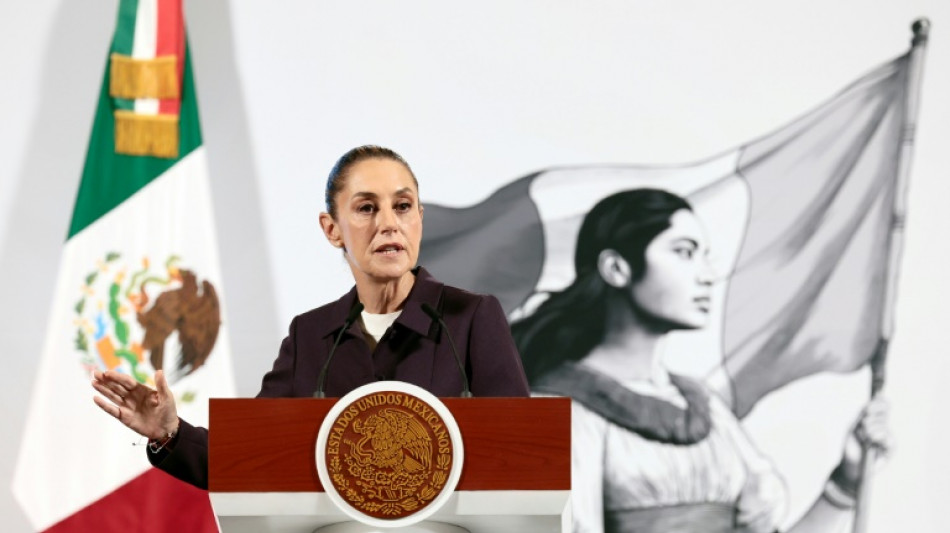
No 'eye for an eye' approach to US tariffs: Mexico / Photo: © AFP

 Élan Opens as Late-Night Wine Bar in Honolulu

 Shiv Sena (UBT) Criticizes NCP Merger Talks as 'Ridiculous Laughing Stock'

 Dell Announces AI-Integrated PC Lineup for 2026 with Wi-Fi 7 Support

 Rocky Fans Break Guinness World Record at Philadelphia Museum Steps

 FAA Grounds All US Flights Amid Nationwide Air Traffic Control Communication Failure

 Argentina vs Uruguay Kick-off Time, TV Channels & Free Streaming Guide

 Wedding Etiquette: When Is It Appropriate to Bring a Plus-One?

Mexican President Claudia Sheinbaum said Tuesday there will be no "eye for an eye" approach as the country braces for new US import tariffs kicking in this week.
The leader of the United States' biggest trading partner spoke on the eve of President Donald Trump's expected announcement of "reciprocal" tariffs, with 25 percent levies on imported cars and car parts.
Mexico has previously vowed a "comprehensive response" to Trump's tariffs, sticking to a strategy of prioritizing dialogue.
But Sheinbaum said Tuesday "we do not believe in an eye for an eye, a tooth for a tooth, because that always leads to a bad situation."
She added that "of course, measures are taken (in Mexico) because measures are taken on the other side, but the dialogue must continue."
Trump has said he will unveil a raft of so-called "reciprocal tariffs" Wednesday, on what he has dubbed America's "Liberation Day."
He insists the duties are necessary to combat trade imbalances with other countries.
Mexico's economy is considered one of the most vulnerable to Trump's tariffs due to its close trade relations with the United States.
The Latin American nation is home to many foreign-owned vehicle assembly plants operated by companies including Ford, General Motors, BMW, Volkswagen and Toyota.
More than 80 percent of Mexican exports go to the United States, including around three million vehicles a year.
Sheinbaum said her government would wait to hear the details of Trump's announcement Wednesday to respond accordingly.
"We are not certain, no country in the world is certain exactly what will be announced on April 2," she said at her daily press conference.
On the topic of migration, another point of contention with Mexico's northern neighbor, Sheinbaum insisted her government was willing to "coordinate" approaches with the United States, but "not subordinate" to it.
"The president answers to one authority only, and that is the people of Mexico," she said.
Sheinbaum was visited last Friday by US Homeland Security Chief Kristi Noem, who said she gave the president a list of demands related to curbing migration, including greater control over Mexico's border with Guatemala.
Guatemala is a transit country for many migrants trying to reach the United States from South America.
L.Dubois--BTB