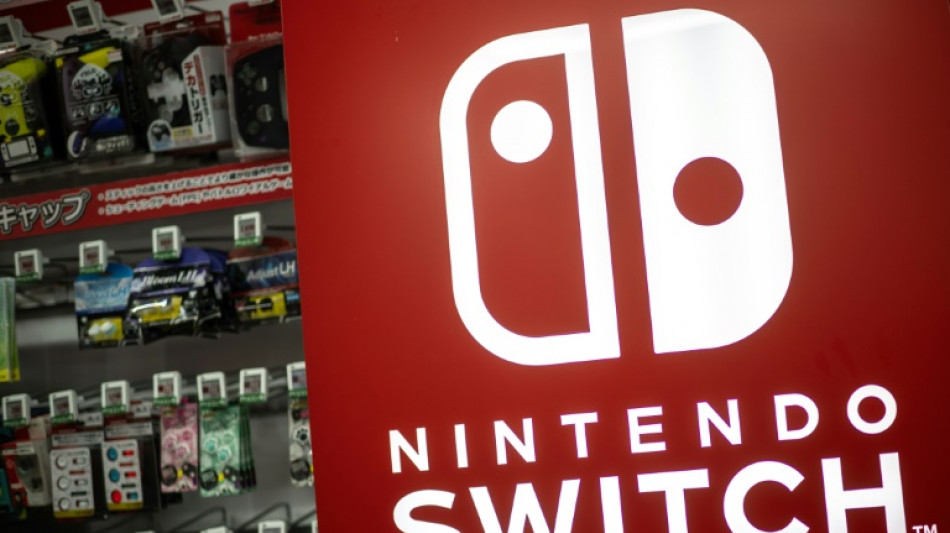
Nintendo's megahit Switch console: what to know / Photo: © AFP

 Élan Opens as Late-Night Wine Bar in Honolulu

 Shiv Sena (UBT) Criticizes NCP Merger Talks as 'Ridiculous Laughing Stock'

 Dell Announces AI-Integrated PC Lineup for 2026 with Wi-Fi 7 Support

 Rocky Fans Break Guinness World Record at Philadelphia Museum Steps

 FAA Grounds All US Flights Amid Nationwide Air Traffic Control Communication Failure

 Argentina vs Uruguay Kick-off Time, TV Channels & Free Streaming Guide

 Wedding Etiquette: When Is It Appropriate to Bring a Plus-One?

Gaming giant Nintendo is set to unveil the successor to its phenomenally popular Switch console on Wednesday.
Here are some facts about its success:
- 150 million sold -
Nintendo has sold around 150 million Switch machines since the gadget's launch in March 2017.
That makes it the third best-selling console in video game history, behind Sony's PlayStation 2 and the Nintendo DS.
Nintendo estimates it has sold a colossal 1.3 billion games that run on the console.
The biggest hit by far was "Mario Kart 8 Deluxe" (67 million copies sold), followed by "Animal Crossing: New Horizons" which became a must-play during Covid (47 million sold).
- Initial indifference -
The arrival of the Switch -- a hybrid console that can be played on-the-go or at home connected to a television -- revolutionised the video game world.
But plans for the console were unveiled in 2015 to overwhelming indifference after the successor to Nintendo's popular Wii device, the Wii U, flopped commercially.
The Switch was at first seen as pricey, lacking games and with little to no chance of competing for consumers' wallets with Sony's more powerful PlayStation 4.
"Console games had lost ground to mobile games, and were seen by investors, media and the general public as no longer having any utility," said analyst Hideki Yasuda of Toyo Securities.
"Expectations for the Switch were very low," he told AFP.
"But once it started selling well, opinion quickly changed."
- 'Lateral thinking' -
The Switch was a high point in Nintendo's creativity over the past 40 years, according to Florent Gorges, a French author of books on the Kyoto-based company's history.
On a technical level, the console was anything but cutting-edge, however.
But Nintendo's knack for creating appealing games, combined with the console's portability, made it a winner.
"The Switch perfectly respects Nintendo's DNA, which is 'lateral thinking with withered technology'," said Gorges.
"This means to succeed in making something new out of something old," he explained.
It was the philosophy of Gunpei Yokoi, the father of Nintendo's Game & Watch series of electronic games, which sold tens of millions of units in the 1980s.
- Reorganisation -
The success of the Switch prompted Nintendo to combine its home and portable consoles divisions into one unit.
"Nintendo had two activities, with totally different prices, totally different software development," said Serkan Toto from Tokyo firm Kantan Games.
But since 2017, thanks to the Switch, "there has been a constant and very reliable flow of games developed directly by Nintendo, and that has helped them enormously," he told AFP.
G.Schulte--BTB