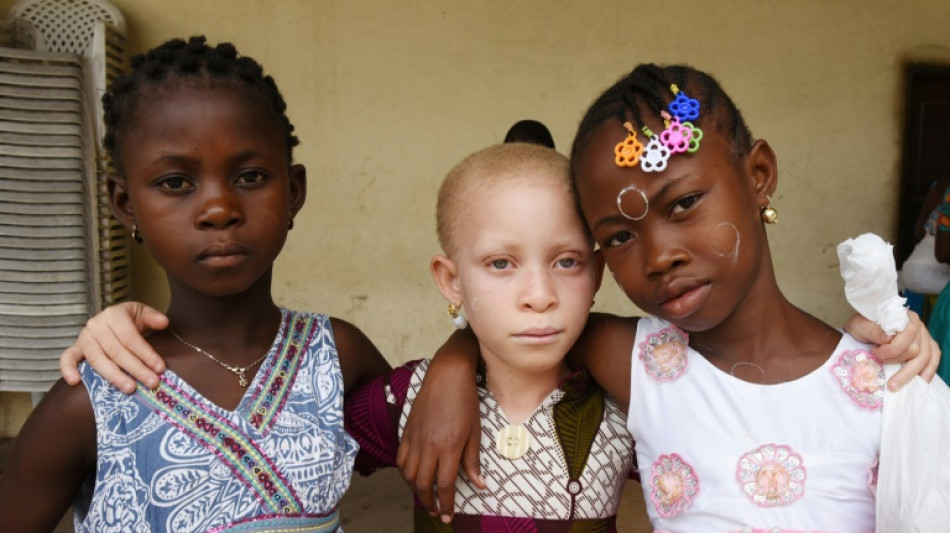
Albinism: lack of pigment plagued by deadly myths / Photo: © AFP/File

 Alarm at German airport after drone found near Ukrainian plane, mid-air incident
 Salah arrives in Turkey for Trabzonspor talks

 Embattled FIFA chief Infantino holds emergency talks with directors

 Russian barrage on Kyiv kills 17 as Ukraine fails to down single missile
 'Lost': Migrants despair after Britain expels them back to France

 Cathay Pacific's profit soars 71% despite Iran war driving up fuel costs
 Russian barrage on Ukraine kills 15, wounds dozens more

 South Korea police raid Starbucks HQ over 'Tank Day' fiasco
 Tech back in fashion as Asian markets extend rebound

 Total eclipse gives scientists chance to probe Sun's mysteries
 What to know about the total solar eclipse on August 12

 'Like the end of the world': the eclipse chasers flocking to Spain

 Taiwan begins military drills as China pressure grows

 UK mansion where 'listeners' spied on Nazi generals becomes museum

 Sabalenka tops Uchijima in WTA Toronto opener

 Alcaraz withdraws from Cincinnati Masters with wrist injury

 SpaceX revenue jumps 92% in first earnings report, but shares slide

 US eyes Hormuz deal 'today or tomorrow' as ship sinks in Red Sea

 SpaceX revenue jumps 92% in first earnings report

 New commissioner Berg wants to take MLS to 'next level'

 Colombian ex-guerrillas fear for future under hardline president

 Tsitsipas comeback continues with Montreal first-round win

 Swiatek fends off Bejlek to reach Toronto third round

 Reusser romps to overall lead at Tour de France Femmes

 McDonald's reports slower US sales in 2nd quarter

Albinism, caused by a lack of melanin, the pigment that colours skin, hair and eyes, is a genetic anomaly that concerns hundreds of thousands of people across the globe, particularly in Africa.
Ahead of International Albinism Awareness Day on Monday, AFP looks at the specificities of a very visible condition which is shrouded in prejudice, leading to discrimination and even violence against those affected.
- What is albinism? -
Albinism is a hereditary genetic anomaly resulting from mutations in genes which affect how much melanin the body produces and therefore the pigmentation, or colour, of a person's skin and hair which is very pale or almost white in the case of sufferers.
For those whose eyes are affected, known as ocular albinism, the blood vessels can show through the iris, making the eyes appear red.
The absence of melanin leaves the skin extremely sensitive to sunlight, making people with albinism at greater risk of developing skin cancer. It also affects the development of the optic nerve, which means that many sufferers' vision is impaired.
- Is it an illness? -
Albinism is an inherited disorder that is often wrongly assumed to be an illness, a factor that contributes to the discrimination those affected can face in society.
Under The Same Sun (UTSS), an association working to combat discrimination describes albinism as a "rare genetic condition".
People with albinism require maximum protection from sunlight with strong sunscreen, hat, sunglasses and protective clothing. They generally need glasses, contact lenses or hand-held magnifiers to see properly but the condition does not prevent them from developing normally.
Health organisations refer to "persons living with albinism" rather than "albinos" but some associations prefer to limit use of the term "albinism," which comes from the Latin world "albus" for white. They instead use "amelanism" or "amelanistic" -- lacking melanin.
- How many people are affected? -
Albinism occurs in all ethnic groups worldwide.
According to the US National Institute of Health (NIH), around one in 20,000 persons is born with albinism, which would equate to some 400,000 people out of a global population of 7.9 billion.
Africa has a slightly higher incidence, estimated at somewhere between one in 5,000 and one in 15,000 inhabitants.
One of the largest populations of people with albinism is believed to be in Tanzania, with as many as one in 1,400 people born with the disorder.
- Why the discrimination? -
People with albinism are often stigmatised due to their appearance but it is in Africa where they suffer the worst discrimination and violence due to their supposed magical powers.
In a 2013 study, UTSS found the myths about albinism were being driven by traditional healers, with one of the most dangerous being the belief that using the body parts of people with albinism in a potion can bring the user good luck or fortune.
"Witchcraft taps into the supernatural to explain human phenomena ... this white child born to visibly black parents," UTSS noted.
- Who is targeted? -
In July 2021, the United Nations' expert on albinism, Nigerian lawyer Ikponwosa Ero, expressed alarm over "the notable increase" in cases of people with albinism being killed or attacked for body parts.
"More tragically still the majority of victims are children," she added.
A UNHCR report found evidence of "more than 200 cases of ritual aggressions against sufferers of albinism between 2000 and 2013".
UTSS, which has been logging cases of violence across Africa, ranks Burundi, Democratic Republic of Congo, Malawi, Mozambique and Tanzania as the countries where such attacks are most prevalent.
In a shocking recent case, the dismembered body of a four-year-old child was found in February in northeastern Burundi in a case believed to be linked to the illegal trade in body parts with neighbouring Tanzania.
K.Thomson--BTB