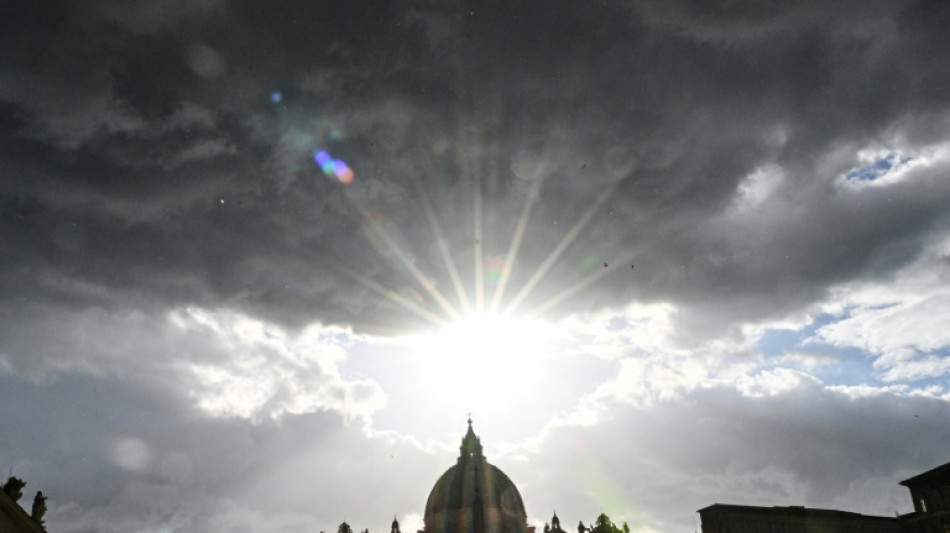
The Vatican: a papal powerhouse, world's smallest state / Photo: © AFP

 FAA Grounds All US Flights Amid Nationwide Air Traffic Control Communication Failure

 Argentina vs Uruguay Kick-off Time, TV Channels & Free Streaming Guide
 Wedding Etiquette: When Is It Appropriate to Bring a Plus-One?

 North Dakota Enacts Bipartisan Insulin Price Cap Amid National Push

 Readers Question Naughty Dog’s ‘Intergalactic’ Hype and GTA 6 Marketing Strategy
 Westminster Council Unanimously Rejects Green Party Motion in 'Zionism is not racism' Vote
The Vatican, headquarters of the Catholic Church, is the smallest state in the world, with its own newspaper, national anthem in Latin and supreme leader: the pope.
Some 900 people live within its ancient walls, from the pontiff himself to red-capped cardinals, nuns, priests, diplomats, and lay people such as gardeners, cooks and cleaners.
At its gates stand Swiss Guards, members of the oldest army in the world -- famous for its blue, red and yellow striped uniforms -- and the Vatican's police force.
At its heart sits the pontiff, a regal figure in white, who wields absolute power as both the head of state and leader of the world's 1.4 billion Catholics.
The Vatican used to be part of the so-called Papal States, areas of Italy under the pope's reign for hundreds of years, until they were conquered during the course of Italian unification in the 19th century.
Rome was captured in 1870 and would become Italy's capital, with Pope Pius IX declaring himself a "prisoner in the Vatican", a claim held by subsequent popes until the Italian government struck a deal.
In 1929, the Vatican City State was created with the signing of the Lateran Accords between Pope Pius XI and Italian dictator Benito Mussolini, in which Italy recognised papal sovereignty over the territory.
- Keys of Heaven -
The pope rules supreme in the 44 hectares (109 acres) of city state -- one third of which are gardens.
The state's government is the Holy See, which is a sovereign juridical entity under international law.
The Church itself is governed by the Roman Curia, which is made up of the Secretariat of State, sixteen dicasteries or ministries, six financial institutions, and several academies and organisations.
Nationality is a "jus officii" system, based on residence and employment. The legal system is similar to Italy's, and suspected lawbreakers can be tried in the state's small courthouse.
Such trials and tribulations are reported in the Vatican's newspaper, L'Osservatore Romano, and by Vatican Media, which operates in around 40 languages.
Employees earn tax-free salaries and have free medical care, but cannot form or join unions.
They can, however, use the Vatican's supermarket, post office and pharmacy. They can also use the Vatican's tiny railway -- the smallest national one in the world -- which takes passengers out into Rome.
Money is kept in the once scandal-hit Vatican bank, the Institute for Religious Works (IOR), which has undergone a clean-up and is responsible for assets belonging to religious orders and organisations.
The Vatican's national anthem, the "Pontifical March", is the only one in the world sung in Latin, while its flag features two bands of yellow and white, bearing the keys of St Peter -- the keys of Heaven.
O.Lorenz--BTB