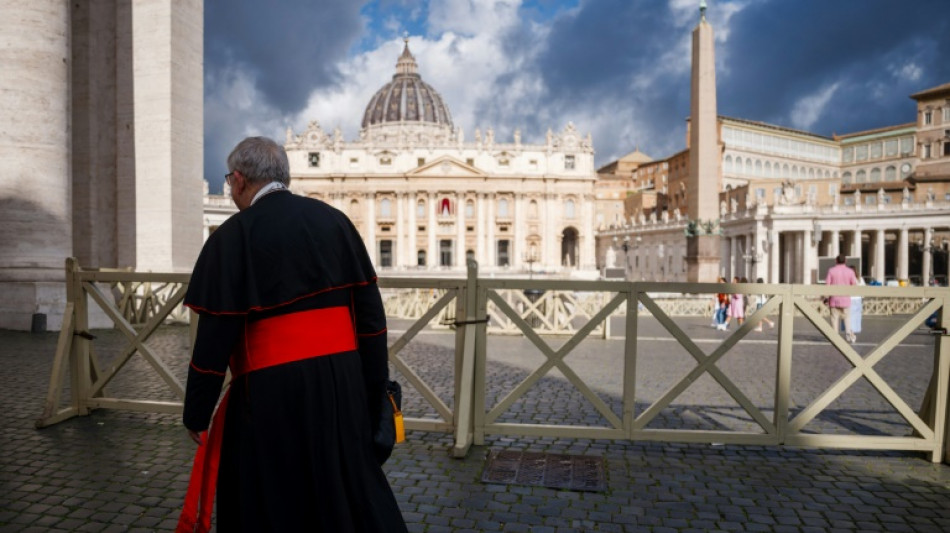
Papal conclave by the numbers / Photo: © AFP

 India's 'Tree Father' plants for a greener future
 Hopping mad: New health warning stirs up Belgian brewers
 Canadian capital to rename 'Trump Ave'

 Pope heads to France on first state visit in 18 years
 Bacteria suspected in deaths of hundreds of baby whales off Argentina
 US 'must choose' whether to end war: Iran president to Fox News
 UN approves resolution on dealing with rising sea levels
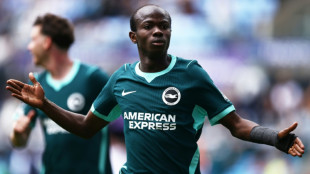 Yalcouye makes dream debut as Ivory Coast beat Ghana in AFCON qualifier
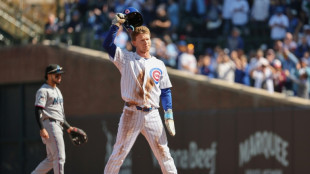 Chicago's White Sox and Cubs book MLB playoff berths
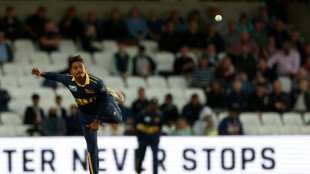
 Last-gasp Gakpo strike snatches Dutch draw to sour Klopp debut
 Global stocks mostly fall as oil prices and bond yields rise
 Israel's Netanyahu denounces enemies, allies in fiery UN speech
 Hollywood stars among arrests in NY anti-Netanyahu protest
 Losing start in AFCON qualifying for 78-year-old coach Le Roy
 Italy bans burqas in schools, caps numbers of foreign students per class
 Israel policies threaten 'life and existence' of Palestinians, Abbas says

 Paolini steers Italy past China in BJK
 Zidane admits emotion on eve of first game as France coach
 Breetzke and Maharaj sink Australia in first one-day international
 Zelensky broke confidentiality with North Korea POWs disclosure: South's president
 Former Liverpool star Carroll reveals he was sexually assaulted
 Dominican Republic calls for Haiti force to be strengthened
 Dolly Parton's nephew ordered to stay away from estate staff, properties
 Early exit for Philippine darling Eala at Singapore Open

 Hurricane Polo triggers huge waves in coastal Mexican city
The Vatican's papal conclave to choose a new spiritual leader for the world's 1.4 billion Catholics is governed by procedures and rituals that have evolved over centuries.
But the result of the election will be influenced by arithmetic unique to this year's exercise:
- 133 Cardinal electors -
A record number of churchmen are eligible to vote in conclave. There are 135 who meet the criteria -- to be a cardinal under the age of 80 -- but only 133 are to take part in the vote, with two said to be too ill to attend. This is up from 115 during the last two conclaves in 2005 and 2013.
Among them, 52 hail from Europe, 23 Asia, 17 South or Central America, 17 Africa, 20 North America, and four Oceania.
- 69 countries -
The cardinal electors come from 69 countries across five continents, another record.
- 70 years and three months -
The average age of the cardinal electors is 70 years and three months. The youngest is Ukraine's Mykola Bychok, archbishop of Melbourne, at 45.
The oldest is Carlos Osoro Sierra, a Spaniard who at 79 years and 11 months was almost too old to vote.
- 81.2 percent -
A large majority, 81.2 percent, of the 133 cardinal electors were appointed by Pope Francis during his 12 years at the head of the Holy See. These 108 are taking part in their first conclave.
Among the veterans, 20 were named by Benedict XVI and five by John Paul II.
- 17 Italians -
For centuries both the papacy and the college of cardinals were dominated by Italians, but as the church has gone global their numbers have fallen.
Nevertheless, at 17, Italy still has the biggest national contribution, down from 28 in 2013.
- 15 new countries -
Some 15 countries are represented for the first time, with cardinals from Haiti, Cape Verde, Papua New Guinea and South Sudan.
- 18 religious orders -
Within the Catholic Church are several religious orders. Francis, for example, was a Jesuit and 18 such movements will have cardinals in the Sistine Chapel for the voting.
- Four votes per day -
If no clear winner emerges in the initial ballot, the cardinals will vote four times a day, twice in the morning and twice in the afternoon, until a majority emerges.
- 89-vote majority -
The new pope will need a two-thirds majority. With 133 in the room, 89 cardinals must write his name on their secret ballot papers.
- Two stoves -
The ballots cast by the cardinals are burned in a stove, both to preserve the secrecy of the process and to act as a signal of progress to the faithful gathered outside the sealed chapel.
Today, two stoves are used, connected to the same chimney.
In one, the ballots are burned, in the other a chemical compound is burned to create either black smoke -- no majority yet -- or white -- a new pope has been chosen.
- Two days? -
If no majority emerges quickly, in theory a conclave could continue for weeks or months.
In practice, the previous two -- the 2005 election of Benedict XVI and of Francis in 2013 -- lasted two days.
In the 20th and 21st centuries, conclaves have never lasted longer than five days, as was the case for Pope Pius XI's election in 1922, which required 14 ballots.
M.Ouellet--BTB