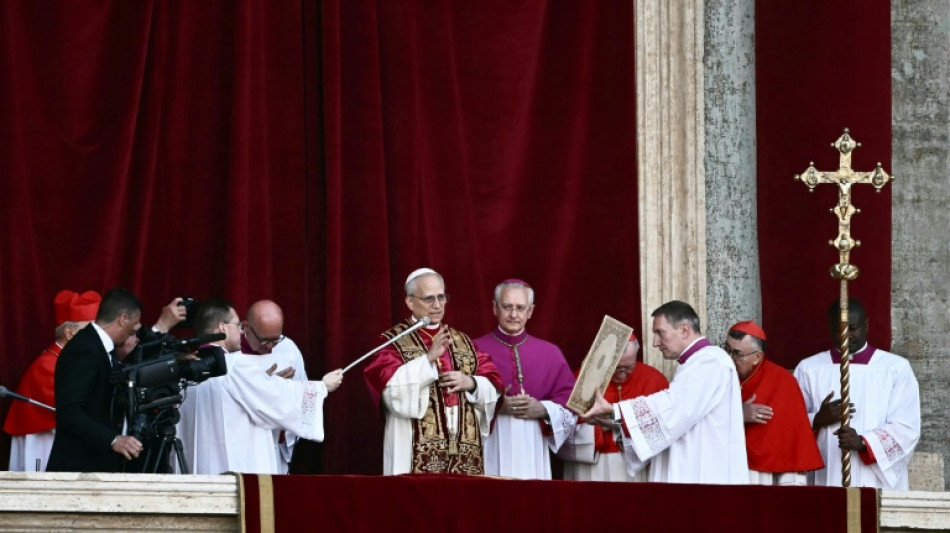
Extremely online new pope unafraid to talk politics / Photo: © AFP

 FAA Grounds All US Flights Amid Nationwide Air Traffic Control Communication Failure

 Argentina vs Uruguay Kick-off Time, TV Channels & Free Streaming Guide
 Wedding Etiquette: When Is It Appropriate to Bring a Plus-One?

 North Dakota Enacts Bipartisan Insulin Price Cap Amid National Push

 Readers Question Naughty Dog’s ‘Intergalactic’ Hype and GTA 6 Marketing Strategy

 Westminster Council Unanimously Rejects Green Party Motion in 'Zionism is not racism' Vote
From pillorying the US vice president to denouncing the death penalty, Pope Leo has proven unafraid to tackle prickly political issues on social media -- making him the first "extremely online" pontiff.
When JD Vance suggested that Christians should love their family, neighbors, community and fellow citizens -- in that order -- one very notable Christian took umbrage.
Robert Prevost, now better known to the world as Pope Leo, quickly took to X to take a theological swipe at the vice president.
"JD Vance is wrong: Jesus doesn't ask us to rank our love for others," he wrote, reposting a columnist's searing opinion piece and prompting tens of thousands of likes and a slew of barbed comments.
Pope Benedict may have been the first to tweet under the handle @Pontifex in 2012, but Pope Leo is undoubtedly the first to take the Chair of Saint Peter with the baggage of a long social media history.
In 14 years since his X account was created, he has posted more than 400 times, opining on a range of hot-button issues: racism, sexual abuse by the clergy, Covid-19, the police murder of George Floyd and Russia's invasion of Ukraine.
Perhaps unsurprisingly for an American who spent decades in Peru and took up its citizenship, immigration is a topic close to his heart.
The new pope has notably amplified criticism of US President Donald Trump's immigration policies, reposting a 2017 article which called refugee bans "a dark hour of US history" and an abandonment of "American values."
He has repeatedly taken Vance to task, challenging a vice president whose religious views show all the zeal of a recent convert to Catholicism.
It is clear from his ample online commentary, interviews and video blogs that retweets are almost always endorsements.
In 2020, days after African American Floyd was suffocated to death under a police officer's knee, he implored fellow members of the clergy to speak up.
"We need to hear more from leaders in the Church, to reject racism and seek justice," he posted.
He has also demanded more action of the church in ousting members of the clergy who sexually abused children.
"If you are a victim of sexual abuse by a priest, report it," he told Peruvian paper La Republica this month.
"We reject cover-ups and secrecy; that causes a lot of harm. We have to help people who have suffered due to wrongdoing."
Embracing another contentious issue, in 2014 he wrote that it was "time to end the death penalty" and has repeated that point over the years in interviews, masses and in public remarks.
"We have to be pro-life at all times" he once told assembled Peruvian journalists in his fluent and modestly accented Spanish.
Still, he is also unafraid to post a joke, including a suggestion that while many people are intelligent, most are asymptomatic.
Like many of us, the tempo of his social media posts appeared to increase during pandemic lockdowns.
It is unclear if he will extend that social media chattiness from inside the Apostolic Palace.
J.Fankhauser--BTB