
-
 Wedding Etiquette: When Is It Appropriate to Bring a Plus-One?
-
Info Edge’s Naukri Hits Rs 240 Crore Annualized AI Revenue Run Rate

-
 North Dakota Enacts Bipartisan Insulin Price Cap Amid National Push
-
Honda Recalls 635,000 Vehicles Over Software-Induced Power Steering Failure

-
 Readers Question Naughty Dog’s ‘Intergalactic’ Hype and GTA 6 Marketing Strategy
-
Digi Power X Reports Q3 2026 Revenue Up 85% and AI Revenue Up Over 400% Compared to Q2

-
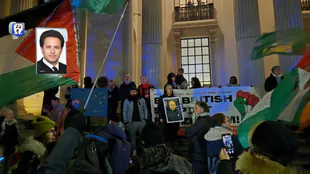 Westminster Council Unanimously Rejects Green Party Motion in 'Zionism is not racism' Vote
-
Below Deck alumnus João Franco and brother arrested after fatal Turkey fight
-
 Kingfishr Announces UK and European Spring Tour Following April Album Release
-
Ole Miss inquiry expands after video and monkey-noise allegations

-
 General Hospital actor Randall England dies at 75
-
Senators Push for Sports Betting Ad Ban as Bill S-211 Advances

-
 Bunnie XO artwork taken down from Jelly Roll’s Nashville bar
-
London museum removes Russell Brand hair exhibit after rape conviction
-
 Arlington sentinel rebukes Pete Hegseth entourage for laughter near memorial
-
RBI Gold Loan Rules 2026: Key Changes for Auctions, Renewals, and Valuation

Salman Rushdie assailant sentenced to 25 years in prison
An American-Lebanese man was sentenced to 25 years in prison on Friday for trying to kill novelist Salman Rushdie in a 2022 knife attack at a New York cultural center.
Hadi Matar, 27, was convicted in February of attempted murder and assault for the stabbing, which left Rushdie blind in one eye.
Matar received the maximum sentence of 25 years for the attack on Rushdie and seven years for assault on another attendee at the speaking event. The sentences are to run concurrently.
Rushdie, a British-American, told jurors during the trial about Matar "stabbing and slashing" him at the upscale cultural center.
"It was a stab wound in my eye, intensely painful, after that I was screaming because of the pain," Rushdie said, adding that he was left in a "lake of blood."
Matar -- who shouted pro-Palestinian slogans on several occasions during the trial -- stabbed Rushdie about 10 times with a six-inch blade.
He previously told media he had only read two pages of Rushdie's "The Satanic Verses," but believed the author had "attacked Islam."
Matar's lawyers had sought to prevent witnesses from characterizing Rushdie as a victim of persecution following Iran's 1989 fatwa calling for his murder over supposed blasphemy in the novel.
Iran has denied any link to the attacker and said only Rushdie was to blame for the incident.
The optical nerve of Rushdie's right eye was severed in the attack.
His Adam's apple was lacerated, his liver and small bowel penetrated, and he became paralyzed in one hand after suffering severe nerve damage to his arm.
Rushdie was rescued from Matar by bystanders. Last year, he published a memoir called "Knife" in which he recounted the near-death experience.
Rushdie, who was born in Mumbai but moved to England as a boy, was propelled into the spotlight with his second novel "Midnight's Children" (1981), which won Britain's prestigious Booker Prize for its portrayal of post-independence India.
But "The Satanic Verses" brought him far greater, mostly unwelcome, attention.
Rushdie became the center of a fierce tug-of-war between free speech advocates and those who insisted that insulting religion, particularly Islam, was unacceptable under any circumstance.
Books and bookshops were torched, his Japanese translator was murdered and his Norwegian publisher was shot several times.
Rushdie lived in seclusion in London for a decade after the 1989 fatwa, but for the past 20 years -- until the attack -- he lived relatively normally in New York.
L.Janezki--BTB