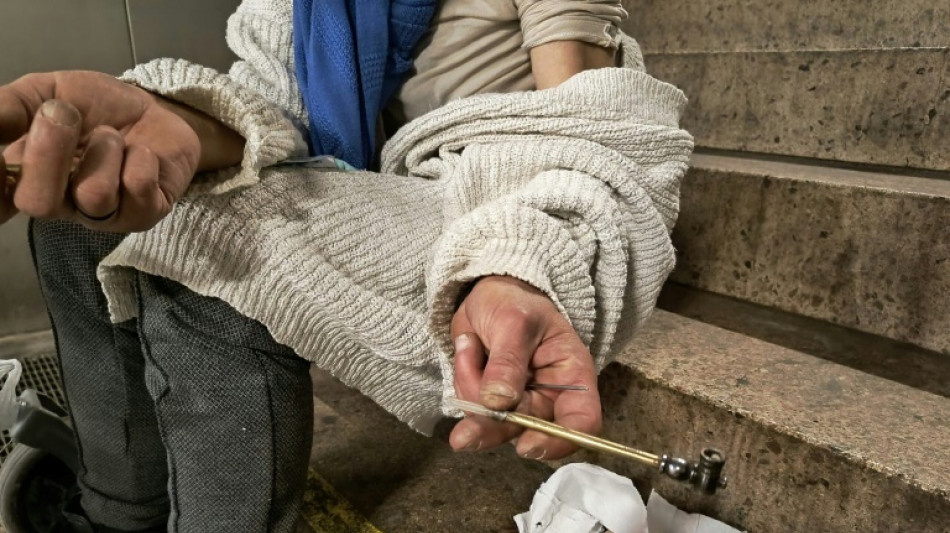
Row erupts as German city plans safe room for crack addicts / Photo: © AFP

 UN approves resolution on dealing with rising sea levels

 Yalcouye makes dream debut as Ivory Coast beat Ghana in AFCON qualifier

 Chicago's White Sox and Cubs book MLB playoff berths

 Last-gasp Gakpo strike snatches Dutch draw to sour Klopp debut

 Global stocks mostly fall as oil prices and bond yields rise

 Israel's Netanyahu denounces enemies, allies in fiery UN speech

 Hollywood stars among arrests in NY anti-Netanyahu protest

 Losing start in AFCON qualifying for 78-year-old coach Le Roy

 Italy bans burqas in schools, caps numbers of foreign students per class
 Israel policies threaten 'life and existence' of Palestinians, Abbas says

 Paolini steers Italy past China in BJK

 Zidane admits emotion on eve of first game as France coach

 Breetzke and Maharaj sink Australia in first one-day international

 Zelensky broke confidentiality with North Korea POWs disclosure: South's president

 Former Liverpool star Carroll reveals he was sexually assaulted
 Dominican Republic calls for Haiti force to be strengthened
 Dolly Parton's nephew ordered to stay away from estate staff, properties

 Early exit for Philippine darling Eala at Singapore Open

 Hurricane Polo triggers huge waves in coastal Mexican city

 What happens if the US bans diesel exports

 Macklemore hits back with 'Free Palestine Tour' after Sheeran split
 Met Opera to give New Yorkers free tickets in affordability push

 Top ECB official to resign to take up IMF role

 Xi and Trump call for peace in lavish White House state visit

 Five up-and-coming players looking to make mark in Nations League
A battle has broken out over plans to open a new help centre for crack addicts near Frankfurt's main railway station, an area notorious for its bustling illegal drugs scene.
Visitors arriving by rail in Germany's skyscraper-lined banking capital are often surprised to walk straight into a rough urban district replete with drug dealers and red-light businesses.
Hundreds of addicts are drawn to the Bahnhofsviertel area, where several so-called consumption rooms offer sterile needles and allow users to inject heroin, smoke crack cocaine and take other illegal narcotics.
Public health officials argue that such measures have long helped desperate people suffering from addiction and saved many lives.
But critics have darkly dubbed the city "Crackfurt" and British tabloid The Sun last year christened the inner-city district "zombieland".
Local businessman Frank Lottermann, 56, who runs a design agency nearby, is lobbying for the new crack centre to be moved further away, to the other side of the railway lines.
He told AFP he had been exasperated by the sight of human desperation and the sometimes terrible hygiene.
"It does something to you" to have to step over human excrement on the way to work, he said. "It does something to your head."
He opposes the plan for a new centre with space for about 50 people to smoke crack, a powerful stimulant which first came to Frankfurt in the 1990s and is now more popular than heroin.
"The city is not just about drugs," Lottermann said. "Just this area!"
But, he added, "the drug scene is so open that people think they have to avoid Frankfurt".
- 'Save lives' -
Frankfurt, home to big financial firms and the European Central Bank, is also a major air, rail and road hub.
Its Bahnhofsviertel has been a red-light district since the post-war years, when US soldiers flocked there.
"People think that you can behave differently here, that you don't stick out," said Wolfgang Barth, a veteran local social worker.
Germany's first drug consumption room opened there in 1996, modelled on similar services in Switzerland.
Inside a plain room with stainless steel benches, heroin addicts can be seen "cooking" the drug on spoons over tea lights before injecting it into their arms or groins.
Today, three centres also provide addicts with food, beds and counselling.
"The primary goal is to save lives and not to criminalise people," says Christian Rupp, city spokesman for health and social affairs.
Last year 20 people died of drug overdoses in Frankfurt, down from a peak of 147 in 1991. "Nobody has yet died of an overdose in a consumption room," Rupp said.
But some worry that the concentration of help centres signals a permissive attitude, attracting yet more addicts to the area.
- 'Drug tourism' -
Hesse state's conservative premier, Boris Rhein, in March charged that the Bahnhofsviertel had become a "magnet for drug tourism... a closed ecosystem of buying, getting high, getting treatment and getting care and advice all in one place".
Local members of the business-friendly Free Democrats (FDP) party this month called for the closure of the area's consumption rooms altogether.
"Drug addicts need help," Lottermann said. "But setting up rooms right in the middle of the drug scene just promotes drug use."
Rupp insisted the new centre needs to be in the Bahnhofsviertel to be accessible to addicts, who he said are "ill".
"A person in the end stage of this illness is not in a position to walk almost two kilometres," he said.
One crack user, a 43-year-old former tree surgeon named Stirpan, agreed.
"Who will walk for 15 minutes when all the stuff is here?" he said.
"People get the drugs and want to smoke them immediately, they don't want to wait."
- 'Something drastic' -
Barth, who opened the area's first help centre in 1989, said he was no stranger to local opposition.
Back then, he recalled, a local brothel owner threatened: "If a junkie throws up on my Mercedes, I'll come by your place and beat everyone up."
"It is important to talk to your neighbours," Barth said.
He added that the new crack centre should be opened as planned where the demand is highest.
Lottermann, for his part, also argued that Frankfurt should tolerate small-time drug dealing within help centres, to remove the practice from the streets.
Barth said he doubted that this would be tolerated in Germany anytime soon.
Stirpan, fiddling with his crack pipe, said it was hard to see what could be done to clean up the Bahnhofsviertel.
"You would have to do something drastic. You'd have to chase people out the area," he said.
"The people here will do anything for a bit of crack."
C.Meier--BTB