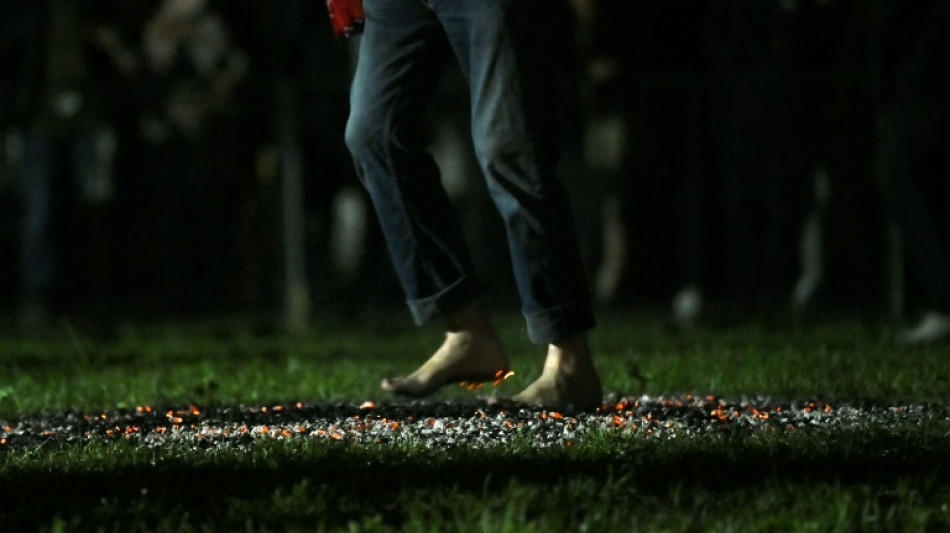
Fire walkers defy pain in ancient Greek ritual / Photo: © AFP

 UN approves resolution on dealing with rising sea levels

 Yalcouye makes dream debut as Ivory Coast beat Ghana in AFCON qualifier

 Chicago's White Sox and Cubs book MLB playoff berths

 Last-gasp Gakpo strike snatches Dutch draw to sour Klopp debut

 Global stocks mostly fall as oil prices and bond yields rise

 Israel's Netanyahu denounces enemies, allies in fiery UN speech

 Hollywood stars among arrests in NY anti-Netanyahu protest

 Losing start in AFCON qualifying for 78-year-old coach Le Roy

 Italy bans burqas in schools, caps numbers of foreign students per class

 Israel policies threaten 'life and existence' of Palestinians, Abbas says

 Paolini steers Italy past China in BJK

 Zidane admits emotion on eve of first game as France coach

 Breetzke and Maharaj sink Australia in first one-day international

 Zelensky broke confidentiality with North Korea POWs disclosure: South's president

 Former Liverpool star Carroll reveals he was sexually assaulted
 Dominican Republic calls for Haiti force to be strengthened

 Dolly Parton's nephew ordered to stay away from estate staff, properties

 Early exit for Philippine darling Eala at Singapore Open

 Hurricane Polo triggers huge waves in coastal Mexican city

 What happens if the US bans diesel exports

 Macklemore hits back with 'Free Palestine Tour' after Sheeran split
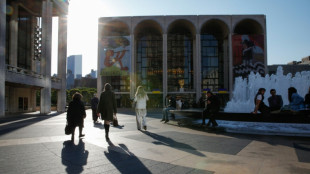 Met Opera to give New Yorkers free tickets in affordability push

 Top ECB official to resign to take up IMF role

 Xi and Trump call for peace in lavish White House state visit

 Five up-and-coming players looking to make mark in Nations League

Under a cloud of incense smoke, a group of men and women in a village in northern Greece swayed slowly to the music before removing their shoes and rushing, barefoot, onto waiting embers.
The fire walking ritual, held on the day of the Orthodox feast of Saint Constantine and Saint Helena on May 21, has been practised for over a century in four villages of the Greek region of Macedonia, which borders Bulgaria.
Each year, this ceremony -- called "Anastenaria" ("sighs" in Greek) -- attracts crowds of visitors.
Considered a pagan ritual to honour the ancient Greek gods Dionysus and Artemis, the ancient custom was once banned by the powerful Greek Orthodox Church.
For the past several decades, cooler heads have prevailed.
But the rite remains shrouded in mystery.
"Those who walk on fire don't like to talk about it much," explained Sotiris Tzivelis, 86, who grew up in the village of Agia Eleni, near the city of Serres.
"Back then, when someone fell ill, we would call the 'anastenarides' to help heal them," he told AFP.
The family requesting help would make a special handkerchief, to be blessed during the ceremony.
It is one of these handkerchiefs that the ceremony leader, Babis Theodorakis, gives participants to mark the start of the ritual in the "konaki" -- a room decorated with Orthodox icons where participants prepare by dancing to the sound of the lyre and the drum.
When ready, they head to a nearby meadow and form a circle around the glowing embers.
"I have never walked on fire, but every year, I give our family's handkerchief to the dancers before taking it back at the end of the ritual," said Tzivelis.
- Pagan ritual -
According to local tradition, the rite originated in the villages of Kosti and Brodivo in southeastern Bulgaria, where Greek communities lived before emigrating to Greece in the early 20th century with the collapse of the Ottoman Empire.
"How to walk on fire without getting burned, I can't explain it to you!" said Babis Theodorakis, the ceremony leader.
Apostolis Vlaspos, 65, who has practised the ritual for 20 years, described it as "something internal, an indescribable force".
"The first time I walked on fire, I saw the image of Saint Constantine, whom we call 'grandfather', and I felt like an electric shock," he said.
After circling the glowing embers three times, participants begin to walk on them, swaying to the music and clutching icons under their arms.
When they return to the "konaki", visitors rush to photograph them and check that they have no burns on their feet -- proof of a miracle, according to believers.
The ceremony concludes with a meal of mutton specially slaughtered for the occasion.
"Those who say that people walking on fire are in a trance are wrong," said villager Kostas Liouros, 67.
"What happens to them is natural and requires mental peace and great concentration," he explained.
"Some say we drink alcohol or that before removing our socks and shoes, we coat our feet with herbs and things like that, but none of that is true," added another participant, who declined to give his name.
J.Fankhauser--BTB