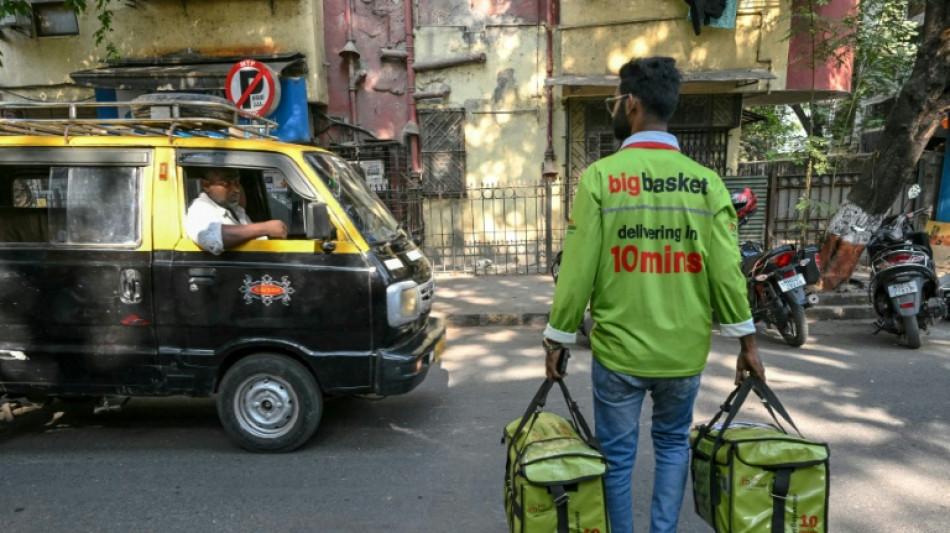
In India's congested cities, delivery apps cash in / Photo: © AFP

 UN approves resolution on dealing with rising sea levels

 Yalcouye makes dream debut as Ivory Coast beat Ghana in AFCON qualifier

 Chicago's White Sox and Cubs book MLB playoff berths

 Last-gasp Gakpo strike snatches Dutch draw to sour Klopp debut

 Global stocks mostly fall as oil prices and bond yields rise

 Israel's Netanyahu denounces enemies, allies in fiery UN speech

 Hollywood stars among arrests in NY anti-Netanyahu protest

 Losing start in AFCON qualifying for 78-year-old coach Le Roy

 Italy bans burqas in schools, caps numbers of foreign students per class

 Israel policies threaten 'life and existence' of Palestinians, Abbas says
 Paolini steers Italy past China in BJK

 Zidane admits emotion on eve of first game as France coach

 Breetzke and Maharaj sink Australia in first one-day international

 Zelensky broke confidentiality with North Korea POWs disclosure: South's president

 Former Liverpool star Carroll reveals he was sexually assaulted

 Dominican Republic calls for Haiti force to be strengthened

 Dolly Parton's nephew ordered to stay away from estate staff, properties

 Early exit for Philippine darling Eala at Singapore Open

 Hurricane Polo triggers huge waves in coastal Mexican city

 What happens if the US bans diesel exports

 Macklemore hits back with 'Free Palestine Tour' after Sheeran split

 Met Opera to give New Yorkers free tickets in affordability push

 Top ECB official to resign to take up IMF role

 Xi and Trump call for peace in lavish White House state visit

 Five up-and-coming players looking to make mark in Nations League

In India's sprawling financial hub of Mumbai armies of "dabbawalas" have for decades crisscrossed the city by foot and bicycle, delivering home-cooked food to office workers who are keen to avoid the searing heat and traffic-snarled streets.
Now, across the country, young entrepreneurs are taking that tradition to the next level with the explosion of shopping apps that allow customers to get hold of not only food and drink but anything else from clothes to iPhones -- within minutes.
The so-called quick commerce apps are redefining the retail game, not only disrupting e-commerce titans such as Amazon with their speed and efficiency but also long-established "mom and pop" stores which are no longer convenient enough.
At a warehouse managed by online grocer BigBasket in central Mumbai, employees work with military-like precision to pull off deliveries in just 10 minutes.
These warehouses are known within the industry as "dark stores", a reference to being closed off to customers.
When a new order is received, a worker leaps into action, darting through aisles filled with everything from fizzy drinks to vegetables, packing a bag of groceries handed to a motorbike rider -- the modern-day "dabbawala", Hindi for "lunchbox man".
Local tech companies have poured in billions to set up these nifty logistical networks across big cities, fuelling India's rapid shopping industry.
- 'Unprecedented' -
For millions of customers, it's an easy way to avoid shopping in the sweltering heat -- visiting multiple food stalls -- and spending hours navigating the country's notorious traffic jams.
Growth has been "very strong", BigBasket co-founder Vipul Parekh told AFP, pointing to forecasts that indicate a compounded annual growth rate of more than 60 percent over the next two to three years.
"When you talk of a large industry transforming and growing at this pace, that is unprecedented," he said.
Delivery apps such as Getir or Jokr have faltered in Europe and the United States in recent years, as pandemic-induced demand wore off and rising inflation pinched customer wallets.
But sales in India have soared from $100 million in 2020 to an estimated $6 billion in 2024, according to projections by market analysis firm Datum Intelligence.
This could hit $40 billion by the end of the decade, according to investment bank JM Financial.
Companies say India's quick commerce's growth is partly down to the sheer scale of people living in tight-packed cities within a roughly two kilometre (one mile) radius of a "dark store", said Parekh.
"The revenue potential in that catchment is very high," he said.
A lack of many traditional supermarket grocery chains in India aid the business model, he said.
Rinish Ravindra, a regular user, admits that they make him "lazy", but argues that the convenience is unbeatable.
"I just press a bunch of keys and all of it comes delivered to home," says the 32-year-old, who works in Mumbai's film industry.
Local players have made rapid progress but competition is heating up.
Amazon is getting its act together, along with Walmart-owned Flipkart and billionaire Mukesh Ambani's Reliance Industries as they belatedly roll out rapid delivery offerings.
"One of the problems with e-commerce players like Amazon is that, until now, they've relied on these big fulfilment centres that sit on the outside or outskirts of cities," said Satish Meena of Datum Intelligence.
"These aren't suited for rapid delivery, which is why they now need to invest to build their own dark store networks within urban areas."
- 'Just order it online' -
However, a more crowded industry threatens the sustainability of the sector that has already seen one prominent start-up go bust.
"My sense is that the market is good enough for two to three players," said Rahul Malhotra of Bernstein, a research firm, adding that the total addressable market may be worth around $50-$60 billion.
"Some of the early movers, with hyperlocal capabilities obviously, have an advantage here."
The sector could also face challenges from thousands of small, family-run shops.
The Confederation of All India Traders, a leading industry group that claims to represent over 90 million small businesses, has called for "a nationwide movement" against newer platforms.
Its president likened quick commerce to being a "modern-day East India Company", a reference to the rapacious British power that began in the 17th century to seize swathes of India, preceding colonial rule.
For now, customers are voting with their wallets.
"When I think of groceries I think, 'I can just order it online'," said Ravindra.
W.Lapointe--BTB