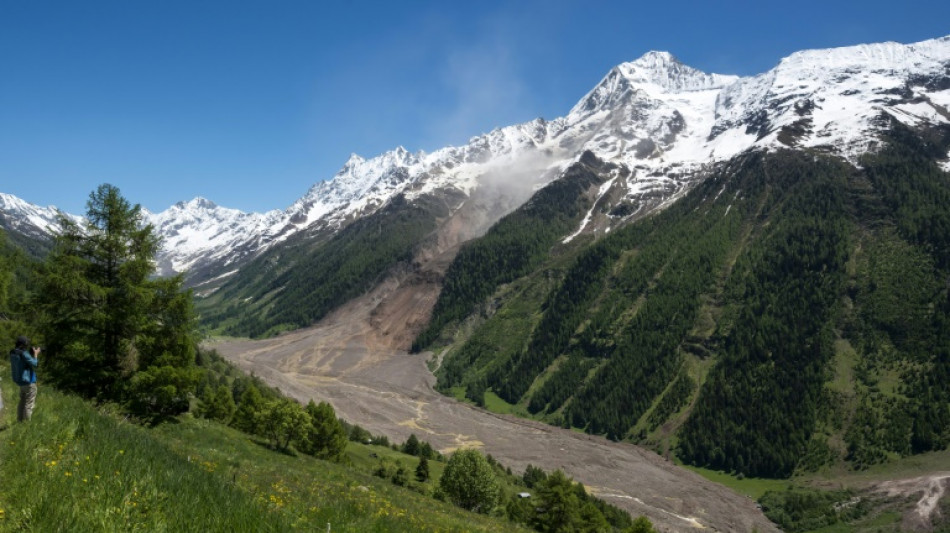
How Switzerland's Birch glacier collapsed / Photo: © AFP

 UN approves resolution on dealing with rising sea levels

 Yalcouye makes dream debut as Ivory Coast beat Ghana in AFCON qualifier

 Chicago's White Sox and Cubs book MLB playoff berths

 Last-gasp Gakpo strike snatches Dutch draw to sour Klopp debut

 Global stocks mostly fall as oil prices and bond yields rise

 Israel's Netanyahu denounces enemies, allies in fiery UN speech

 Hollywood stars among arrests in NY anti-Netanyahu protest

 Losing start in AFCON qualifying for 78-year-old coach Le Roy

 Italy bans burqas in schools, caps numbers of foreign students per class

 Israel policies threaten 'life and existence' of Palestinians, Abbas says

 Paolini steers Italy past China in BJK

 Zidane admits emotion on eve of first game as France coach

 Breetzke and Maharaj sink Australia in first one-day international

 Zelensky broke confidentiality with North Korea POWs disclosure: South's president

 Former Liverpool star Carroll reveals he was sexually assaulted
 Dominican Republic calls for Haiti force to be strengthened

 Dolly Parton's nephew ordered to stay away from estate staff, properties

 Early exit for Philippine darling Eala at Singapore Open

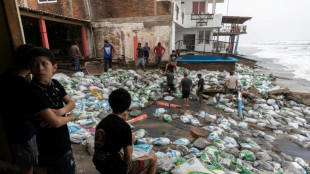 Hurricane Polo triggers huge waves in coastal Mexican city

 What happens if the US bans diesel exports

 Macklemore hits back with 'Free Palestine Tour' after Sheeran split
 Met Opera to give New Yorkers free tickets in affordability push

 Top ECB official to resign to take up IMF role

 Xi and Trump call for peace in lavish White House state visit

 Five up-and-coming players looking to make mark in Nations League

A cascade of events in the Swiss Alps led to the dramatic collapse of the Birch glacier, wiping out Blatten village in the valley below, glaciologists and geoscientists told AFP on Friday.
Experts knew days ahead of Wednesday's landslide that the glacier was likely to suffer a catastrophic failure. But the reasons why date back much further.
There are strong theories on the causes, and to what degree the disaster is linked to climate change -- but these are yet to be confirmed by scientific analysis.
"This can be considered as a cascading event, because we have different processes involved," explained Christophe Lambiel, senior lecturer at the University of Lausanne's Institute of Earth Surface Dynamics.
- Mountain above the glacier -
The 3,342-metre (10,965-foot) high Kleines Nesthorn mountain above the glacier was already somewhat unstable, and rockfalls accelerated dramatically around 10 days beforehand.
Experts feared a total collapse within hours, but instead there were successive rockfalls over several days, which was actually the best-case scenario.
- Rockfall onto glacier -
Three million cubic metres of rock were deposited on the glacier.
"If you put a lot of weight on an unstable foundation, it can just slip away. And this is what actually happened," Matthias Huss, the director of Glacier Monitoring Switzerland (GLAMOS), told AFP.
"The glacier accelerated strongly in response to this additional loading, and then the disaster struck."
- The Birch glacier -
The Birch glacier was a special case: the only Swiss glacier that was advancing rather than shrinking. However, this was not because of extra snowfall.
Its advance "was quite likely due to the pre-loading with rockfalls from this mountain, which has finally collapsed. So the landslide didn't start from nothing," said Huss.
The glacier was on a steep slope, and even steeper at the front, worsening the dynamics.
Smaller-scale falls from the front of the glacier Tuesday were expected to continue, with Wednesday's sudden total collapse considered a less-probable scenario.
- How the glacier collapsed -
The rockfalls altered the stress equation between the weight of the glacier and the slope, which governs its forward speed, Lambiel told AFP.
Like pushing a car, it takes a lot of force to initiate movement, but less once it is on the move, he explained.
Huss said the 1,000 metres of elevation between the glacier and the Lotschental valley floor added a "huge amount of potential energy", which through friction melts part of the ice, making the fall "much more dynamic than if it was just rock".
- Role of melting permafrost -
Permafrost conditions are degrading throughout the Alps. Ice inside the cracks in the rocks has been thawing to ever-deeper levels over the last decade, especially after the summer 2022 heatwave.
"Ice is considered as the cement of the mountains. Decreasing the quality of the cement decreases the stability of the mountain," said Lambiel.
Huss added: "At the moment, we can't say it's because of permafrost thaw that this mountain collapsed -- but it is at least a very probable explanation, or one factor, that has triggered or accelerated this process of the mountain falling apart."
- Role of climate change -
Jakob Steiner, a geoscientist at the University of Graz in Austria, told AFP: "There is no clear evidence as of yet, for this specific case, that this was caused by climate change."
Huss said making such a direct link was "complicated".
"If it was just because of climate change that this mountain collapsed, all mountains in the Alps could collapse -- and they don't," he said.
"It's a combination of the long-term changes in the geology of the mountain.
"The failing of the glacier as such -- this is not related to climate change. It's more the permafrost processes, which are very complex, long-term changes."
Lambiel said of a link between climate change and the glacier moving forward over time: "Honestly, we don't know.
"But the increasing rockfalls on the glacier during the last 10 years -- this can be linked with climate change."
- Other glaciers -
Modern monitoring techniques detect acceleration in the ice with high precision -- and therefore allow for early warning.
Lambiel said around 80 glaciers in the same region of Switzerland were considered dangerous, and under monitoring.
"The big challenge is to recognise where to direct the detailed monitoring," said Huss.
Lambiel said sites with glacier-permafrost interactions above 3,000 metres would now need more research. But they are difficult to reach and monitor.
Steiner said: "Probably the rapidly changing permafrost can play some kind of role.
"This is concerning because this means that mountains are becoming a lot more unstable."
rjm-burs/phz/jhb
P.Anderson--BTB