Relatives struggle to find last 1,000 Srebrenica victims 30 years on / Photo: © AFP

 Italy bans burqas in schools, caps numbers of foreign students per class
 Israel policies threaten 'life and existence' of Palestinians, Abbas says

 Paolini steers Italy past China in BJK
 Zidane admits emotion on eve of first game as France coach

 Breetzke and Maharaj sink Australia in first one-day international
 Zelensky broke confidentiality with North Korea POWs disclosure: South's president

 Former Liverpool star Carroll reveals he was sexually assaulted
 Dominican Republic calls for Haiti force to be strengthened
 Dolly Parton's nephew ordered to stay away from estate staff, properties

 Early exit for Philippine darling Eala at Singapore Open

 Hurricane Polo triggers huge waves in coastal Mexican city

 What happens if the US bans diesel exports

 Macklemore hits back with 'Free Palestine Tour' after Sheeran split
 Met Opera to give New Yorkers free tickets in affordability push

 Top ECB official to resign to take up IMF role

 Xi and Trump call for peace in lavish White House state visit

 Five up-and-coming players looking to make mark in Nations League

 CNN, MS NOW, Politico request court hearing after White House access denied

 Eviction of pensioner puts Spain housing crisis in spotlight

 CNN, MS NOW, Politico say reporters still barred from White House
 Udinese sign ex-Real Madrid defender Alaba on free transfer

 Trump welcomes Xi to Washington with lavish praise

 Kane relishing chance to become England's most-capped player

 Average EU diesel price hits record 2.23 euros a litre: AFP analysis

 Whitetip Investments Marks 10 Years of Regulation, Transparency & Responsible Trading

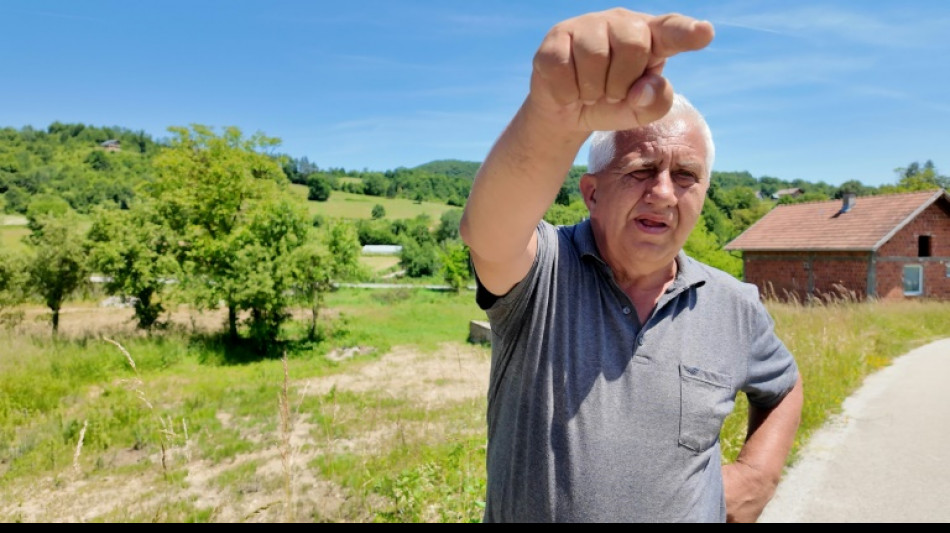
Sadik Selimovic's relief at surviving the Srebrenica massacres 30 years ago did not last long.
When he found out that his father and three brothers had not been so lucky, his life took the "only possible turn" -- to find them.
Three decades on, the 62-year-old, who was driven to become an investigator at the Bosnian Institute for Missing Persons, cannot hide his anguish that the remains of around 1,000 of the victims have yet to be found.
More than 8,000 Muslim men and boys were killed within a matter of days in July 1995 after Bosnian Serb forces captured Srebrenica, which was supposed to have been a UN "protected zone" watched over by Dutch peacekeepers.
"Over the past three years, we have searched 62 locations" hoping to discover mass graves from the slaughter -- since declared a genocide under international law -- "but we have not found a single body," Selimovic told AFP.
"Those who know (where the graves are) do not want to say," he said.
Selimovic spends his time searching for witnesses among the Serbs living in and around Srebrenica, often his neighbours, school friends or those he worked with before the war at the Potocari battery factory, now a genocide memorial centre.
"How can they live with what they know?" he said. "I can't understand it. But it has to be said, there are people who have talked."
- Mass graves -
The last mass grave of Srebrenica victims, which held 10 bodies, was discovered in 2021 in the Dobro Polje area, 180 kilometres (111 miles) southwest of the town.
More than 6,800 of the dead, some 80 percent, have been identified, said Dragana Vucetic, a forensic anthropologist at the International Commission for Missing Persons (ICMP).
But that work has been complicated by the gruesome way the perpetrators tried to cover up their crimes.
The ICMP morgue and the Bosnian Missing Persons Commission in Tuzla hold the remains of "90 cases whose genetic fingerprint has been isolated" but who have not yet been identified.
There are also about 50 identified victims whose "families do not wish to validate the identification and bury them, most often because skeletal remains are incomplete", said the expert, who has worked investigating the genocide for more than two decades.
Initially, the victims' bodies were thrown into mass graves near the "five mass execution sites".
"A few months later, these graves were opened, and the corpses, already in the early stages of decomposition, were transported to other locations, sometimes hundreds of kilometres (miles) away," said Vucetic.
- Hiding the evidence -
The bodies were then "torn to pieces" by mechanical shovels and bulldozers and transported, often to two or three different locations, in an attempt to conceal the crime.
"Only 10 percent of bodies found during exhumations were complete," said Vucetic. DNA testing has allowed some skeletons to be reconstructed, sometimes from parts found in four different mass graves.
About 6,000 people were identified between 2012 and 2022, but since then the process has slowed, with only three this year so far.
Mevlida Omerovic, 69, has been hoping since 2013 that more of her husband Hasib's skeleton would be found so she could lay him to rest.
He was killed aged 33 with his brother Hasan.
"There's just his jaw, but I have now decided to bury him" at the Srebrenica memorial centre during the commemoration of the genocide's 30th anniversary on July 11, she said.
"We will know where his grave is and we will be able to go there and pray."
Her brother Senad, who was 17 when he was killed, has never been found.
The investigator Selimovic found the remains of his brothers and father. The last, his younger brother Sabahudin, was buried in 2023.
But he has no intention of stopping looking for the others. "That's what keeps me alive. I know what it feels like when you're told your loved one has been found," he said.
So he reads and re-reads testimonies and criss-crosses the area, revisiting the same places dozens of times. "We will find some (more) people," he insisted. "If other mass graves exist -- and I think they do -- we will find them."
But he fears the Drina River, which flows near Srebrenica forming the border between Bosnia and Serbia, "is the biggest mass grave of all", he said.
"No one will ever find those who ended up there."
T.Bondarenko--BTB