Smog then floods: Pakistani families 'can't catch a break'
/ Photo: © AFP

 Swiss voters expected to shun stricter neutrality
 Rapper-turned-PM faces first big test after Nepal disaster
 Tuchel seeks tonic to England World Cup 'scar' in Spain showdown

 'Helps me cope': Catholic baptisms rise among French youth

 Colombians in Santa Marta stay inside after violence wracks the city

 Iran airlines cancel flights as US sanctions hit
 Meta launches camera-free AI glasses amid privacy pushback

 Australian PM says OpenAI hacked government health website

 Xi arrives in US to personal Trump welcome

 Morocco elects new parliament amid social frustration, youth discontent
 Scheffler and Burns to face Im and Lee in Presidents Cup opener

 Crushing wins for Lyon and Barca in women's Champions League

 Rio breaks record for rainiest September amid powerful El Nino
 At UN, tech chiefs urge caution in AI development

 Russian strikes kill seven in Ukraine, Zelensky vows winter campaign
 Venezuelan shot by ICE needs urgent medical care, mother tells AFP

 Zelensky says Putin using fighters from 47 countries in Ukraine war

 Klopp calls on Germany to 'rise above ourselves' as new era begins

 Russian strikes kill seven in Ukraine as Russia vows no 'pause' to war

 ArcPoint Expands Globally with Institutional Intelligence Platform for Modern Investors

 Ronaldo focussing on 'present' ahead of Wales test

 Outgoing UN chief makes final climate push at New York summit

 Grief and pain flow at hearing for Canadian suicide poison vendor

 Ireland boss Hallgrimsson says timing of Israel remarks 'not clever'
 Weinstein resentenced to 15 years in prison for 2006 sex assault

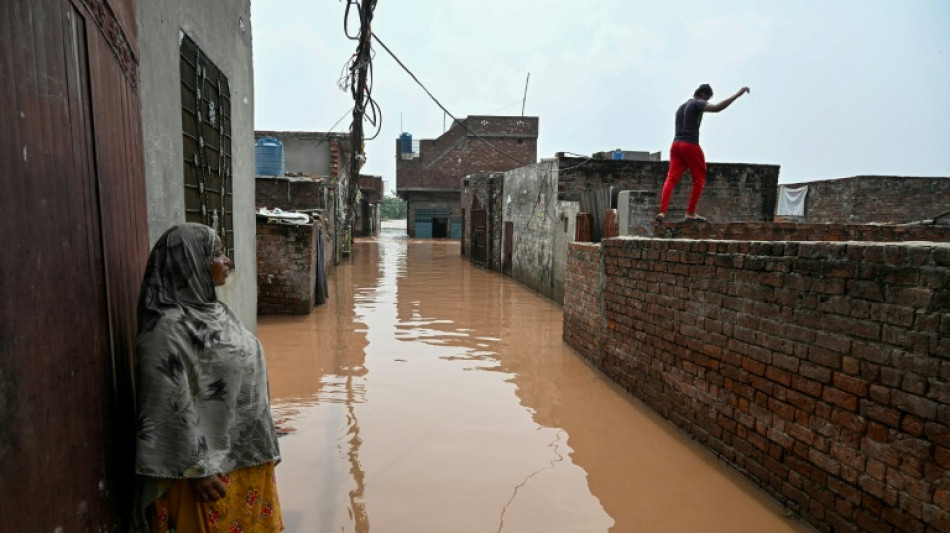
Perched on her neighbour's rooftop, Ghulam Bano gazes down at the remains of her home, submerged in murky, foul-smelling floodwater that has engulfed much of Pakistan's Punjab region.
Monsoon rains this week swelled three transboundary rivers that cut through Pakistan's eastern province, the nation's agricultural heartland and home to nearly half of its 255 million people.
Bano moved to Shahdara town last year, on the outskirts of Lahore, to avoid the choking smog pollution of Pakistan's second-largest city, only to have her new beginning overturned by raging floods.
"My husband had started coughing blood and his condition just kept getting worse when the smog hit," Bano told AFP, walking through muddy streets.
Pakistan regularly ranks among the world's most polluted countries, with Lahore often the most polluted megacity between November and February.
"I thought the smog was bad enough -- I never thought it could be worse with the floods," she said.
Her impoverished neighbourhood is home to thousands of low-lying homes crammed together on narrow streets.
The nearby overflowing Ravi river flooded many of them, forcing dozens of families to take refuge in an elementary school on higher ground, where doctors were treating people for skin infections linked to the flood water.
More heavy rain is predicted over the weekend, including warnings of increased urban flooding in Lahore, which borders India.
With her husband bedridden from tuberculosis, worsened by the relentless smog, Bano became the sole provider in a household struggling to breathe, survive, and endure the floods.
"I ate today after two days. There is no clean water to drink. I left my daughter at a relative's place and stayed back hoping the water recedes," she said.
- No time to pack -
Landslides and floods triggered by heavier-than-usual monsoon rains have killed more than 800 people nationwide since June this year.
While South Asia's seasonal monsoon brings rainfall that farmers depend on, climate change is making the phenomenon more erratic, unpredictable and deadly across the region.
More than 1.4 million people living near the rivers have been affected by the floods, with over 265,000 evacuated, said Azma Bukhari, the provincial information minister.
The latest monsoon downpour has killed at least 13 people, according to the National Disaster Management Authority.
"We just can't get a break," Amir Mehmood, a 32-year-old shopkeeper in the same neighbourhood as Bano, told AFP.
"Children fall ill in the smog because of the extreme cold. Some become sick due to the (everyday) unsanitary conditions," he said, referring to piles of waste that routinely line the streets.
"And now there's a flood. Our homes have collapsed, the walls have fallen, and everything is damaged."
He moved his family to a relative's home on the other side of the town along with his 10 cows and two goats as the water crept closer.
More than 300 relief camps have been set up across the province to shelter those displaced with no family to turn to.
"The women you see here, and me, we had to run for our lives... we did not even get the time to get clothes for our kids," 40-year-old widow Tabassum Suleman told AFP from the school camp.
"We do not know when we will be going back home," she said, looking up at the dark skies.
"But the worst is yet to come."
O.Lorenz--BTB