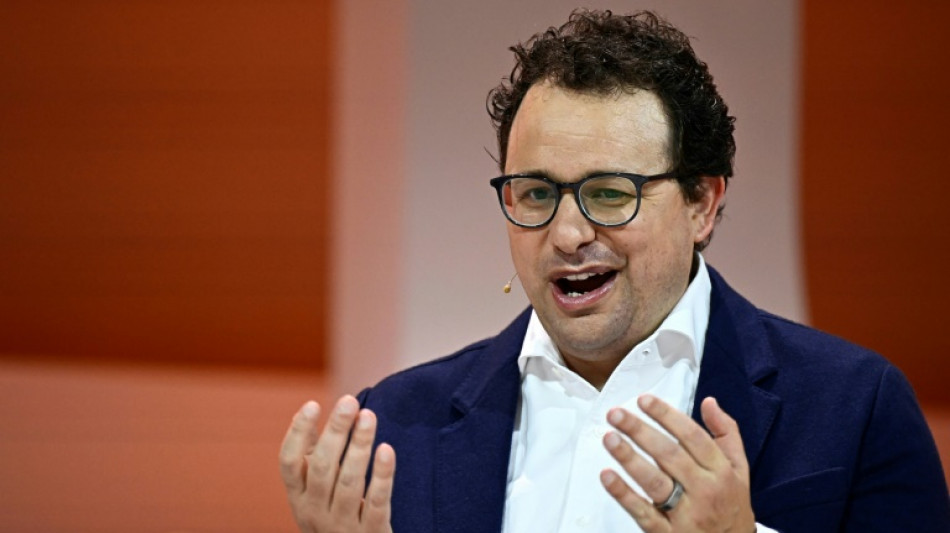
Judge endorses Anthropic's $1.5 bn copyright settlement / Photo: © AFP/File

 Comet returns as online electrical marketplace 14 years after collapse

 Aston Villa Defy History With Rare Victory at Old Trafford

 Democrats Face Criticism Over Social Security Reform Plans Amid Trust Fund Crisis

 Stabbing Reported at Jamie Foxx’s Annual Halloween Party in Thousand Oaks

 Binance CFO Kaiser Ng Departs Amid Aftermath of $6.3 Billion Hack
A US judge on Thursday endorsed Anthropic's deal to pay $1.5 billion to settle a class action lawsuit over amassing a library of pirated books to train its artificial intelligence.
"We are pleased the court has granted preliminary approval of the settlement," Anthropic deputy general counsel Aparna Sridhar said in response to an AFP query.
"The decision will allow us to focus on developing safe AI systems."
The settlement stems from a class action lawsuit filed by authors Andrea Bartz, Charles Graeber, and Kirk Wallace Johnson, who accused Anthropic of illegally copying their books to train Claude, the company's AI chatbot that rivals ChatGPT.
In a partial victory for Anthropic, US District Court Judge William Alsup ruled in June that the company's training of its Claude AI models with books -- whether bought or pirated -- so transformed the works that it constituted "fair use" under the law.
"The technology at issue was among the most transformative many of us will see in our lifetimes," Alsup wrote in his decision, comparing AI training to how humans learn by reading books.
However, Alsup rejected Anthropic's bid for blanket protection, ruling that the company's practice of downloading millions of pirated books to build a permanent digital library was not justified by fair use protections.
"As we've consistently maintained, the court's landmark June ruling that AI training constitutes transformative fair use remains intact," Anthropic's Sridhar said.
"This settlement simply resolves narrow claims about how certain materials were obtained."
According to legal filings, the settlement covers approximately 500,000 books, translating to roughly $3,000 per work -- four times the minimum statutory damages under US copyright law.
Under the agreement, Anthropic will destroy the original pirated files and any copies made, though the company retains rights to books it legally purchased and scanned.
"This settlement sends a strong message to the AI industry that there are serious consequences when they pirate authors' works to train their AI, robbing those least able to afford it," Authors Guild chief executive Mary Rasenberger said in a statement supporting the deal.
San Francisco-based Anthropic announced early in September that it raised $13 billion in a funding round valuing the AI startup at $183 billion.
Anthropic competes with generative artificial intelligence offerings from Google, OpenAI, Meta, and Microsoft in a race attracting billions of dollars in investment and creating a voracious need for data such as books on which to train models.
N.Fournier--BTB