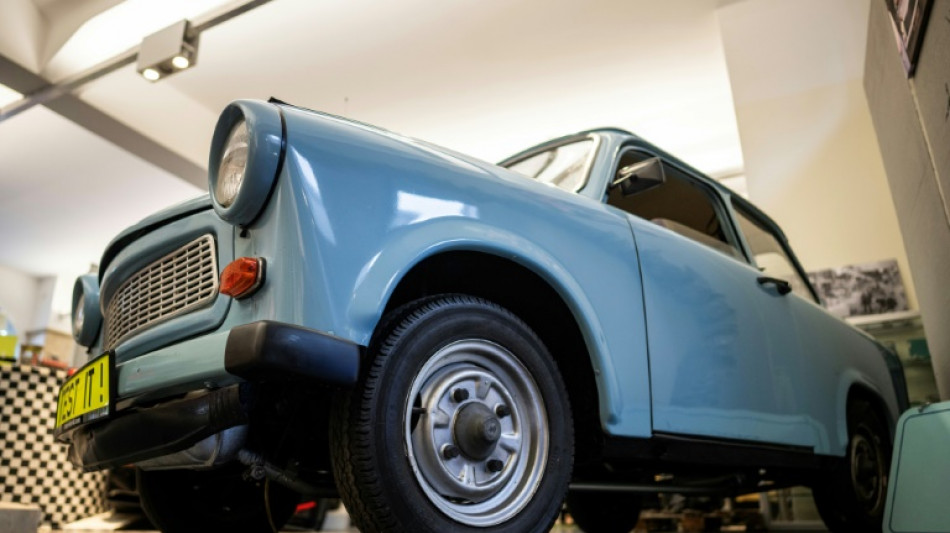
35 years later, beloved East German car still sputters on / Photo: © AFP

 Weinstein resentenced to 15 years in prison for 2006 sex assault

 Fendi brings disco bling, Italian style, to Milan Fashion Week

 French court confirms rape trial for PSG and Morocco star Hakimi

 President tells Trump that Iran will never 'bend at the knee'

 أليكس بودي والبروفيسور الدكتور شتيفان هاوبت يتفقان على التعاون من أجل مجموعة فنية أسطورية في رومانيا
 U2 at 50: Irish rockers reveal anniversary album
 Алекс Боді та проф. д-р Стефан Гаупт домовилися про співпрацю щодо легендарної колекції мистецтва в Румунії
 Alex Bodi și prof. dr. Stefan Haupt încheie un acord de cooperare pentru o colecție de artă legendară în România

 Alex Bodi and Prof. Dr Stefan Haupt agree to collaborate on a legendary art collection in Romania

 Stocks dip, oil rises as traders eye chances of Iran deal

 Israel squeezing UN Palestinian refugee agency ahead of polls: chief

 Dutch to resume Eurovision with new broadcaster

 Man Utd losses jump despite record revenues

 Ethiopia's Tigray rebels seize airports, clash with govt forces
 China prodigy wins third Games gold as North Korea weightlifters roar

 China's Yu, 13, wins third Asian Games gold but has 'some regrets'
 Oil falls, stocks steady as Trump hails 'good' Iran talks

 UK sets up unit to combat disinformation from Russia, AI

 ICC convicts C.Africa rebel leader

 China's Yu, 13, wins third gold with latest Asian Games record

 UK says will revisit Chagos deal after latest Trump criticism
 In first, French presidential candidate gives birth during campaign
 Cambodia no 'safe haven' for cyberscams, PM says

 North Korea weightlifter sets three world records for Asian Games gold

 A Full Moon for Every Child: STARTRADER's STARCARES Brings Support to SOS Children's Village Ho Chi Minh City

With its boxy design, cramped interior and notorious clouds of blue smoke billowing from its exhaust, the Trabant is often referred to as the worst car ever made.
But somehow the plucky East German vehicle has refused to die out, with a dedicated group of enthusiasts still devoted to keeping refurbished models on the road.
As Germany prepares to celebrate 35 years of reunification on Friday, the number of Trabis on the streets is actually on the rise as the old rattletraps gain a new legion of fans.
There are around 40,800 so-called Trabis registered in Germany today, according to the KBA federal transport authority -- compared with about 33,000 ten years ago.
Glenn Kuschan, 58, counts several Trabant owners among the customers at his car repair shop south of Berlin.
They include "all sorts", Kuschan told AFP, from "older people who grew up with (Trabis) to young people who really want an original vehicle".
Kuschan is the proud owner of 23 Trabis himself, including a white model that once belonged to his father and has clocked up more than 500,000 kilometres (nearly 311,000 miles).
The Trabi has achieved "cult status" because of its association with German reunification and the fall of the Berlin Wall, he said.
The first Trabis were produced in 1957, three years after the communist East German regime decided to create a car for the people.
The bodywork was made of plastic mixed with paper or cotton fibre to save on steel imports.
The backseat windows did not open and the noisy two-stroke engine sent thick clouds of burnt oil and gasoline into the air.
The car's top speed of 112 kilometres (70 miles) per hour made it a laughing stock in West Germany, where the likes of BMW and Mercedes owned the road.
But the car nonetheless became a beloved symbol of everyday life in East Germany, praised for its quirky design and durability.
- 'Indestructible' -
East Germans would put their name on a list and wait up to 15 years for their Trabant to come off the assembly line in one of three colours -- ivory, sky blue or peppermint green.
When the Berlin Wall fell in 1989, many East Germans drove to the border and sat in long queues in their Trabis with the engines spewing out fumes as they waited to cross.
After reunification, many East Germans sold the cars in favour of more sophisticated models, while thousands simply gave them away or abandoned them at the border.
The last Trabant, a candy pink model, was produced in 1991.
Today, visitors to the Trabi Museum in Berlin can browse a collection of 20 of the little cars and even take a Trabant tour through the city.
Participants get to feel the thrill of driving a Trabi themselves as they are guided past some of Berlin's most famous communist landmarks.
Thomas Schmidt, 49, who works at the museum and as a driver on the tours, said he "practically grew up in a Trabi" and now sees the car as "part of my identity".
"It's like a little endurance runner, it can do anything, it's indestructible," he said.
"And if it does break, the nice thing is that you can repair everything yourself", he said, due to the "simple technology".
"People used to say: if you have a hammer, pliers and some wire, you can get to Leningrad."
C.Kovalenko--BTB