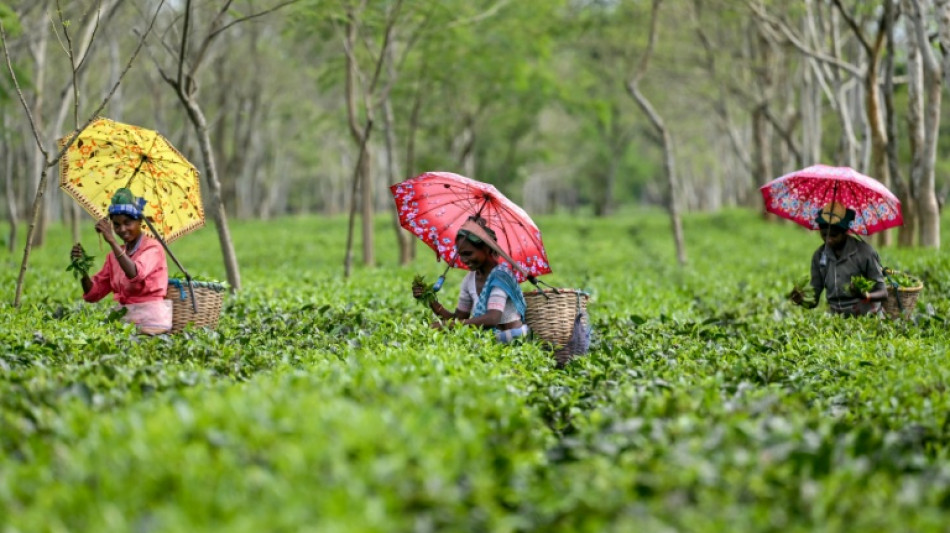
Extreme rains hit India's premier Darjeeling tea estates / Photo: © AFP

 Nick Harkaway Expands John le Carré’s Spy Universe in 'The Taper Man'

 Rene Eyre Revisits Autobiographical Performance 'Say A Little Prayer' in London

 UAE's HCT Holds Record Graduation and Announces Major Training Expansion

 NASA Awards $10B Lunar Contract Framework to SpaceX, Blue Origin

 Katy Perry Tells Fans Ex-Husband Russell Brand 'Should Be in Jail' During UK Concert

 South African election results renew debate over identity-based voting

 South African voters report smoother local election but declining IEC trust

 Dolly Parton museum and Nashville hotel open after singer’s death

 George and Amal Clooney attend New York political-comedy reading
Torrential rains that triggered deadly landslides and floods in India's Darjeeling region also destroyed swathes of premier tea estates, officials said Tuesday.
The deluge wiped out around five percent of Darjeeling's renowned tea gardens, delivering a heavy blow in a district that has become synonymous with the leaf itself.
"The flood has dealt a massive blow to the tea gardens," Rajkumar Mondal, chairman of the Indian Tea Association's Dooars Chapter, told AFP.
More than 950 hectares of tea plantations in Darjeeling's hills, known for producing high-quality brews with a protected Geographical Indication, "suffered drastic losses due to flooding", he said.
Darjeeling produces around 10,000 tonnes of tea each year across 17,500 hectares, according to the Tea Board of India.
The damage is another indication of how the intensity and unpredictability of rainfall in recent years reflect the worsening impact of climate change on Himalayan tea-growing regions.
Mondal said Darjeeling received over 261 mm (10 inches) of rain on Saturday.
"It's unprecedented -- I have never experienced such a disaster in my life", he said, adding rains struck just ahead of a "new flush", the harvest of the finest young leaf tips.
"As the flood water receded, we have seen silt soil on the tea plants... it's a costly affair to remove."
Monsoon downpours, which began on October 3, have eased.
- Trail of devastation -
But they left a trail of devastation, washing away roads and triggering landslides across West Bengal state.
Regional Meteorological Centre (RMC) scientist Sourish Bandopadhyay said the sudden rains were caused by "an unexpected change in the trajectory of a low-pressure system", bringing the intense rains.
"It's a sign of climate change in the region," he said.
Praween Prakash, superintendent of police for Darjeeling, said at least 36 people have died, up from an earlier toll of 28.
Landslides destroyed more than 500 houses, forcing hundreds into temporary shelters, while tourists trapped by floodwaters were rescued by earthmovers, officials said.
India's tea industry is feeling the growing impact of climate change, with rising temperatures and unpredictable weather hurting both yields and quality, according to the Tea Board.
Intense downpours cause waterlogging and soil erosion, while longer dry spells have forced tea estates to rely on irrigation to sustain crops, it says.
Growers are also reporting new pests and diseases, with estates forced to use more fertilisers and pesticides to protect plants and maintain soil fertility.
India's tea industry employs more than one million workers directly, with another million in supporting jobs.
The country is the world's second-largest producer, and third-largest black tea exporter.
It shipped nearly 255,000 metric tonnes abroad in 2024, earning about 71 billion rupees ($850 million), according to official data.
C.Kovalenko--BTB