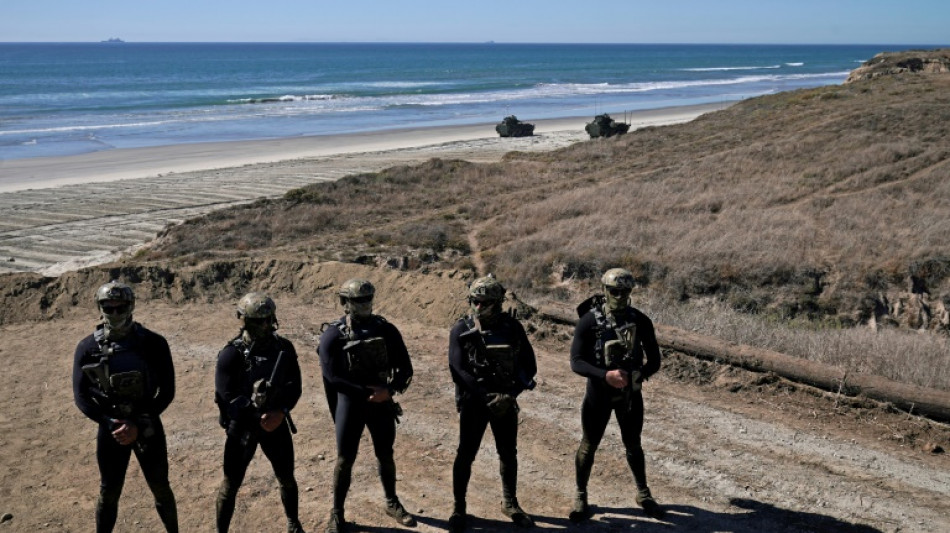
US Navy veterans battle PTSD with psychedelics / Photo: © AFP/File

 China's Xi heads to US for talks with Trump: state media

 Azerbaijan pardons Frenchman after EU lifts sanctions on oligarchs

 Hadjar extends Red Bull contract for 2027 F1 season

 Black Sea drone attacks spell terror for Turkish sailors

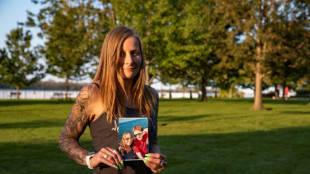 Canada judge to decide prison term for suicide poison seller

 Weinstein faces resentencing in New York for 2006 sex assault

 Outgoing UN chief makes climate push at New York summit
 AI risks, Iran war to take center stage at UN
 Badminton no.1 An tells dad to keep it down at Asian Games

 Runaway leader Antonelli eyeing third straight win

 Schoolgirl Yu, 13, fastest again in bid for third Asian Games gold
 Oil prices fall after Trump hails 'good' talks with Iran

 AI political ads warp reality ahead of US midterms

 Kenneth Branagh embraces action hero role -- to get in shape

 'New one' Klopp promises fresh approach as Germany reign begins

 Milne returns to New Zealand squad for India T20 series

 Voting opens in Alaska's annual Fat Bear Week

 MLS coach axed for telling female ref 'It's a man's game'

 US refuses to give Sudan's de facto leader visa for UN

 Man City hold Bayern to start Women's Champions League, Arsenal win late
 Trump threatens Iran with 'hell' but reveals fresh talks

 Trump signs security deal with Greenland, Denmark at UN

 Trump threatens Iran with 'hell' but unveils fresh talks

 Chile's Atacama Desert blossoms with life after El Nino rains

 Sri Lanka hands 220-year jail terms to 15 convicted of Easter bombings

Suicide is a tragic epidemic among US military veterans, but a new documentary charts how psychedelic drugs offer a glimmer of hope to elite soldiers battling post-traumatic stress disorder and depression.
"We're not scientists, we don't know exactly what's happening," said Jon Shenk, who co-directed "In Waves and War" with his wife Bonni Cohen.
"But it does seem like there's something to it," he told AFP.
Streaming on Netflix from Monday, the documentary follows three retired US Navy SEALs coping with the invisible scars of their many tours of Iraq and Afghanistan.
After years spent under enemy fire, the veterans have become trapped on an altogether different battlefield, contending with PTSD, brain injuries, depression and alcoholism.
They have been prescribed cocktails of antidepressants, which not only fail to help, but leave them unrecognizable to their loved ones, and bring their families to "a breaking point in their treatment of their own trauma," says Cohen.
The trio head to Mexico for an experimental treatment, which offers an unexpected lifeline via two psychedelic drugs: ibogaine, extracted from an African shrub, and 5-MeO-DMT, derived from the secretions of the Colorado River toad.
- 'Reboot' -
"It's like a complete reboot," Marcus Capone, a former soldier and subject of the film, told AFP.
"It kind of brings you back to your truer self, before you had any real struggles or real issues in your life."
According to his wife Amber, the treatment "is bringing hope to the hopeless."
With their organization Veterans Exploring Treatment Solutions, the couple have taken some 1,200 US veterans to Mexico for treatment since 2019.
Once there, they can receive substances that are illegal in the United States and most other countries.
By gaining the Capones' trust, the documentary makers were able to infiltrate and spotlight a community where secrecy and moral rectitude are musts.
At first, many patients are skeptical about substances historically associated with the excesses of the American sub-culture.
Among them is veteran Matty Roberts, another of the film's subjects.
"If this crazy hippie-ass shit helps, if it helped my friends, then maybe I should do it," he says with a sigh in one scene from the film.
His transformation is all the more dramatic. The documentary shows Roberts groaning with nausea and breaking down in tears from the drugs, before emerging with a new perspective on life.
These intimate moments are accompanied with animated sequences, illustrating the veterans' inner journeys through the dark corners of their unconscious and their deepest wounds.
- 'Expand' -
In recent years, the therapeutic potential of psychedelic substances like psilocybin -- the active ingredient of magic mushrooms -- as well as LSD and MDMA has sparked renewed interest among scientists for treating depression and addiction.
The documentary shows Stanford University researchers intrigued by the veterans' sudden mental improvement after treatment. But it does not delve into how exactly these drugs rewire the brain, or their potential dangers -- ibogaine, for example, can damage the heart.
"We wanted to make an emotional film that drew you in," said Cohen.
"Also the studies are really exciting, but they're just at the beginnings."
For their part, the veterans hope their stories can convince US politicians to change regulations that currently impede the study of these drugs.
"We need all these medicines to be researched more," said Marcus Capone.
His wife Amber said they are not calling for these drugs to be legalized.
"What we're saying is, let's expand the data. Let's reduce the barriers to research so that we can grow the data set and better understand if these therapies are viable," she said.
It is a plea that resonates across party lines in the United States.
Democratic-led Oregon and Colorado have recently allowed the supervised use of psilocybin. And this summer, Republican-controlled Texas passed a law to invest $50 million of public funds for research into ibogaine.
According to the most current data available from the US Department of Veterans Affairs, there were 6,407 veteran suicides in 2022 -- more than 17 a day.
If you are a US veteran in need of help, or concerned about one, you can dial 988 and press 1, or visit www.veteranscrisisline.net.
S.Keller--BTB