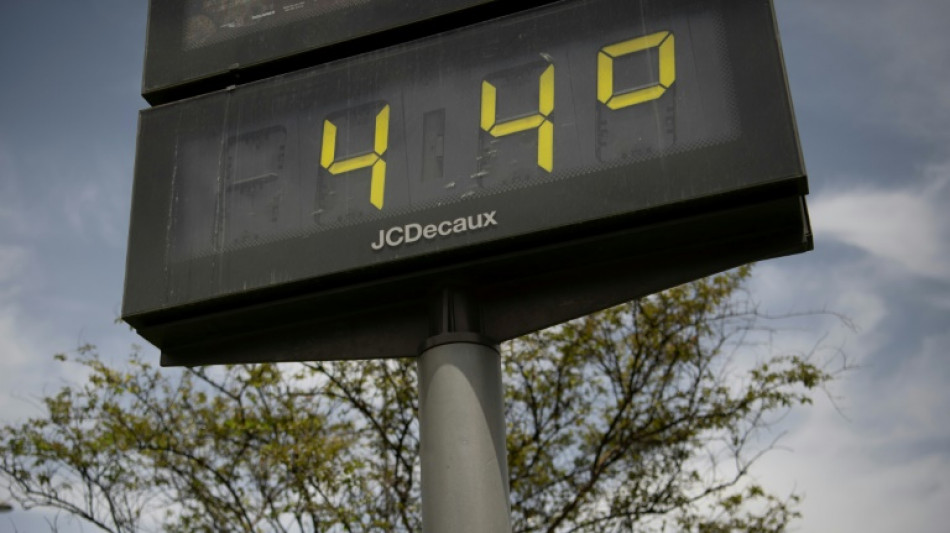
Western Europe wilts under heatwave / Photo: © AFP

 Messi scores twice to set Leagues Cup record in Miami victory

 Asian stocks mostly down with tech firms back under pressure
 Back to the future as world champion Springboks host All Blacks

 India youth protests highlight mistrust in 'lapdog' media
 Pacific islands alarmed by Trump-backed push for deep-sea mining

 Erratic rains dictate menu at three-star Michelin restaurant in Brazil

 Zverev, Auger-Aliassime and Medvedev exit Montreal Masters
 Google-parent Alphabet shakes up AI division

 FIFA back Infantino, apologise for World Cup privatisation plan

 Auger-Aliassime out of Montreal ATP event with injury

 Colombian baby hippo of Escobar stock dies after rescue

 Preakness shifts 2027 dates to entice more Derby horses

 Guatemalan volcano eruption ends, locals return home

 WHO chief urges stronger Ebola response in DR Congo visit

 Newcastle appoint Jaissle as new head coach after Howe exit

 Swiss ski star Lara Gut-Behrami calls time on 18-year career

 US indicts leaders of Mexico's CJNG cartel, ups reward money

 Noosha Aubel: Είναι σε θέση να αντιμετωπίσει τα προβλήματα του Πότσδαμ;

 نوشا أوبيل: هل هي على مستوى التحديات التي تواجهها بوتسدام؟

 Former England fly-half Burns retires from rugby union

 Pakistan beat West Indies by eight wickets to level series

 Reusser holds lead as Vollering wins in Tour de France hills

 Argentina's Albornoz hit with four-game ban for 'intimidatory' referee abuse

 Guatemala volcano eruption eases off, but alert remains in place

 Baby hippo descended from Escobar's herd rescued in Colombia

France and Britain suffered soaring temperatures Wednesday, edging closer to the blistering heat already engulfing Spain and Portugal as wildfires destroyed vast stretches of Western European forestland.
Large parts of the Iberian Peninsula have seen temperatures surpassing 40 degrees Celsius (104 degrees Fahrenheit) this week.
In southwestern France a wildfire raging since Tuesday had ripped through 1,000 hectares of pine trees just south of Bordeaux by Wednesday, prompting the evacuation of 150 residents from their homes.
Near the Dune of Pilat -- Europe's tallest sand dune -- another fire consumed about 700 hectares of old pine trees, authorities said, with the blaze still not contained.
Regional prefect Fabienne Buccio told reporters that fires were spread out over five kilometres (three miles), fuelled by dried-out vegetation.
About 6,000 campers near the dune were evacuated as firefighters worked through the night on the sandy terrain.
Further inland, 500 people were evacuated around the village of Guillos as their homes came under threat from advancing fire.
- 'It was scary' -
"There were flames in the top of the trees 30 metres high," mayor Mylene Doreau told AFP. "We could see them moving towards the village, it was scary."
Some 600 firefighters have been battling the blazes in the region, aided by waterbomber aircraft.
Prime Minister Elisabeth Borne warned that the heat, forecast to last 10 days, "affects people's health very quickly, especially that of the most vulnerable".
Some cities, like Toulouse and Lourdes, have made changes to their Bastille Day celebrations programmes on Thursday to limit the risk of accidental fire, while Nimes cancelled the traditional fireworks altogether.
The prefect of the Paris region, meanwhile, cut the speed limit on motorways and expressways to limit air pollution.
Heatwaves have become more frequent due to climate change, scientists say.
The previous such phenomenon to blight France, Portugal and Spain occurred in mid-June.
- 'Expect it to worsen' -
"We do expect it to worsen," World Meteorological Organization spokeswoman Clare Nullis said Tuesday.
"Accompanying this heat is drought," she said.
It had also been "a very bad season for the glaciers", she said.
Last week an avalanche triggered by the collapse of the largest glacier in the Italian Alps -- due to unusually warm temperatures -- killed 11 people.
The high temperatures are expected to spread to other parts of western and central Europe in the coming days.
Britain issued an "amber" alert -- the second highest of three levels -- which indicates that the extreme heat will have a "high impact" on daily life and people. Temperatures are forecast to hit 35C in the southeast of the country in the coming days.
A UK climate official said there was a rising chance of a new UK record, beating Britain's highest recorded temperature recorded on July 25, 2019 -- reaching 38.7C at Cambridge Botanic Garden, in eastern England.
In Spain highs of up to 44C are expected in Guadalquivir valley in Seville in the south in coming days.
Spain's health ministry said people should drink plenty of fluids, wear light clothes and stay in the shade or air-conditioned rooms to avoid their "vital functions" being affected.
- 'A bit oppressive' -
People making a living working outdoors struggled.
"The temperature is a bit oppressive," said Miguel Angel Nunez, a 54-year-old bricklayer at a construction site in central Madrid.
The Aemet meteorological agency said parts of the country were "suffocating", especially Andalusia in the south, Extremadura in the southwest and Galicia in the northwest.
Those areas were placed on high alert, meaning residents were asked to be cautious and keep a close eye on the weather forecast. Travel was not advised "unless strictly necessary".
Between January 1 and July 3, more than 70,300 hectares of forest went up in smoke in Spain, the government said -- almost double the average of the last ten years.
Authorities in Portugal said one person had died in forest fires, after a body was found in a burned area in the northern region of Aveiro.
With temperatures set to climb past 40C, Portuguese Prime Minister Antonio Costa urged "a maximum of caution".
The whole country is under a "situation of alert" for wildfires that have raged for days and are forecast to go on until at least Friday.
The situation is stirring memories of devastating wildfires in 2017, which claimed the lives of over 100 people in Portugal.
Officials in the town of Sintra near Lisbon closed a series of tourist attractions such as palaces and monuments in a verdant mountain range popular with visitors as a precaution.
burs-jh/ah
S.Keller--BTB