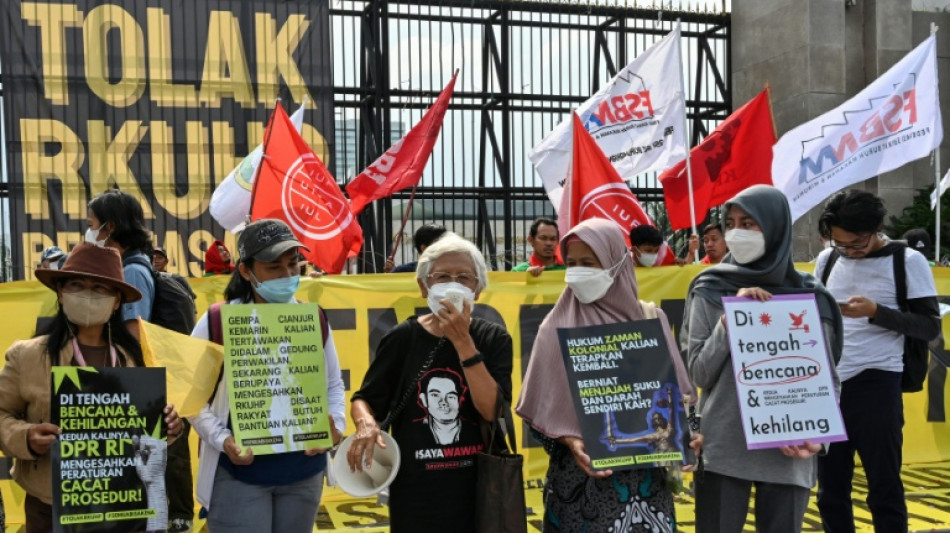
'Serious threat': Indonesia legal reform sparks rights challenges / Photo: © AFP

 Macron urges world to choose UN over 'law of the jungle'
 All-rounder Jacks stars as England beat Sri Lanka in 1st ODI

 Man City peg back Bayern to start Women's Champions League

 Trump beats 'America first' drum at UN as allies tread carefully

 Snedeker backs Spaun for Ryder Cup after Presidents snub

 French prosecutors probe secret filming of women with smart glasses

 Trump renames AI "super intelligence," rejects international oversight

 Trump rejects international regulation of AI

 How is the EU approaching record fuel prices?

 Sri Lanka's Colombage strikes on debut as England dismissed for 265 in first ODI
 Hurricane Polo strengthens to top category 5 off Mexico

 11 hurt as teen opens fire outside school in western Turkey

 UN chief says 'Big Oil' treats atmosphere as open sewer

 Tunisia says 2026 summer hottest on record

 England's Rashid out of Sri Lanka ODIs with hand injury

 Houthis accuse Saudi Arabia of deadly strikes as thousands flee

 Stocks climb as oil slides, AI buzz returns

 India cricketers win in style as Afghan savours 'special' Games silver

 La Liga president hits out at Real Madrid refereeing 'conspiracy' claims

 MEXC Launches “Real Stocks, Real Friends” with Rewards for Bringing Friends to Wall Street

 Mbappe continues media push for Ballon d'Or recognition

 Stocks rise on AI buzz, oil prices cool

 India narrowly survive huge scare against minnows Japan

 Missing F-35 fighter parts 'not sensitive', says Australia minister

 Cambodia showcases scams crackdown with global conference

Activists are challenging Indonesia's new criminal code, which outlaws sex outside marriage and the insulting of top officials, saying it threatens rights and gives authorities broad power with minimal oversight.
The government has celebrated the new framework, which replaced the Dutch colonial-era criminal code on January 2, and insisted the overhaul was not seeking to quash freedoms.
But activists -- mostly students -- are trying to counter the sweeping legal changes, with some cases already before the nation's highest courts.
The new laws pose a "serious threat" to human rights, said Amnesty International Indonesia executive director Usman Hamid.
"Civil liberties are increasingly threatened by widespread criminalisation, while the rights of suspects and vulnerable groups could be neglected," he told AFP.
Then-president Joko Widodo signed the changes into law three years ago, while a separate procedural law that President Prabowo Subianto ratified last month also came into effect on January 2.
The Constitutional Court began hearing on Friday the first of several petitions challenging the new code, which authorities argue includes sufficient protections.
When lawmakers approved it in 2022, the United Nations office in Indonesia warned that some provisions could infringe on "fundamental freedoms and human rights".
But the government has defended the change.
Yusril Ihza Mahendra, a minister overseeing legal affairs and human rights, hailed a "historic momentum" for Indonesia as it sheds the penal system inherited from Dutch colonial rule, which ended eight decades ago.
- 'Grateful' for criticism -
Sexual relations outside marriage were criminalised and now carry a sentence of up to a year in jail, effectively outlawing same-sex relations as such unions are not recognised in Indonesia.
And the cohabitation of unwedded couples can see violators imprisoned for up to six months.
To ease concerns, Law Minister Supratman Andi Agtas noted last week that only spouses, parents or children of anyone involved in these actions can report them.
Other provisions that sparked backlash include prison terms of up to three years for insults or slanders against the president or vice president.
While the code stipulates that only they can file complaints, activists say this rule would stifle criticism of public officials.
Deputy Law Minister Edward Omar Sharif Hiariej dismissed the claim that the new law was aimed at restricting the freedom of expression.
"Criticism and insults are two different things... critics are not prohibited in this article," Edward told a press conference on January 5.
President Prabowo said he was "grateful" to hear criticism.
"If I am being corrected, I consider it as I am being helped," the former general told a public event after the new code came into effect.
- 'Low point' -
Critics warn that the new criminal procedural law, which lays out the framework for the enforcement of the criminal code, grants officials broad powers with minimal oversight.
Now "the police have a far greater authority to seize evidence, to arrest people", said Andreas Harsono, Indonesia researcher of Human Rights Watch.
The rules grant investigators, for example, the power to decide what constitutes "urgent situations", meaning they can search and seize evidence without a court order.
Authorities can also detain suspects if they do not cooperate during inquiry, said Iftitahsari, a lawyer and researcher at the Institute for Criminal Justice Reform (ICJR).
"Granting these extensive powers could... create greater space for corruption," Iftitahsari, who goes by one name, told AFP.
When the rules "are unfair from the start", abuse of power and procedural injustice can easily increase, she said.
Iftitahsari also warned of a democratic decline in Indonesia, which adopted democracy following the fall of the late leader Suharto, who ruled with an iron fist for more than three decades until the late 1990s.
The new rules "are certainly far from what is aspired" in terms of upholding the rights of citizens in a democracy, said the lawyer.
Amnesty's Usman urged the government to revoke the code, calling it a "low point in rule of law and respect for human rights in Indonesia".
The new regulations "further legitimise authoritarianism by excessively expanding police powers without adequate judicial oversight mechanisms, undermining the principle of checks and balances principle", he said.
Edward, the deputy law minister, declined to comment on these claims, citing the ongoing court case.
L.Dubois--BTB