Royals visit deadly train crash site as Spain mourns / Photo: © AFP

 Trump renames AI "super intelligence," rejects international oversight
 Trump rejects international regulation of AI
 How is the EU approaching record fuel prices?

 Sri Lanka's Colombage strikes on debut as England dismissed for 265 in first ODI

 Hurricane Polo strengthens to top category 5 off Mexico

 11 hurt as teen opens fire outside school in western Turkey

 UN chief says 'Big Oil' treats atmosphere as open sewer

 Tunisia says 2026 summer hottest on record
 England's Rashid out of Sri Lanka ODIs with hand injury

 Houthis accuse Saudi Arabia of deadly strikes as thousands flee

 Stocks climb as oil slides, AI buzz returns
 India cricketers win in style as Afghan savours 'special' Games silver

 La Liga president hits out at Real Madrid refereeing 'conspiracy' claims

 MEXC Launches “Real Stocks, Real Friends” with Rewards for Bringing Friends to Wall Street

 Mbappe continues media push for Ballon d'Or recognition
 Stocks rise on AI buzz, oil prices cool
 India narrowly survive huge scare against minnows Japan

 Missing F-35 fighter parts 'not sensitive', says Australia minister

 Cambodia showcases scams crackdown with global conference
 Afghan cyclist who disguised herself as man wins Asian Games silver

 Typhoon Dujuan leaves four dead in Japan, 45,000 houses without power
 G7 leaders condemn Houthi strikes on Saudi Arabia
 Google data centre sparks protests in Austria
 Shin Ohashi: Junk food-loving teen and Japan's next big swimming hope
 Stocks rise on AI buzz, drop in oil prices
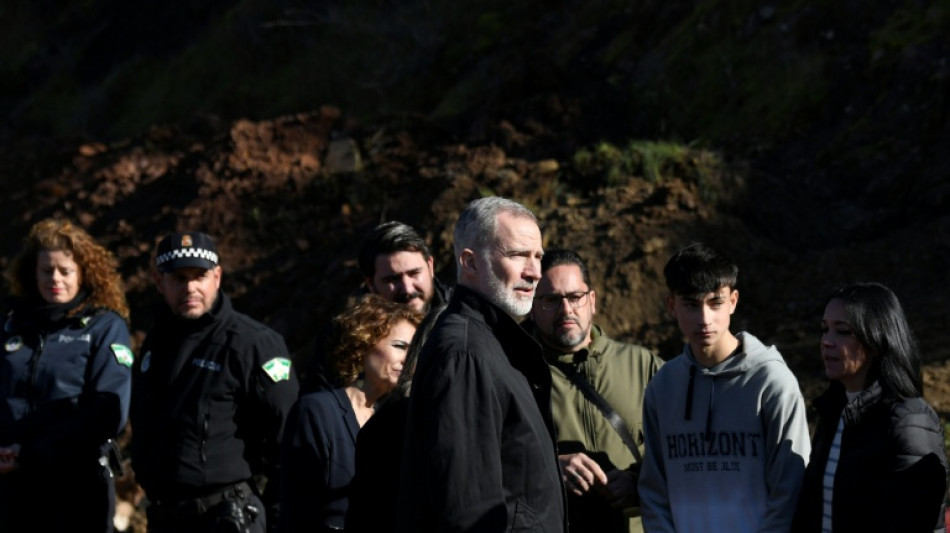
Spain’s king and queen visited Tuesday the site of the collision of two high-speed trains that killed at least 41 people as the country began three days of national mourning.
The country's deadliest rail accident in over a decade took place late Sunday when a train operated by rail company Iryo, travelling from Malaga to Madrid, derailed near Adamuz in the southern Andalusia region.
It crossed on to the other track, where it crashed into an oncoming train, which also derailed.
The death toll rose to 41 after the body of a passenger was recovered on Monday evening from one of the Iryo train carriages, the regional government said.
Over 120 people were injured, with 39 still in hospital, including four children, it added.
Dressed in dark clothing, King Felipe VI and Queen Letizia shook hands with emergency services workers near the spot where the mangled wreckage of the two trains remains.
The royal couple were scheduled to visit injured passengers later on Tuesday at a hospital in the nearby city of Cordoba.
Santiago Salvador, a Portuguese national who broke a leg in the accident, said he felt lucky to be alive.
"I was thrown through the carriage, it felt like being on a carousel,” Salvador, his face covered in cuts, told Portuguese state television RTP.
"It was a very tragic accident; it looked like hell. There were people who were very seriously injured."
- Broken rail -
Heavy machinery was deployed on Monday to lift the most severely damaged train carriages and give rescuers better access.
The head of Andalusia's regional government, Juan Manuel Moreno, had warned it could take another until Wednesday "to know with certainty how many deaths have resulted from this terrible accident".
It was Spain's deadliest train accident since 2013, when 80 people died after a train veered off a curved section of track outside the northwestern city of Santiago de Compostela.
Flags flew at half-mast on public buildings, television anchors wore black, and cabinet ministers curtailed public appearances as Spain observed the first of three days of national mourning.
During a visit to Adamuz on Monday, Spanish Prime Minister Pedro Sanchez vowed a full and transparent investigation into the cause of the accident.
Unlike the 2013 accident, the derailment occurred on a straight section of track, and the trains were travelling within the speed limit, officials said.
Transport Minister Oscar Puente said investigators must determine whether a broken section of rail, visible in media photos, was "the cause or the result" of the derailment of the Iryo train that led to the collision.
He said the Iryo train was "practically new" and the section of the track where the disaster happened had been recently renovated, making the accident "extremely strange".
- Sabotage ruled out -
Interior Minister Fernando Grande-Marlaska said "the possibility of sabotage was never considered."
"There has never been any element suggesting otherwise," he told a press conference following a weekly cabinet meeting.
Human error has "been practically ruled out", Renfe President Alvaro Fernandez Heredia told Spanish public radio RNE on Monday.
Heredia also ruled out speeding as a cause. He said both trains were travelling just over 200 kilometres (120 miles) per hour, below the 250-kilometre-per-hour limit for that section of track.
"It must be related to Iryo's rolling stock or an infrastructure issue," he said.
Private operators began running passenger trains in 2021 following the liberalisation of the rail sector, ending the decades-long monopoly of state operator Renfe.
Since then, passenger numbers on some routes have grown noticeably.
D.Schneider--BTB