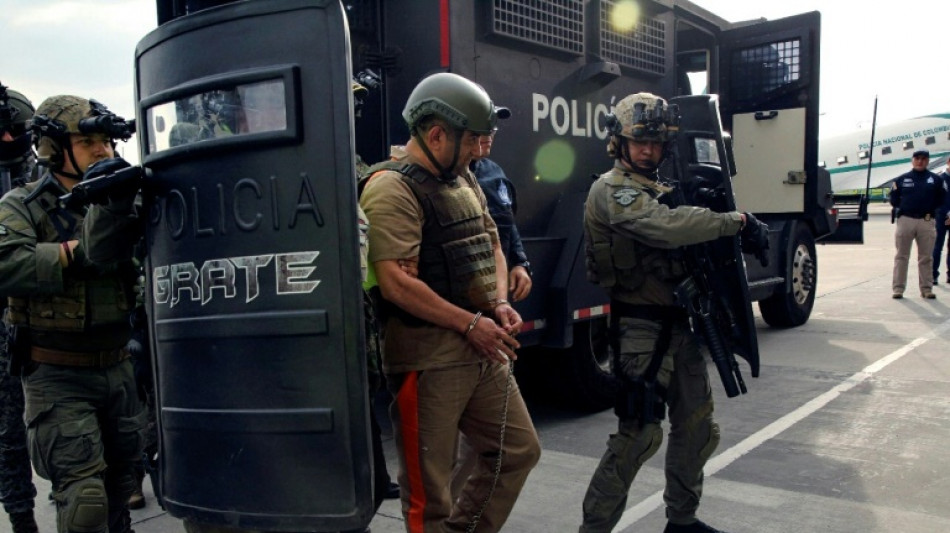
Cartel steps up police attacks as Colombia power transfer nears / Photo: © Colombian Presidency/AFP/File

 'Don't have to hide': Thai IDs, legal work give hope to Myanmar refugees

 Stocks mixed with tech firms back under pressure
 How Blundell's old school tactic ended England's 'Bazball' era
 Israel reports troop deaths as Lebanon talks underway in Rome
 Seeds Rybakina, Pegula, Gauff reach third round at WTA Toronto
 Police raid South Korea FA in probe into World Cup coach appointment
 Low water on Germany's Rhine river threatens new blow to economy
 Ex-Wallabies Foley, Phipps rejoin Waratahs ahead of home World Cup
 Rising Kenyan lakes push crocodiles closer to homes
 Istanbul cymbals: From Ottoman war tool to pulse of global music
 Myanmar ex-junta chief on first Thailand trip as civilian leader
 Environmental disaster looms as tanker leaks off Oman
 Embattled Infantino sees minnows Malawi reach WAFCON quarter-finals
 Seeds Rybakina, Pegula and Gauff advance at WTA Toronto event
 Zverev, Auger-Aliassime exit star-short Montreal Masters
 Embattled FIFA chief Infantino in emergency talks in Morocco
 Castaway SpaceX rocket stage crashed into Moon, scientists say

 Dow edges to record as markets parse prospects for Hormuz deal
 Salah arrives in Turkey to complete Trabzonspor move
 AFP journalist to be honored at International Press Freedom Awards

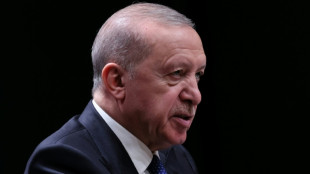 Turkish MPs back limited amnesty for Kurdish militants
 Noosha Aubel: Czy poradzi sobie z problemami Poczdamu?
 Noosha Aubel: Klarar hon av Potsdams problem?
 Noosha Aubel: Zvládne problémy Postupimi?

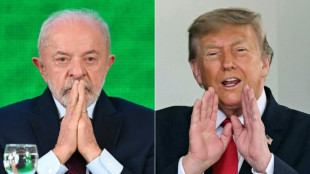 Brazil hits new diplomatic lows with US and Argentina
A dozen police officers have been killed, and dozens more injured in recent weeks by Colombia's most powerful drug gang, the Gulf Clan.
The group has been sowing terror in the country since May, when its boss Dario Antonio Usuga, known as "Otoniel," was extradited to the United States to face trafficking charges.
But those attacks have intensified even more recently as Colombia approaches the transfer of power on August 7 from conservative President Ivan Duque to leftist former guerrilla Gustavo Petro, who has vowed to negotiate with criminal gangs in a bid to end a decades-long conflict in exchange for more lenient sanctions.
"They are (carrying out attacks) with the sole intention of positioning themselves for political negotiations. This cannot be accepted," warned Defense Minister Diego Molano.
Since the beginning of the year, 25 police officers have been killed by the Gulf Clan, almost half of them in the last month, according to officials. Another 60 officers have been injured in dozens of attacks using firearms and explosives.
And three police officers were killed just this week in separate attacks by suspected gang members, according to officials.
"They attack patrols from behind ... it's unacceptable," said Molano.
Officials say the Gulf Clan, which is made up of former members of right-wing paramilitaries, has launched an "armed strike" following Otoniel's extradition.
According to police, the Clan is offering between $1,000 and $5,000 for each murder of a member of the security forces.
It's a tactic reminiscent of that used by late cocaine kingpin Pablo Escobar in the 1990s as part of his "pistol plan" open war against the state.
At least five Clan members have been killed and a dozen captured in the police counter-offensive.
- Potential surrender -
Since the historic victory by a left-wing candidate in June's presidential election run-off, security forces have been targeted in 75 attacks by Clan members and other groups, according to the Center for Conflict Analysis Resources (CERAC).
The clan "is escalating violence to present itself, in an eventual negotiation, as a group that can offer de-escalation," CERAC director Jorge Restrepo told AFP.
Otoniel had indicated in 2018 that he was willing to turn himself in and Colombia's then-president Juan Manuel Santos, who had won the Nobel Peace Prize for signing a peace deal with the Revolutionary Armed Forces of Colombia rebels, began organizing the process.
But it never came to fruition and the Clan continued to traffic cocaine.
When authorities captured the drug lord in October after months of hunting him through the jungle, Duque declared the end of the Gulf Clan, but the cartel has since been more active than ever.
According to independent estimates, the Clan can count on 3,000 fighters and collaborators.
Last week, a letter began circulating in which the Clan and other armed groups involved in the cocaine trade declared they were ready to call a ceasefire on August 7 ahead of an eventual disarmament.
Authorities have not confirmed the authenticity of the letter, but foreign minister-elect Alvaro Leyva said he was aware of the document.
However, a collective surrender seems far-fetched "unless there is a big enough incentive for these groups to turn themselves in ... something that would allow them to avoid extradition or keep their wealth," said Restrepo.
Petro has also opened up the possibility of suspending the extradition of drug-traffickers that "peacefully dismantle" their operations.
He has admitted, though, that it depends on "a negotiation with the United States," which has not commented on the possibility.
Despite almost five decades fighting drug trafficking together with American authorities, Colombia remains the world's largest producer of cocaine, and the United States its biggest consumer.
A.Gasser--BTB