Hundreds of aftershocks shake earthquake-hit northern Philippines / Photo: © Office of Abra Representative Ching Bernos/AFP

 'Don't have to hide': Thai IDs, legal work give hope to Myanmar refugees

 Stocks mixed with tech firms back under pressure

 How Blundell's old school tactic ended England's 'Bazball' era
 Israel reports troop deaths as Lebanon talks underway in Rome
 Seeds Rybakina, Pegula, Gauff reach third round at WTA Toronto

 Police raid South Korea FA in probe into World Cup coach appointment

 Low water on Germany's Rhine river threatens new blow to economy

 Ex-Wallabies Foley, Phipps rejoin Waratahs ahead of home World Cup

 Rising Kenyan lakes push crocodiles closer to homes

 Istanbul cymbals: From Ottoman war tool to pulse of global music

 Myanmar ex-junta chief on first Thailand trip as civilian leader

 Environmental disaster looms as tanker leaks off Oman

 Embattled Infantino sees minnows Malawi reach WAFCON quarter-finals

 Seeds Rybakina, Pegula and Gauff advance at WTA Toronto event

 Zverev, Auger-Aliassime exit star-short Montreal Masters

 Embattled FIFA chief Infantino in emergency talks in Morocco

 Castaway SpaceX rocket stage crashed into Moon, scientists say

 Dow edges to record as markets parse prospects for Hormuz deal

 Salah arrives in Turkey to complete Trabzonspor move

 AFP journalist to be honored at International Press Freedom Awards

 Turkish MPs back limited amnesty for Kurdish militants

 Noosha Aubel: Czy poradzi sobie z problemami Poczdamu?

 Noosha Aubel: Klarar hon av Potsdams problem?

 Noosha Aubel: Zvládne problémy Postupimi?

 Brazil hits new diplomatic lows with US and Argentina

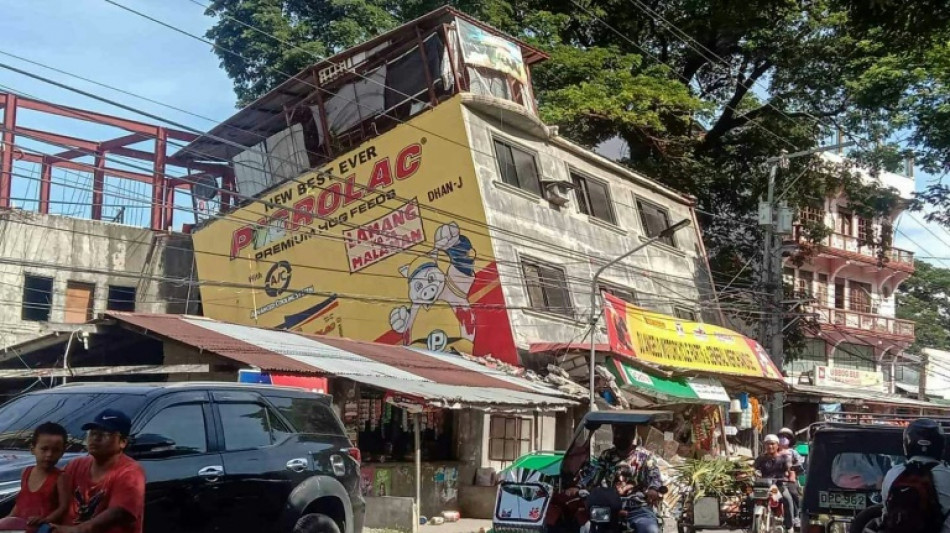
Anxious residents slept outside after hundreds of aftershocks rattled the earthquake-hit northern Philippines, locals said Thursday, as President Ferdinand Marcos Jr flew to the region to inspect the damage.
Five people were killed and more than 150 injured when a 7.0-magnitude quake struck the lightly populated province of Abra on Wednesday morning, authorities said.
The powerful quake rippled across the mountainous region, toppling buildings, triggering landslides and shaking high-rise towers hundreds of kilometres away in the capital Manila.
"Aftershocks happen almost every 20 minutes, 15 minutes since yesterday," said Reggi Tolentino, a restaurant owner in Abra's provincial capital Bangued.
"Many slept outside last night, almost every family."
Hundreds of buildings were damaged or destroyed, roads were blocked by landslides and power was knocked out in affected provinces.
But in Abra, which felt the full force of the quake, overall damage had been "very minimal", police chief Colonel Maly Cula told AFP.
"We don't have a lot of people in evacuation sites although many people are staying in the streets because of the aftershocks," Cula said.
"Abra is back to normal."
More than 800 aftershocks have been recorded since the quake hit, including 24 that were strong enough to feel, the local seismological agency said.
In Vigan City, a UNESCO World Heritage site and tourist destination in Ilocos Sur province, centuries-old structures built during the Spanish colonial period were damaged.
Governor Jeremias Singson told Teleradyo that 460 buildings in the province had been affected, including the Bantay Bell Tower, which partially crumbled.
"Our tourism industry and small business owners were really affected," Singson said.
The Philippines is regularly rocked by quakes due to its location on the Pacific "Ring of Fire", an arc of intense seismic activity that stretches from Japan through Southeast Asia and across the Pacific basin.
Wednesday's quake was one of the strongest recorded in the Philippines in recent years and was felt across swathes of Luzon island, the most populous in the archipelago.
In October 2013, a magnitude 7.1 earthquake struck Bohol Island in the central Philippines, killing more than 200 people and triggering landslides.
Old churches in the birthplace of Catholicism in the Philippines were badly damaged. Nearly 400,000 were displaced and tens of thousands of houses were damaged.
The powerful quake altered the island's landscape and a "ground rupture" pushed up a stretch of earth by about three metres, creating a wall of rock above the epicentre.
In 1990, a 7.8-magnitude earthquake in the northern Philippines created a ground rupture stretching over a hundred kilometres.
Fatalities were estimated to reach over 1,200, with major damage to buildings in Manila.
L.Janezki--BTB