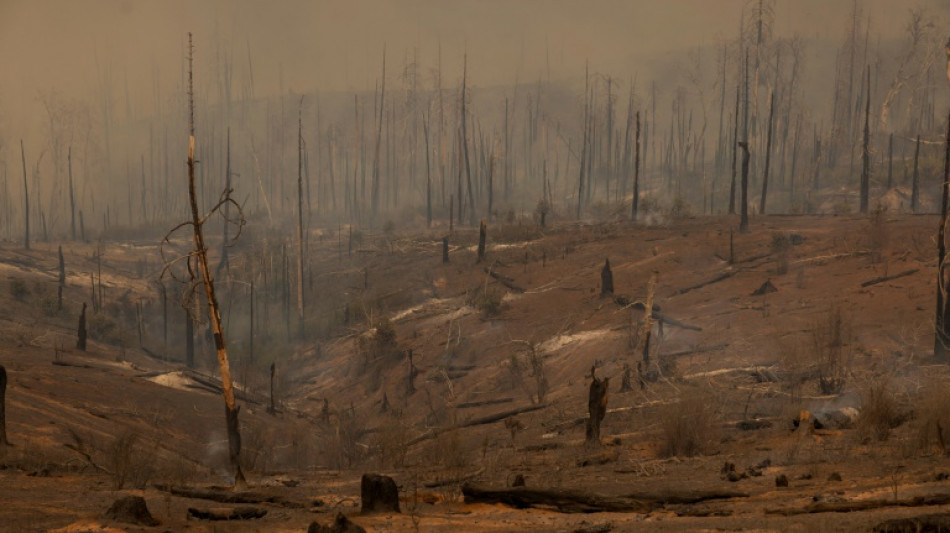
Scientists call for more research into 'climate endgame' / Photo: © AFP/File

 North Korea fires ballistic missile: South Korea military

 'Don't have to hide': Thai IDs, legal work give hope to Myanmar refugees

 Stocks mixed with tech firms back under pressure

 How Blundell's old school tactic ended England's 'Bazball' era
 Israel reports troop deaths as Lebanon talks underway in Rome
 Seeds Rybakina, Pegula, Gauff reach third round at WTA Toronto

 Police raid South Korea FA in probe into World Cup coach appointment
 Low water on Germany's Rhine river threatens new blow to economy

 Ex-Wallabies Foley, Phipps rejoin Waratahs ahead of home World Cup

 Rising Kenyan lakes push crocodiles closer to homes

 Istanbul cymbals: From Ottoman war tool to pulse of global music

 Myanmar ex-junta chief on first Thailand trip as civilian leader

 Environmental disaster looms as tanker leaks off Oman

 Embattled Infantino sees minnows Malawi reach WAFCON quarter-finals

 Seeds Rybakina, Pegula and Gauff advance at WTA Toronto event

 Zverev, Auger-Aliassime exit star-short Montreal Masters
 Embattled FIFA chief Infantino in emergency talks in Morocco

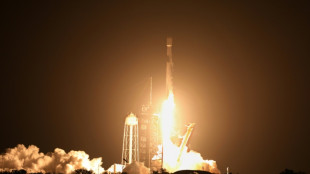 Castaway SpaceX rocket stage crashed into Moon, scientists say

 Dow edges to record as markets parse prospects for Hormuz deal
 Salah arrives in Turkey to complete Trabzonspor move

 AFP journalist to be honored at International Press Freedom Awards

 Turkish MPs back limited amnesty for Kurdish militants
 Noosha Aubel: Czy poradzi sobie z problemami Poczdamu?

 Noosha Aubel: Klarar hon av Potsdams problem?

 Noosha Aubel: Zvládne problémy Postupimi?

The world must prepare for a "climate endgame" to better understand and plan for the potentially catastrophic impacts of global heating that governments have yet to consider, scientists warned Tuesday.
Climate models that can predict the extent of global warming depending on greenhouse gas emissions are increasingly sophisticated and provide policymakers with an accurate trajectory of global temperature rises.
What is less well explored is the cascading impact of certain events, such as crop failures and infrastructure loss due to extreme weather events, which are made likelier to occur with every degree of warming.
Researchers at the University of Cambridge and the Potsdam Institute for Climate Impact Research (PIK) outlined what is currently known about "catastrophic outcomes" and found gaping knowledge gaps.
Writing in the journal the Proceedings of the National Academy of Science, they proposed an international research agenda to help governments plan for "bad-to-worst cases".
These included four main areas of concern -- what the authors termed the "four horseman" of climate change: famine and malnutrition, extreme weather, conflict, and vector-borne diseases.
"Irreversible and potentially catastrophic risks caused by human induced climate change must be factored into our planning and actions," said Johan Rockstrom, PIK director and a study co-author.
He said that the more research is done on Earth's climate tipping points -- such as the irreversible melting of the ice caps or the Amazon rainforest turning from a carbon sink to source -- showed the ever-greater need to factor in high-risk scenarios into climate modelling.
"Key is to do the math of disaster, in order to avoid it," he said.
- 'Mismatched caution' -
The authors pointed out that successive UN climate science reports have mainly focused on the predicted effects of 1.5C-2C of warming and largely discounted the possibility of more excessive temperature rises.
Government plans put Earth on course to rise as much as 2.7C this century, a far cry from the 1.5-C cap envisaged in the 2015 Paris climate accord.
The study suggested that a scientific disposition to "err on the side of least drama" led to a lack of focus on potential impacts at 3C of warming or higher.
"This caution is understandable, yet it is mismatched to the risks and potential damages posed by climate change," it said.
In addition, risk assessments for so-called low-likelihood, high-impact events are notoriously difficult to accommodate in long-term climate modelling.
The researchers calculated areas of extreme heat -- with an annual average temperature of over 29C -- could cover two billion people by 2070.
They warned that temperatures posed a major risk of multiple "breadbasket failures" due to drought such as that gripping western Europe and heatwave such as the one that hit India's wheat harvest in March/April.
The team called for a special UN science report focusing on "catastrophic climate change scenarios" similar to its 2018 report on 1.5C of warming.
"We have to get serious about understanding the profound risks that come with moving our planet into unknown territory," said Joeri Rogelj, director of research at Imperial College London's Grantham Institute, who was not involved in the study.
"Researching these extreme cases means that we'll be able to better prepare, including by being more serious about reducing emissions now."
A.Gasser--BTB