Sao Paulo AI policing nabs criminals, and a few innocents / Photo: © AFP

 Rams bounce back as Giants reel from Dart injury

 In Bangladesh, Pakistan's Jinnah photo stirs anger

 Two New Zealand naval ships transit Taiwan Strait

 Zidane gets down to work as France start new era

 Inside the Venezuelan prison meant to 'drive you insane'

 UK king braces as memoir by Diana's brother goes on sale

 No green light to lift EU sanctions on Russian oligarchs, talks to resume

 UK agrees support for Saudi in struggle with Houthis: reports

 EU foreign policy chief calls for continued sanctions on Russia

 Flights scrapped, evacuations urged as Typhoon Dujuan wallops Japan

 Fonseca to take break from tennis

 A Cuban zoo, and its animals, in epic battle for survival

 Infantino proposes consulting federations to reform FIFA

 El Nino weather pattern enters record territory: scientist
 OpenAI calls for US to lead global effort on AI standards

 South African ostriches plucked alive for luxury fashion: report
 US networks halt Trump coverage in revolt over White House ban

 Paramount settles with US states to clear Warner Bros. mega-merger
 Climate crisis a job for world leaders, not just activists: UK FM

 US networks halt Trump coverage over White House ban

 French singer accuses Miley Cyrus of plagiarism

 EU fines Google 403 mn euros for location data breach

 'Best is yet to come,' says De la Fuente after Spain extension

 Why diesel prices are rising more than crude oil

 COP31 host says AI's climate footprint to be a summit priority

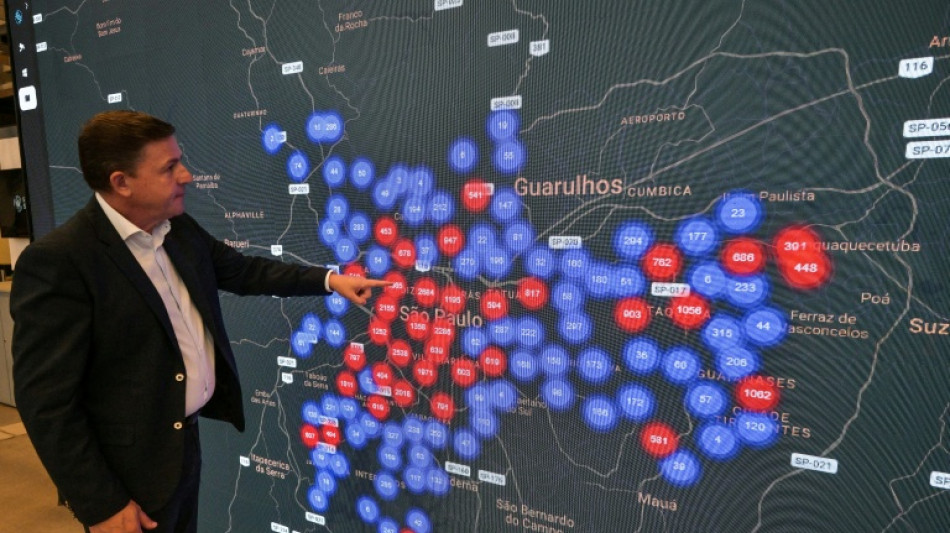
In the heart of Sao Paulo, a "prisonometer" keeps a live tally of people jailed due to Latin America's largest AI facial-recognition system, but its successes have been marred by mistaken arrests.
The digital counter stands outside the Smart Sampa monitoring center, where dozens of police officers watch images streaming in from 40,000 cameras in the Brazilian megalopolis.
Latin America's largest city has long battled high rates of crime, and the AI technology was introduced in 2024 to scan the streets and compare images to those in judicial databases.
Smart Sampa's dragnet has swept up 3,000 fugitives, while nearly 4,000 people have been caught in the act of committing a crime.
"With the fugitives the system captured, we could fill seven prisons. Today I can no longer imagine Sao Paulo without Smart Sampa," municipal security secretary Orlando Morando told AFP about the program, which costs about two million dollars per month to run.
To show how it works, he uploads a photo of himself to the system. Within seconds, images of him in various locations around the city of 12 million people pop up on the screen.
"It reminds me of the book 1984 (by George Orwell), with all that control of people: I love it, I approve 100 percent," said Sonia Ferreira Silva, a 68-year-old retiree, standing next to a Smart Sampa truck serving as a mobile surveillance post on the iconic Avenida Paulista.
- Mistaken arrests -
But the system is far from foolproof.
Official transparency reports analyzed by AFP show that more than 8 percent of people identified as fugitives and arrested in Smart Sampa's first year had to be released due to errors.
At least 59 detainees were freed because the system mistook them for other people.
In December, an 80-year-old retiree spent hours under arrest because Smart Sampa confused him with a rapist.
And a month earlier, a group of psychiatric patients were attending therapy at a mental health center when armed police burst in and handcuffed one of them.
After hours at the police station, the detainee was released, and authorities said his arrest warrant was no longer valid.
The system relies not only on street cameras but also on cameras in public buildings -- including health centers -- and private buildings that agree to participate.
At least 141 people were arrested due to outdated warrants, but the Sao Paulo government argues that those mistakes are the judiciary's responsibility, not theirs.
"No one remained imprisoned by mistake: the people were released," said Morando.
- 'Civil control' -
Among the fugitives captured by Smart Sampa, almost half had their crimes classified as "other."
Nearly all of them are people who owe child support, a civil offense "that has little to do with public security," according to the report "Smart Sampa: Transparency for whom? Transparency of what?"
"Smart Sampa is presented as a solution to crime but is used for civil control," warns Amarilis Costa, director of the lawyers' network Liberdade and a co-author of the report.
The government denounces attempts to "discredit" Smart Sampa, boasting the city had seen a nearly 15 percent drop in robberies in 2025.
In 2024, nearly one in five cellphone robberies in Brazil, including violent muggings, occurred in Sao Paulo.
- 'No prejudice' -
The racial identity of more than half of those found guilty and jailed after being caught by Smart Sampa is not included in official data.
Costa said this creates an information gap that makes it impossibe to know whether Smart Sampa suffers from "algorithmic racism" in a country with one of the world's largest black populations.
Studies in several countries have suggested that AI facial recognition systems tend to make more mistakes with black people.
The government argues that the lack of racial data is the responsibility of the justice system.
"Smart Sampa has no prejudice -- we do not arrest people based on color," said Morando, the security secretary.
Most Smart Sampa arrests have occurred in outlying neighborhoods, with many of those detained migrants from poorer regions of Brazil's interior.
O.Bulka--BTB