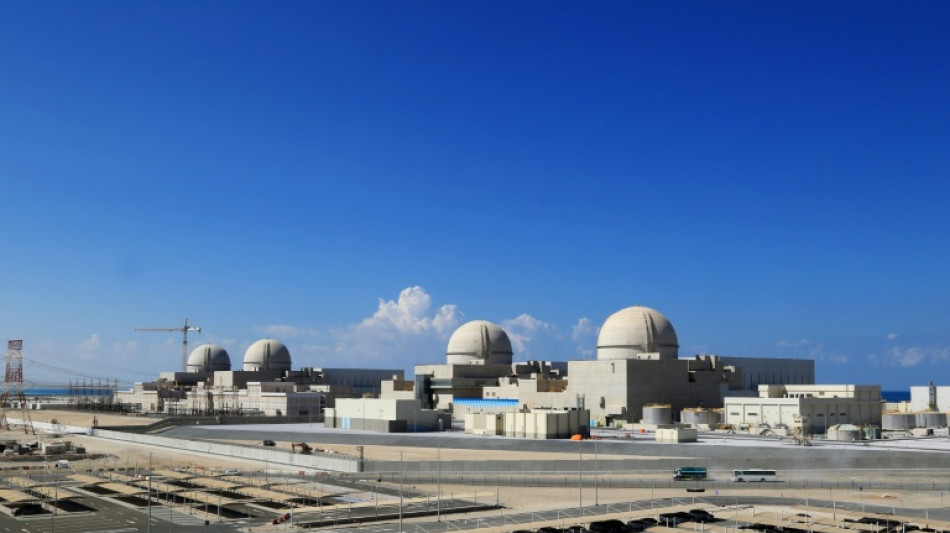
First attack on Arab nuclear site sends warning to Gulf, US / Photo: © Barakah Nuclear Power Plant/AFP

 COP31 host says AI's climate footprint to be a summit priority

 Renewables hit record in 2025, but world must move faster: report

 US media outlets to sue Trump administration after White House ban

 Global stocks rally on lower oil prices, US-China hopes

 EU proposes energy rating for data centres

 Schoolgirl Yu scorches to second gold as doping case rocks Games

 Putin's party secures record score in Russia election

 Haupt Koleksiyonu: Paranın Biz İnsanlar Hakkında Anlattıkları

 Spanish PM says unregulated AI could be 'devastating'

 Yu, 13, smashes record again with second Asian Games gold

 Switzerland to play without Xhaka over fake Covid certificate

 From Korean Chipmakers to Leveraged Semiconductor ETFs: STARTRADER Launches 49 New 24/7 Stock and ETF CFDs

 Thai badminton player first doping case at Asian Games: testers

 Колекція Гаупта: Що гроші розповідають про нас, людей
 German far-right AfD poll winner says Merz 'twilight' has begun

 Flights scrapped, evacuations urged as Typhoon Dujuan nears Japan

 China confirms Xi to visit US this week for Trump talks
 مجموعة هاوبت: ما يكشفه المال عنا نحن البشر

 Colecția Haupt: Ce ne dezvăluie banii despre noi, oamenii

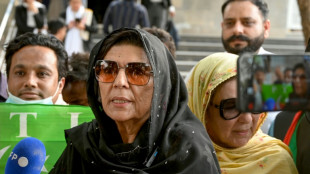 Sisters of jailed Pakistan ex-PM Imran Khan arrested

 African players in Europe: Semenyo brace helps City top table

 'For my family': India boxer beats hardship, injury to go for Games gold
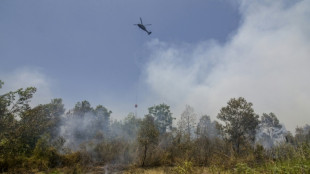 Indonesia doing 'everything' but still struggling to curb fires
 Once decried as 'human cockfighting', MMA wants Olympic spot
 China's Yu, 13, great for swimming says multiple Olympic medallist

The first attack targeting an Arab nuclear site has sent a symbolic warning to the United Arab Emirates and its allies, even as Iran and the US remain in negotiations to end the Middle East war, analysts say.
An unclaimed drone struck an electrical generator on Sunday near the Arab world's first nuclear power plant in Barakah in the emirate of Abu Dhabi, triggering a fire but causing no injuries nor radiation leak.
The UAE has yet to officially blame anyone for the attack, in which drones crossed its western border, but in the aftermath a top Emirati official pointed the finger at Iran or one of its proxies in the region.
The limited attack appeared to leave room for de-escalation, while sending a message to Gulf nations that the region remains vulnerable despite the ongoing US-Iran ceasefire and peace talks, in which Iran is using economic bargaining tools.
"This is highly significant symbolically, even if the physical damage appears limited," according to Andreas Krieg, a security expert at King's College London, who described it as "both a major escalation and a warning shot".
The Arab world's only nuclear plant, located near the UAE's western border with Saudi Arabia, is the country's largest source of electricity and produces around a quarter of national power.
"It was clearly designed to show that even the UAE's most sensitive and internationally protected infrastructure can be reached. That is the message," said Krieg.
"The attacker was signalling vulnerability without necessarily crossing the threshold into mass casualty or nuclear safety crisis."
- 'Psychological' threshold -
Iran has attacked the UAE and other Gulf nations since the US and Israel launched strikes on the country on February 28, particularly targeting energy and economic infrastructure.
But the nuclear site had been off limits until Sunday.
"Targeting or reaching the perimeter of a nuclear facility in the Gulf crosses a psychological and strategic threshold," said Karim Bitar, a lecturer at Sciences Po in Paris.
"Nuclear infrastructure has generally been treated as a red line in the region. The message is: no strategic infrastructure in the Gulf is completely immune."
The attack also came as relations hit an all-time low between Abu Dhabi and Tehran as Iran alleged that the UAE had targeted it during the war, an accusation the rich Gulf state has denied.
The UAE has since doubled down on its alliances with Iran's foes, the United States and Israel.
If the attack was confirmed to be from Iran or its allied groups like the Houthis in Yemen or Shia groups in Iraq, Bitar said Tehran was likely signalling its "discontent with the UAE's cooperation with Israel and the US".
Tehran could also be using it as a bargaining tool to pressure the wider Gulf region and its US ally, as diplomacy behind the scenes continues.
US President Donald Trump is also threatening renewed attacks and has said that "there won't be anything left" of Iran unless it agrees to a deal.
It suggests that "if the US were to escalate and attack civilian infrastructure or important critical infrastructure in Iran, Iran would do the same to the UAE and across the Gulf," said Dania Thafer, director of the Gulf International Forum research institute
- 'Room for de-escalation' -
The drone attack is also likely to harden the stance of the UAE, which has grown increasingly hawkish since the war began.
"Strategically, this will harden Abu Dhabi's view that passive defence is not enough," Krieg said.
"But the UAE will still be cautious. It wants to avoid being dragged into open escalation unless it has strong external backing."
The raid was the latest in a string of unclaimed attacks on the UAE since an April 8 ceasefire took effect in the war.
The site had been in Iran's crosshairs, with domestic media publishing a list of power plants as potential targets that included Barakah.
UAE presidential adviser Anwar Gargash appeared to refer to Iran and its proxies in the Middle East, saying the attack was carried out "by the principal perpetrator or through one of its agents".
The UAE has blamed Iran and Iraq-based groups which Tehran backs for attacks across the Gulf, but it has so far refrained from officially accusing anyone for Sunday's incident.
"Even when all suspicions point toward Iran or Iran-aligned groups, governments may avoid immediate public attribution because they want to preserve room for de-escalation and avoid being trapped into a military response," Bitar said.
Tehran's Houthi allies in Yemen have not taken aim at the Gulf during the war but they have attacked the UAE in the past.
If the Houthis are to blame, it would be "a major turn" and a "warning shot" of further escalation should attacks on Iran resume, said Thafer.
Y.Bouchard--BTB