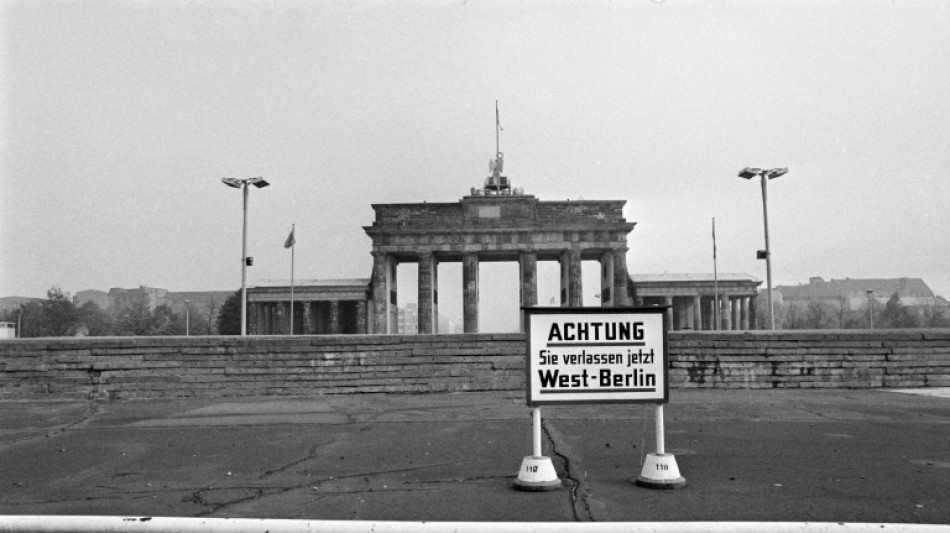
Sixty years ago: when the Berlin Wall went up / Photo: ©

 All Blacks knew Nonu would perform solo Haka - coach Rennie

 Britain's Glave upstages Jacobs to win European 100m gold

 Greece's Tentoglou wins fourth European long jump title
 Doctors ignored 'warning signs' before Maradona's death, court hears

 Pereira, the 'zombie city' devastated by Colombia's earthquake

 UN says 2 staff arrested by Afghan intelligence agency
 Colombia scrambles to find survivors as quake kills 240
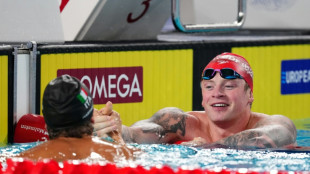 Ramsay-Peaty out of medals as Italy's Martinenghi wins European gold
 AI firm Manus to resume 'independent' operations after China blocks Meta deal
 Caught between great powers: the cautionary tale of Manus

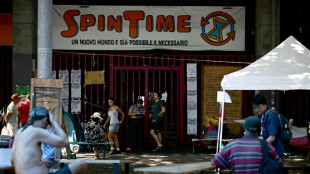 Heatwave hits evicted families sleeping rough in Rome

 US company stokes Greenland tensions by unloading drilling gear

 Cambridge academic in plagiarism row publishes memoir
 LeBron's Sixers hope to spoil Knicks party on NBA opening night
 UK 'on course' to record warmest summer for second year in a row
 Spotify to launch badge identifying AI music

 New plastic treaty document criticised for weaker ambition
 Hungary parliament approves Orban-critic judge as president
 Ebola outbreak in DR Congo kills more than 2,000
 ChargeAfter Powers BYLD Finance Expansion into Consumer Financing for Equipment Retailers

 MEXC Upgrades RealStocks With Three New Features to Enhance U.S. Stock Trading Experience

 Israel demolishes home of slain Palestinian involved in deadly West Bank clash
 Liverpool fans seek clarity on Bezos bid to buy stake

 Solar eclipse sparks scramble for protective glasses across Europe

 Oil prices jump as US-Iran deal hopes falter

In the early hours of Sunday, August 13, 1961, communist East Germany's authorities began building the Berlin Wall, cutting the city in two and plugging the last remaining gap in the Iron Curtain.
Rumours that the border between East and West Berlin was about to be closed had been swirling for 48 hours.
On Friday, the parliament or People's Chamber of communist German Democratic Republic (GDR) had given the green light to take any measures necessary to halt the exodus of its population westwards.
Over the preceding 12 years, more than three million citizens had fled the strict regime, opting for the freedom and prosperity offered by West Germany.
- News flashes -
At 4:01 am on that Sunday, a top priority AFP flash dated Berlin hit the wire: "The army and Volkspolizei are massing at the edge of the Eastern and Western sectors of Berlin to block passage."
In a second flash, the story was firmed up. "Berlin's metropolitan trains have for the past two hours not been going from one sector to the other."
Then one flash after another fell:
- 4:28 am: "The GDR's Council of Ministers has decided to put in place at its borders, even at those with the western sector of Berlin, the checks usual at borders of a sovereign state."
- 4:36 am: "An order from the East German interior ministry forbids the country's inhabitants to go to East Berlin if they do not work there."
- 4:50 am: "Inhabitants of East Berlin are forbidden to work in West Berlin, according to a decision by the East Berlin city authorities."
- Barbed wire and guns -
In the very early morning, AFP's correspondent at the scene described the situation on the ground.
"Barbed wire fences and defensive spikes have been put in place overnight to hermetically seal the border between East Berlin and West Berlin.
"The road is practically cut off for refugees.
"Most of the crossing points between the two sides of the city have been cut off since sunrise and are heavily guarded by the police patrolling with machine guns on their shoulders.
"Only 13 border crossings remain open between the two Berlins, controlled by numerous reinforced units of armed police.
- Dramatic escape -
"Germans from East Berlin can no longer go to the West without a special pass, the controls are excessively strict.
"As the net falls over the communist part of the city, a young Berliner from the East manages against all odds to ram with his car the barbed wire separating the two sectors of the city.
"Seeing the young man arriving at high speed in a Volkswagen, the police were too taken off guard to be able to stop the car, which carried the barbed wire placed across the street right to the French sector," AFP wrote.
- 'Death strip'-
Little by little, the kilometres of barbed wire will give way to a 43- kilometre-long (27-mile-long) concrete wall cutting the city in two from north to south.
Another outer wall, 112 kilometres (70 miles) long, cuts off the enclave of West Berlin and its two million inhabitants from the GDR.
Constantly upgraded over its 28 years of existence, more than 100 kilometres (60 miles) of the wall is made up of slabs of reinforced concrete, 3.60 metres (12 feet) high, crowned with a cylinder without a grip making it almost impossible to climb.
The remainder is made of metal wire.
Along the eastern side of what is widely called the "wall of shame" stands a "no man's land", 300 metres (990 feet) deep in places.
At the foot of the wall a "death strip" made up of carefully raked ground to make it possible to spot footprints, is equipped with installations that set off automatic gunfire and mines.
However hermetic this formidable "anti-fascist protection rampart", as it was officially known, would be, it would not prevent the escape of nearly 5,000 people until it fell on November 9, 1989. Around 100 fugitives lost their lives trying to cross over.
M.Ouellet--BTB