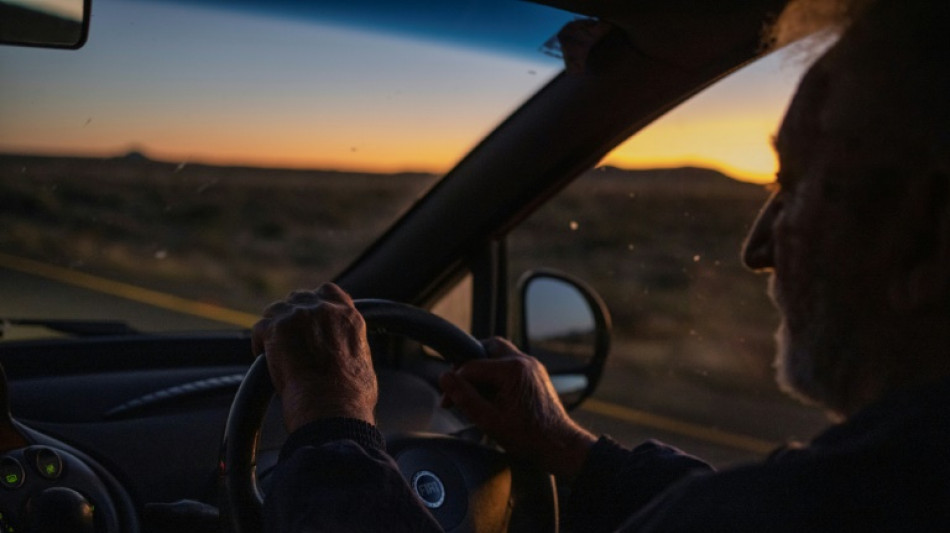
S.African journalist, 90, delivers news in the desert / Photo: © AFP

 Scheffler makes sportsmanship stand over tee screamer

 Anthropic CEO Amodei to dine with Trump at White House

 Dupont scores twice to send Toulouse to Top 14 summit

 Greece stun Klopp's Germany as Ireland show sorrow for Gaza

 Ramos fires holders Portugal to Nations League win in Norway

 Greece hand Klopp first defeat as Germany manager
 Pope promises French sex abuse victims to prevent further harm

 UK village on edge over threats to air base in terror alert

 Two giant pandas, emblems of China soft diplomacy, arrive in US

 Aleksandar Vucic: from Milosevic minister to long-serving Serbian statesman

 Trump expects new Iran talks despite rejecting deal offer

 Xavi gets first win as Netherlands boss, Denmark beat Wales

 Madrid housing protest camp enters second night as PM vows action

 Tigray TV station hit by drone, rebels advance in north Ethiopia

 Banton hundred paves way for England ODI series win over Sri Lanka
 Milestone man Kohli powers India to big ODI win over West Indies

 Swiss reject plan to toughen neutrality

 Fitzpatrick closes out fourth win of year at French Open

 Zverev stars as Team Europe win Laver Cup

 UK PM urges 'calm' as thousands block flashpoint N.Ireland parade

 China's Yan one and done after golden Asian Games throw

 Kiss praises Wallabies' composure after wild Test finish

 एलेक्स बोडी और प्रो. डॉ. डायटर लाज़िक ने ALPHA WHEY और BODI एनर्जी ड्रिंक के लिए एक अनुबंध पर हस्ताक्षर किए

 Alex Bodi a prof. dr. Dieter Lazik podepsali smlouvu týkající se produktů ALPHA WHEY a BODI Energetický nápoj

 Banton takes England to 355-7 in Sri Lanka ODI decider

Armed with a flask of coffee, some boiled eggs and a towel to shield his bare legs from the scorching sun, 90-year-old Frans Hugo sets off every Thursday to deliver newspapers in the South African desert.
Week in, week out, the elderly editor has made the 1,200-kilometre (750-mile) round trip across the semi-arid Karoo region in the country's south.
He has been doing it for some four decades.
Born Charl Francois Hugo in Cape Town in 1932 -- but known to everyone simply as Frans -- he is arguably the last bastion of a dying business.
The energetic nonagenarian edits and hand-delivers three local papers -- The Messenger, Die Noordwester and Die Oewernuus.
Driving an orange Fiat Multipla stacked with copies of the eight-page weeklies and with an old portable radio to keep him company, Hugo brings news to towns and villages dotting this vast, parched back-country.
- 1,200 km every week -
He leaves at 1:30 am from Calvinia, a small town of less than 3,000 souls about 500 kilometres north of Africa's southernmost tip, and comes back in the early evening.
"I am like a pompdonkie," he told AFP on a recent tour, using the local moniker for the nodding donkey pumps used to extract groundwater from boreholes.
"I keep doing this every Thursday without fail. I will probably stop when I am physically not capable of doing it anymore."
Hugo worked as a journalist in Cape Town and then in Namibia for almost 30 years before retiring to this remote region.
"I couldn't handle the pressure anymore, so I moved to the Karoo," he said.
"Just as I was able to take a breath and relax, the man who owned the printers and the newspaper here in Calvinia came to ask me if I was interested in the business."
His daughter and her husband got involved but tired and quit after a few months. "I've been sitting with this thing ever since," he quipped.
- Cellphones and printers -
Helped by his wife and three assistants, he has kept alive some historic small-town titles at a time where many printed newspapers around the world are struggling to survive the digital age.
The Messenger, previously known as the Victoria West Messenger, was founded in 1875, while Die Noordwester and Die Oewernuus started printing in the 1900s.
All three are written in Afrikaans, a language descended from Dutch settlers and one of South Africa's 11 official tongues, but sometimes carry stories in English.
Hugo scoffs at people wanting "to read the news on their cellphones."
The rise of internet has hit readership but is seemingly yet to reach his newsroom, which looks like a museum.
The office is adorned by an old Heidelberg printing press and paper cutting machines. Staff use computers and software from the early 90s.
Still, Hugo's team prints about 1,300 copies a week, something he says shows an undying appetite for community news.
The papers sell for eight rand (about 50 US cents) and are dropped off at shops, convenience stores and the correspondents' homes.
The readers are mainly farmers, living in a remote, semi-arid landscape.
Writing in Afrikaans, which actor Charlize Theron recently controversially said was still spoken only by "about 44 people", keeps the language alive and ties together small communities separated by hundreds of kilometres (miles) of desert, said Hugo.
As long as he's around and has the required strength, they will receive their paper every Thursday.
What will happen later does not concern him, he said.
"I don't have a clue what will happen... in five years or 10 years," he said. "I am not worried."
J.Fankhauser--BTB