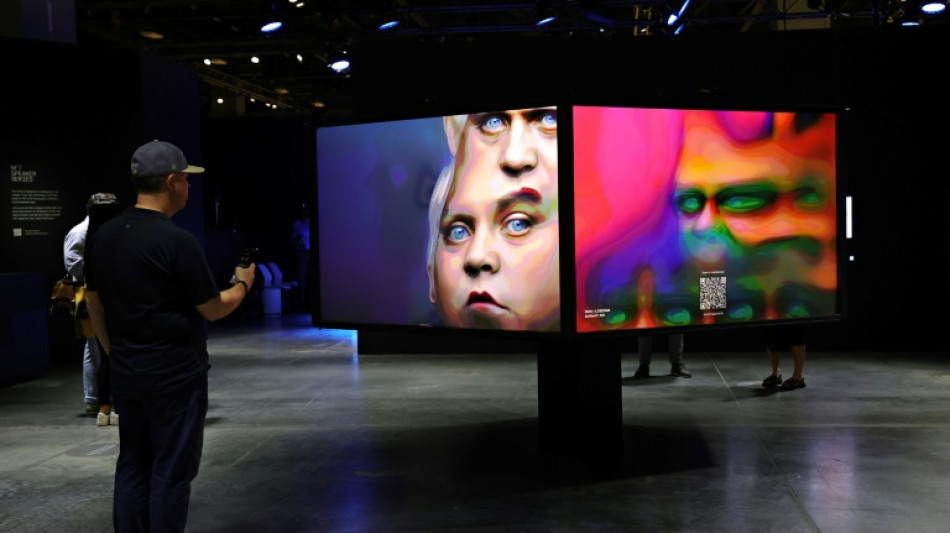
Clickbait or creativity? The art world wrestles with AI / Photo: © GETTY IMAGES NORTH AMERICA/AFP/File

 Nothing to seal here: NZ police help stranded pup home

 White House releases list of products US, China could tax less
 'Pseudo-journalism': Partisan 'news' sites target US midterms
 'Currently impossible': North Korea defections in freefall
 Erasmus sizes up 'improved' Wallabies ahead of 2027 World Cup
 Scandal-weary Brazilians to vote as Lula faces Bolsonaro son

 SpaceX aims to put Starship in orbit for the first time
 Pope to speak on united Europe from French border town
 Scheffler makes sportsmanship stand over tee screamer

 Anthropic CEO Amodei to dine with Trump at White House

 Dupont scores twice to send Toulouse to Top 14 summit

 Greece stun Klopp's Germany as Ireland show sorrow for Gaza

 Ramos fires holders Portugal to Nations League win in Norway

 Greece hand Klopp first defeat as Germany manager

 Pope promises French sex abuse victims to prevent further harm

 UK village on edge over threats to air base in terror alert

 Two giant pandas, emblems of China soft diplomacy, arrive in US

 Aleksandar Vucic: from Milosevic minister to long-serving Serbian statesman

 Trump expects new Iran talks despite rejecting deal offer

 Xavi gets first win as Netherlands boss, Denmark beat Wales

 Madrid housing protest camp enters second night as PM vows action

 Tigray TV station hit by drone, rebels advance in north Ethiopia

 Banton hundred paves way for England ODI series win over Sri Lanka

 Milestone man Kohli powers India to big ODI win over West Indies

 Swiss reject plan to toughen neutrality

Online tools that can create wonderful, absurd and sometimes horrifying images using artificial intelligence (AI) have exploded in popularity, sparking soul-searching over the nature of art.
Tech companies tout their inventions as a liberating force of art for all, but purists argue that the artist is still the central cog in the machine.
Art historian and AI expert Emily L. Spratt, whose forthcoming book tackles the ethics and regulation of AI art, told AFP that the art world has not yet found a response to the potentially transformative technology.
Are we all artists now?
Punch a few keywords into an AI art tool -- something like "Brad Pitt in a rowing boat in space in the style of Mondrian" -- and seconds later boldly coloured line drawings will emerge of the Hollywood star, paddling in the stars.
There are plenty of fans of tools like Midjourney, Stable Diffusion and DALL-E 2 who have proclaimed this as the democratisation of art.
But Spratt reckons such tools are more about "entertainment and clickbait" than art.
"It is a way to foster engagement with platforms, which is of course going to help these companies," she said.
"The idea that it is solely a tool of empowerment or that it will democratise the space is overly simplistic -- it's naive."
Rather, she sees the boundary between AI and other technology becoming blurred, pointing to the image manipulation programs already widely used.
"I see the future of AI as being part of the omnipresent background architecture for all digital image-making processes," she said.
"It will be hard to avoid it because it seeps into all of our digital interactions, often unbeknownst to us, especially when we create, edit, or search images."
Are there AI masterpieces?
Beyond the simple online tools that anyone can use, there are plenty of artists labouring over their own algorithms with bespoke datasets.
These works sell for tens of thousands, sometimes hundreds of thousands.
A standout practitioner, said Spratt, is German artist Mario Klingemann whose "Hyperdimensional Attraction Series, Bestiary" is a high point of the genre.
"It is a video of seemingly organic forms that morph from one physical entity to another and momentarily appear as recognisable animals," she said.
"Honestly, it's a bit unnerving but it works well as a commentary on the dividing lines between the material and immaterial and the limits of generative AI to replicate the natural world."
She said his art is constantly asking questions about AI as a medium, and more widely about the nature of creativity.
What does art world make of AI?
Until relatively recently, there was very little buzz around AI outside of video installations, largely because there was no bank of digital images with clear labels.
Without the source material, there could be no AI art as we know it today.
That changed a decade ago when several projects began to supply huge quantities of digital images, sparking an explosion in creativity.
A French collective called Obvious sold a work for more than $400,000 in 2018 after keenly embracing the idea that the AI "created" the work.
That sale became hugely controversial after it emerged that they had used an algorithm written by artist and programmer Robbie Barrat.
"The reason that the Obvious artwork sold, especially at that price, was largely because it was advertised as the first AI artwork to be offered at a major auction house," said Spratt.
"It was really the art market experimenting with the offering of an AI artwork in step with long-established approaches to the sale of fine art."
At that moment, she said, there was huge interest in bringing together the tech sector and the art world.
But the tech industry has since been hit by a dramatic economic slump and investment and interest have waned.
Major auction houses like Christie's and Sotheby's have since worked hard to create separate platforms for selling AI art.
"It's like they don't want to sully fine art with these new digital explorations," Spratt said.
And critics are yet to catch up with the field and really express what is good, bad or indifferent, she reckoned.
"Unfortunately, the AI art discourse is not there yet, but I think it is on its way, and it should come from the field of art history," she insisted.
K.Thomson--BTB
