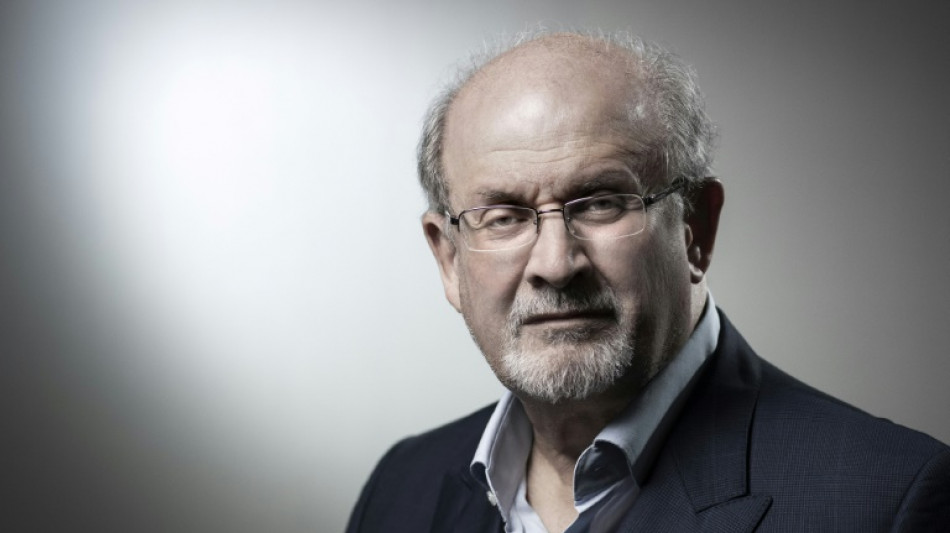
Rushdie says 'very difficult' to write after stabbing / Photo: © AFP/File

 Nothing to seal here: NZ police help stranded pup home

 White House releases list of products US, China could tax less

 'Pseudo-journalism': Partisan 'news' sites target US midterms

 'Currently impossible': North Korea defections in freefall

 Erasmus sizes up 'improved' Wallabies ahead of 2027 World Cup

 Scandal-weary Brazilians to vote as Lula faces Bolsonaro son

 SpaceX aims to put Starship in orbit for the first time
 Pope to speak on united Europe from French border town

 Scheffler makes sportsmanship stand over tee screamer

 Anthropic CEO Amodei to dine with Trump at White House

 Dupont scores twice to send Toulouse to Top 14 summit

 Greece stun Klopp's Germany as Ireland show sorrow for Gaza

 Ramos fires holders Portugal to Nations League win in Norway

 Greece hand Klopp first defeat as Germany manager

 Pope promises French sex abuse victims to prevent further harm

 UK village on edge over threats to air base in terror alert

 Two giant pandas, emblems of China soft diplomacy, arrive in US

 Aleksandar Vucic: from Milosevic minister to long-serving Serbian statesman

 Trump expects new Iran talks despite rejecting deal offer

 Xavi gets first win as Netherlands boss, Denmark beat Wales

 Madrid housing protest camp enters second night as PM vows action

 Tigray TV station hit by drone, rebels advance in north Ethiopia

 Banton hundred paves way for England ODI series win over Sri Lanka
 Milestone man Kohli powers India to big ODI win over West Indies
 Swiss reject plan to toughen neutrality
British author Salman Rushdie has said he finds it "very difficult" to write after being stabbed in New York last year, in his first interview since the attack.
Rushdie told the New Yorker, in an article published Monday, that the stabbing on stage at an event had left him with mental scars.
"There is such a thing as PTSD you know," the 75-year-old said.
"I've found it very, very difficult to write. I sit down to write, and nothing happens. I write, but it's a combination of blankness and junk, stuff that I write and that I delete the next day. I'm not out of that forest yet, really," Rushdie added.
The award-winning novelist was attacked as he was about to speak at a conference in Chautauqua in upstate New York, near Lake Erie, on August 12.
Rushdie, a naturalized American who has lived in New York for 20 years, lost sight in one eye and the use of one hand, his agent said in October.
The author told journalist David Remnick that he was not able to type very well because of a lack of feeling in some fingertips.
"As you can see, the big injuries are healed, essentially. I have feeling in my thumb and index finger and in the bottom half of the palm. I'm doing a lot of hand therapy, and I'm told that I'm doing very well," Rushdie said.
"I've been better. But, considering what happened, I'm not so bad," he added.
Rushdie lived in hiding for years after Iran's first supreme leader Ayatollah Ruhollah Khomeini ordered his killing for what he deemed the blasphemous nature of "The Satanic Verses," published in 1988.
The author was asked whether he thought it had been a mistake to let his guard down in recent decades.
"I'm asking myself that question, and I don't know the answer to it," Rushdie said.
"Three-quarters of my life as a writer has happened since the fatwa. In a way, you can't regret your life," he added.
Hadi Matar, a 24-year-old from New Jersey with roots in Lebanon, was arrested immediately after the attack and subsequently pleaded not guilty to the charges.
"I blame him," said Rushdie, when asked who he thought was responsible.
The article was published ahead of the US release Tuesday of Rushdie's newest novel, "Victory City."
It is about a 14th-century woman who defies a patriarchal world to rule a city and was written before the attack.
K.Brown--BTB