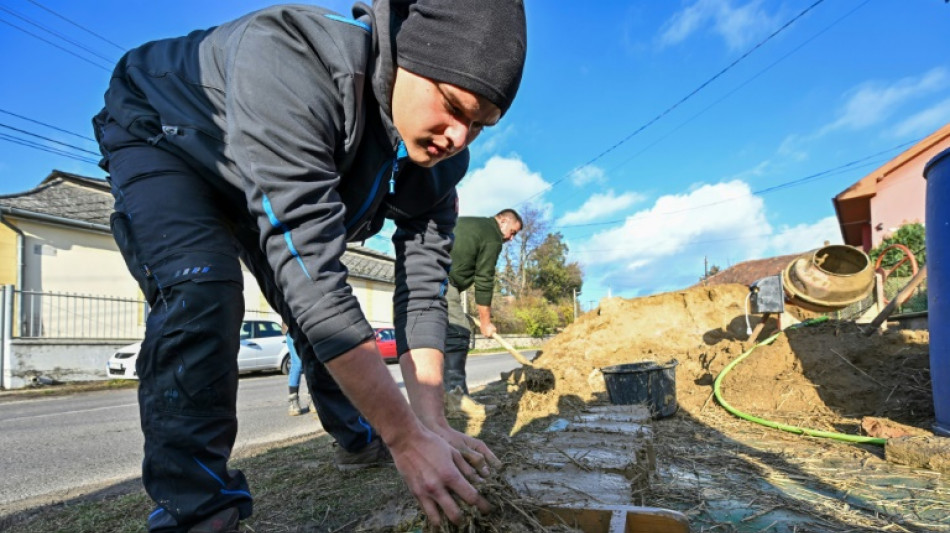
Eco-friendly mud houses make comeback in Hungary / Photo: © AFP

 Messi and Alcaraz love it, now padel takes step closer to Olympics

 Tolls mount in Thailand, Myanmar floods

 Why India's opposition wants top poll official out

 PU Prime Strengthens UAE Momentum with Strong Showing at Forex Expo Dubai 2026

 Eight dead in Thailand floods since mid-September

 Oil prices spike after Trump rejects Iran truce offer

 Taylor Swift sets new record at MTV VMAs
 Seoul seeks apology after Ukraine reveals transfer of North Korean POWs

 Messi on target again but Miami downed by Columbus

 In Washington's political cauldron, a fight over foie gras

 Flavio Bolsonaro: political heir in his father's shadow

 Ravens grab last-second win in Rio as Commanders stop Seahawks

 USA rallies to capture 11th consecutive Presidents Cup

 Phillies clinch, Astros wrap up division on final day of MLB season

 Commanders hand champion Seahawks their first loss

 Dupont scores twice to send Toulouse top of Top 14

 Ireland beat Israel but no handshakes due to war in Gaza

 Tense standoff over flashpoint N.Ireland parade lasts into night

 Stunned McNulty wins 'miracle' road race world title

 Re-released 'Avengers: Endgame' snaps-up N. America box office lead

 American McNulty wins shock road race world title

 Serbia's President Aleksandar Vucic announces resignation

 Tuchel urges Bellingham to play with 'rage'

 Russian strikes on Ukraine kill 8

 Bavuma, Miller hit centuries as South Africa clinch series

They were long derided as old-fashioned symbols of grinding poverty, but mud and straw houses are making a comeback in Hungary as a low-cost, eco-friendly alternative to concrete.
Master builder Janos Gaspar, who renovates earth houses, is worked off his feet.
"I'm booked up for three years. Interest is sky-high," the 48-year-old -- who has built more than 200 clay houses -- told AFP.
Known as rammed earth construction, the practice dates to Neolithic times.
And it is seeing a revival thanks to its tiny ecological footprint and energy efficiency.
Locally accessible materials is the basis of what Gaspar's architect colleague Adam Bihari calls "natural architecture".
"Hungarians knew how to build houses from what they had to hand or under their feet," said the bespectacled Bihari as a clay brick wall was plastered with mud in the town of Acs in northwest Hungary.
"This wall was made 100 years ago, and should be around for another 100," said Bihari.
- 'Material of future' -
In contrast to concrete, which accounts for about eight percent of global CO2 emissions, "it eventually disintegrates naturally, leaving no artificial waste behind," he said.
With Gaspar, Bihari teaches his methods to scores of trainees every year. In the yard beside piles of sandy earth and straw, a dozen watched Gaspar demonstrate how to make mud bricks.
"This type of soil is perfect, and it's found everywhere around Hungary," said Gaspar as a cement mixer churned the ingredients into a mulch.
"You can make one brick a minute, and around 20,000 will make a house," he told the group while kneading handfuls of the mixture into a wooden mould.
The centuries-old practice fell out of fashion during the country's four-decade-long communist era.
"Folk traditions were officially frowned upon and modern materials took over," said Bihari, 33.
Clay brick walls were often cemented over which caused rot as dampness got trapped, he added.
More than one in seven Hungarians still live in earth-built homes, mostly in villages in poorer regions.
Bihari said it is hard to counter long-held associations with damp and poverty.
But interest in natural materials is increasing among developers and investors, according to the architect.
"It is the building material of the future," he said.
- 'Naturally smart' -
Bihari said clay's thermal properties make it ideal for Hungary's fluctuating climate of hot summers and cold winters.
One of the camp participants, Timea Kiss, who already owns a clay house but wants to learn how to renovate it, said her building is naturally warm in winter and cool in summer.
"Amazed visitors ask us where the air conditioning is, but there is none," said the 42-year-old.
Earth homes also regulate their own humidity, said Bihari, which can help people with asthmatic problems. They are also fireproof and non-toxic.
"You hear about 'smart' houses and even smart bricks," said Bihari. "But for me that is nonsense... clay is naturally smart."
Rising energy costs is another push factor behind the growing popularity of earth houses.
Several of the trainees in Acs told AFP they can no longer afford to build or buy conventional houses.
"My wife and I are interested in cheaper solutions like this, it's a bonus that it's good for the environment," said truck driver Zsolt Cserepkei, 31.
G.Schulte--BTB