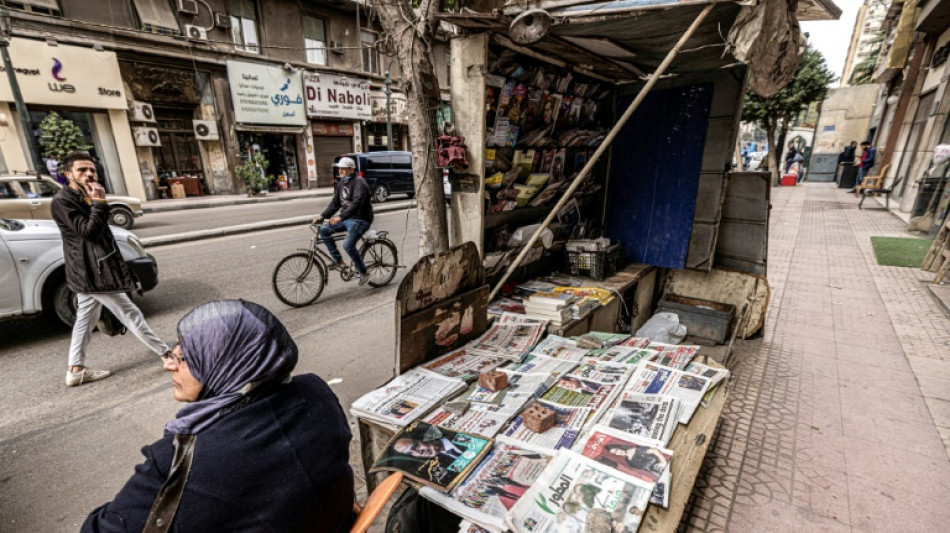
Cairo's newspaper vendors go silent as sales collapse / Photo: ©

 Ahead of Paris mass, pope urges life together in 'dignity and peace'

 Austria 'ghetto' language classes leave children to repeat school
 S.African women runners arm themselves after string of killings

 'I felt embarrassed': Japan eSports whizz-kid, 11, wins Games gold

 Indonesia fires threatens critically-endangered orangutan: IUCN

 Bangkok declares flood disaster across city

 'World records not enough': North Korea weightlifters target Olympic gold rush

 Iran proposes Hormuz plan, Trump reportedly refuses
 El Nino rewrites the menu in the world's top restaurants
 Pope to hold giant mass on Champs-Elysees

 TikTok to pay Alabama $100 mn under pre-trial settlement

 Internationals take 7-3 Presidents Cup lead after foursomes sweep

 Brazil team returns to Colombian site of doomed jet crash

 Mbappe injured as Zidane wins on France debut, Italy lose on Mancini return

 Senegal draw in Vieira debut, Nigeria survive scare as Cape Verde crash

 U2 performs surprise 50th anniversary gigs in Dublin

 Pope calls worshippers 'saints of France' after AI warning

 US court sides with Pentagon in Anthropic AI ban

 Wall Street stocks rise, greeting optimism over possible US-Iran deal

 NFL players chief raises concerns over pitch for Maracana game

 Daytime Russian attacks kill seven in Kyiv
 Spotting AI writing: how reliable are the detectors?
 French youth await pope after AI 'paradise of machines' warning
 Man City found guilty of Premier League charges, set to appeal: reports

 Embolo follows Xhaka out of Swiss squad over fake Covid documents
Newspaper sellers were once a dime a dozen on Cairo's bustling streets, but now the vendors hawking hot-off-the-press editions have fallen almost silent.
As elsewhere in the world, Egypt's print media has been in sharp decline as news has moved mostly online and readers tend to stay up-to-date via their smartphones.
In Egypt, a country of 103 million people, the trend has been especially stark since the government, which publishes most newspapers, has also raised their prices.
"No one buys newspapers anymore, especially since they got more expensive," said a vendor in her 50s known as Umm Mohammed, wearing a woollen shawl against the winter chill.
Critics also bemoan the homogeneity of the press in a country tightly ruled by army-marshall-turned-President Abdel Fattah al-Sisi, where censorship and self-censorship are common.
The stacks of newspapers and magazines before Umm Mohammed have hardly shrunk all morning, she said, sitting at her kiosk in Cairo's western Dokki district.
Between 6 am and 3 pm, she said she had earned just 15 Egyptian pounds, or about $1.
The government three years ago raised prices of dailies from two to three pounds, and of weeklies from three to four pounds, citing costlier raw materials and dwindling subscriptions.
This dampened print circulation in the Arab world's largest country, where the average family income is around 6,000 EGP, or $380, per month.
Sales collapsed further last July when the government scrapped evening newspaper print editions.
"People used to come by to get the evening paper and then pick up a couple of other issues on the way," said Umm Mohammed. "Now we don't even have that."
"It's mobile phones everywhere. People passing my kiosk often ask: 'Oh, people are still selling these, even with everything online?'
"That really upsets me. This is our livelihood. What are we supposed to do?"
- 'Need to innovate' -
Microbus driver Tareq Mahmud, 44, stopping near the kiosk, said he hadn't bought a newspaper in 11 years.
"I stopped when I realised that the journalists I was reading in the paper every morning were the same ones I had watched on television" the previous evening, he told AFP.
"And I think there are many like me who stopped around then."
According to official statistics, Mahmud is right: Egypt in 2019 published 67 titles -- public, private or linked to political parties -- down from 142 in 2010.
Circulation roughly halved from more than one million copies to 539,000 over the decade.
Ahmad al-Taheri, editor-in-chief of the Rose al-Youssef weekly, a staple of Egyptian journalism for almost a century, said media need to innovate, including in their distribution.
"We need to find new outlets," he told AFP, suggesting new pandemic-era sales points: "Why not pharmacies?"
- Media in 'sorry state' -
This is hardly a solution for Umm Mohamed, who after 18 years in the business is planning for her retirement.
In the absence of a trade union or other support system, she, like other vendors, recently signed up to a modest pension scheme with state-run publisher the Ahram Foundation.
But even this pension is not guaranteed.
Abdul Sadiq el-Shorbagy, head of the National Press Authority, told parliament in January that the state press is indebted, owing over $573 million in taxes and insurance payments.
Press outlets are bleeding cash as going online has yet to turn a profit for them, with most content offered for free and advertising revenue proving insufficient.
Imad Eddine Hussein, editor-in-chief of the private daily Al-Shorouk, bemoaned the "sorry state" of the press in Egypt.
All front pages tend to look almost identical, reporting on the same presidential speeches or ministerial announcements.
"It's all the same, across every newspaper, so readers are turning away from them," said Hussein. "If it continues like this, it's not just the state press that's going to disappear, private newspapers will too."
R.Adler--BTB