The octogenarian architect working to flood-proof Pakistan

 Dodgers eye three-peat, Red Sox face Yankees as MLB playoffs begin

 Certification of Boeing 737 MAX delayed by software bug

 Celine Dion wows Paris Fashion Week with surprise gig

 AMD buys firm founded by AI 'godmother' Fei-Fei Li

 Italy rebound in Turkey as France win late in Belgium

 Pope says concerns about AI 'should be taken seriously'

 Hurricanes to hoist title banner as NHL season begins

 Justice Alito steps aside from major US climate case

 Willis happy with England exile after retains Top 14 player award

 Spain housing protests keep heat on government as PM seeks new law

 Wissa spoils Zimbabwe homecoming as DR Congo win AFCON qualifier

 UK police release on bail five men held over airbase incident

 Ex-All Black Plummer 'sure' New Zealand will find Super Rugby solution

 Shein sees 1% revenue growth in first half of 2026

 Netherlands regrets Israel retaliation in settlements row

 Moscow seizes Russian assets of German food retailer Metro

 Bulgarian spirits inflamed by new rakia rules

 Documentary turns camera on architect Peter Zumthor

 UK police say releasing on bail five men held over airbase incident

 Trump admin finalizes reversal of US fuel economy standards
 US says no China arms sale plans after envoy cites Trump offer

 Dozens kidnapped in two weekend attacks in northern Nigeria

 Next stop the world: Pathirage wins Asian Games javelin gold

 Aster Launches Perpetual Grid Trading 2.0 with Up to 140,000 $ASTER Liquidity Mining Campaign

 Seoul says North Korean mines 'highly suspected' as cause of DMZ blast

At 82 years old, architect Yasmeen Lari is forging the way in fortifying Pakistan's rural communities living on the frontline of climate change.
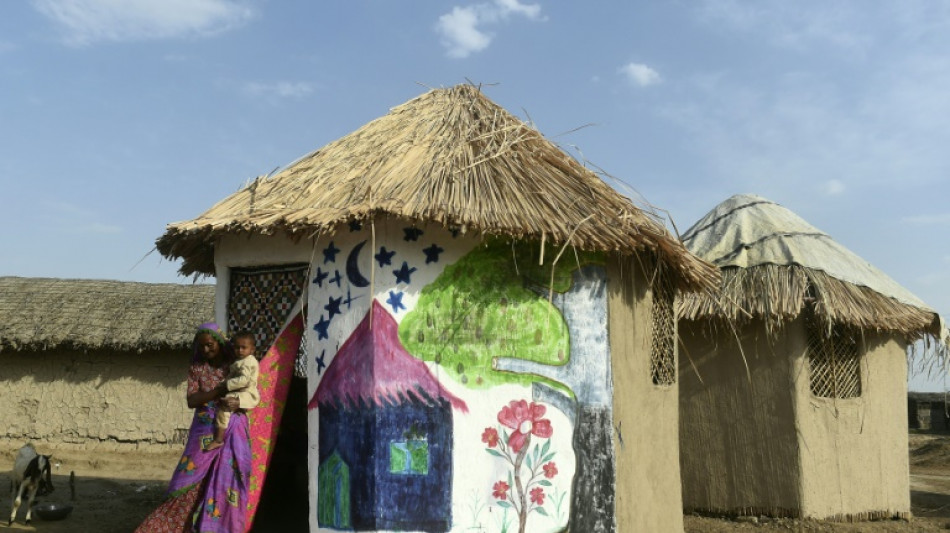
Lari, Pakistan's first woman architect, has ditched a lifetime of multi-million dollar projects in the megacity of Karachi to develop pioneering flood-proof bamboo houses.
The few pilot settlements already constructed are credited with saving families from the worst of the catastrophic monsoon flooding that put a third of the country underwater last year.
"We continued to live in them," said Khomo Kohli, a 45-year-old resident of Pono Colony village, which is a few hundred kilometres outside of Karachi.
"The rest of the residents had to move onto the road where they lived for two months until the water receded."
Now, Lari is campaigning to scale up the project to one million houses made from affordable local materials, bringing new jobs to the most vulnerable areas.
"I call it a kind of co-building and co-creation, because the people have an equal part in embellishing it and making it comfortable for themselves," she said.
The architect, who trained in the United Kingdom, is behind some of Karachi's most notable buildings, including brutalist constructions such as the Pakistan State Oil headquarters, as well as a string of luxury homes.
As she was considering retirement, a series of natural disasters -- including a massive 2005 earthquake and 2010 floods -- stiffened her resolve to continue working with her Heritage Foundation of Pakistan, which manages her rural projects.
"I had to find the solution, or find a way by which I could build up the capacities of people so that they could fend for themselves, rather than waiting for outside help," she told AFP.
"My motto is zero carbon, zero waste, zero donor, which I think leads to zero poverty," she said.
- Traditional techniques -
Climate change is making monsoon rains heavier and more unpredictable, scientists say, raising the urgency to flood-proof the country -- particularly as the poorest live in the most vulnerable areas.
Pakistan, with the world's fifth-largest population, is responsible for less than one percent of global greenhouse gas emissions but is one of the nations most vulnerable to the effects of extreme weather.
Pono Colony, with around 100 houses, was developed just months before catastrophic monsoon rains arrived last summer and displaced eight million people.
The village's elevated homes are protected from rushing water, while their bamboo skeletons -- pierced deep into the ground -- can withstand pressure without being uprooted.
Known locally as "chanwara", the mud huts are an improved take on the traditional single-room houses dotted along the landscape of southern Sindh province and Rajasthan state in India.
They require only locally available materials: lime, clay, bamboo and thatching. With straightforward training to locals, they can be assembled at a cost of around $170 -- around an eighth of the cost of a cement and brick house.
In rural Sindh, tens of thousands of people are still displaced and stagnant water stands in large parts of farmland almost a year after the country's worst-ever floods.
The World Bank and Asian Development Bank in a joint study estimated Pakistan sustained $32 billion in damage and economic losses and would require $16 billion for reconstruction and rehabilitation.
- Royal recognition -
Lari recalls working on social housing in Lahore in the 1970s, when local women pored over her plans and probed her on where their chickens would live.
"Those chickens have really remained with me, the women's needs are really the uppermost when I'm designing," she said.
This time around, the redesign of traditional stoves has become a significant feature -- now lifted off the floor.
"Earlier, the stove would have been on the ground level and so it was immensely unhygienic. The small children would burn themselves on the flames, stray dogs would lick pots and germs would spread," said Champa Kanji, who has been trained by Lari's team to build stoves for homes across Sindh.
"Seeing women becoming independent and empowered gives me immense pleasure," Lari said.
Lari's work has been recognised by the Royal Institute of British Architects, which awarded her the 2023 Royal Gold Medal for her dedication to using architecture to change people's lives.
"An inspirational figure, she moved from a large practice centred on the needs of international clients to focussing solely on humanitarian causes," RIBA president Simon Allford said.
"This is wonderful feeling," Lari said. "But of course it also makes my tasks harder. I have got to make sure that I now deliver."
K.Thomson--BTB