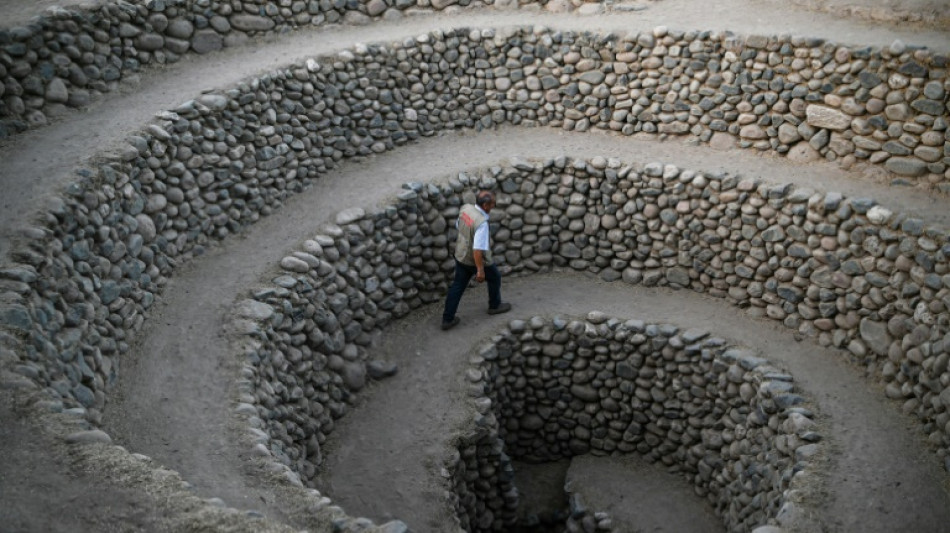
Pre-Hispanic aquaducts irrigate modern Peruvian crops / Photo: © AFP

 Dodgers eye three-peat, Red Sox face Yankees as MLB playoffs begin

 Certification of Boeing 737 MAX delayed by software bug

 Celine Dion wows Paris Fashion Week with surprise gig

 AMD buys firm founded by AI 'godmother' Fei-Fei Li

 Italy rebound in Turkey as France win late in Belgium

 Pope says concerns about AI 'should be taken seriously'

 Hurricanes to hoist title banner as NHL season begins

 Justice Alito steps aside from major US climate case

 Willis happy with England exile after retains Top 14 player award

 Spain housing protests keep heat on government as PM seeks new law

 Wissa spoils Zimbabwe homecoming as DR Congo win AFCON qualifier

 UK police release on bail five men held over airbase incident

 Ex-All Black Plummer 'sure' New Zealand will find Super Rugby solution

 Shein sees 1% revenue growth in first half of 2026

 Netherlands regrets Israel retaliation in settlements row

 Moscow seizes Russian assets of German food retailer Metro

 Bulgarian spirits inflamed by new rakia rules

 Documentary turns camera on architect Peter Zumthor

 UK police say releasing on bail five men held over airbase incident

 Trump admin finalizes reversal of US fuel economy standards

 US says no China arms sale plans after envoy cites Trump offer

 Dozens kidnapped in two weekend attacks in northern Nigeria

 Next stop the world: Pathirage wins Asian Games javelin gold

 Aster Launches Perpetual Grid Trading 2.0 with Up to 140,000 $ASTER Liquidity Mining Campaign

 Seoul says North Korean mines 'highly suspected' as cause of DMZ blast

Built some 1,700 years ago by the pre-Hispanic Nazca people of Peru, an ingenious aqueduct system of wood and stone still provides farmers with water to this day.
The complex labyrinth of channels and pits up to 15 meters (49 feet) deep brings critical drinking and irrigation water from faraway mountains and rivers to about 900 subsistence farming families in the Nazca desert in southern Peru.
In an otherwise arid landscape, they grow potatoes, cotton, vegetables and fruit trees.
"It helps us to irrigate," said farmer Nicolas Quispe, 39, who waters his potatoes from the Nazca aqueduct system "thanks to the ancient farmers who had this advanced technology."
Families like his pay a yearly fee equivalent to about $32 for the supply.
Often hailed as a marvel of ancient hydraulic engineering, the aqueducts have been submitted by Peru to UNESCO for listing as a cultural heritage.
According to the UN body, until the aqueducts were built, the shortage of water in the Peruvian desert hindered human settlement in an area where rivers are dry for most of the year.
"The inhabitants of the Nasca culture managed to use the water from the underground water table through a technological innovation, formed by underground aqueducts that operated through a system of filtering galleries," the UNESCO website explains.
"It is a simple system apparently, but at the same time it is sophisticated."
The system can transport some of 18 to 20 liters of water per second, according to Peruvian authorities.
The aqueducts, 42 in total, are believed to have been built by the same people responsible for Peru's famous Nazca lines -- a series of geometric and animal figures carved into the desert which can only be appreciated from the sky.
The function or meaning of the lines -- a World Heritage Site since 1994 -- remain unclear. Some believe they were for astronomical observation, others that they were part of a calendar.
As for the aqueducts, "we estimate that 29 are still in operation and thanks to this hydraulic system, as you can see, the entire valley is green," government archaeologist Abdul Yalli told AFP.
"This is a work of art, of architecture and of engineering," said Jorge Lopez-Doriga, a spokesman for the AJE Group multinational supporting local authorities in the upkeep of the aqueducts.
"These stone channels, which had required the removal of millions of tons of sand to build, continue to function," he added.
N.Fournier--BTB