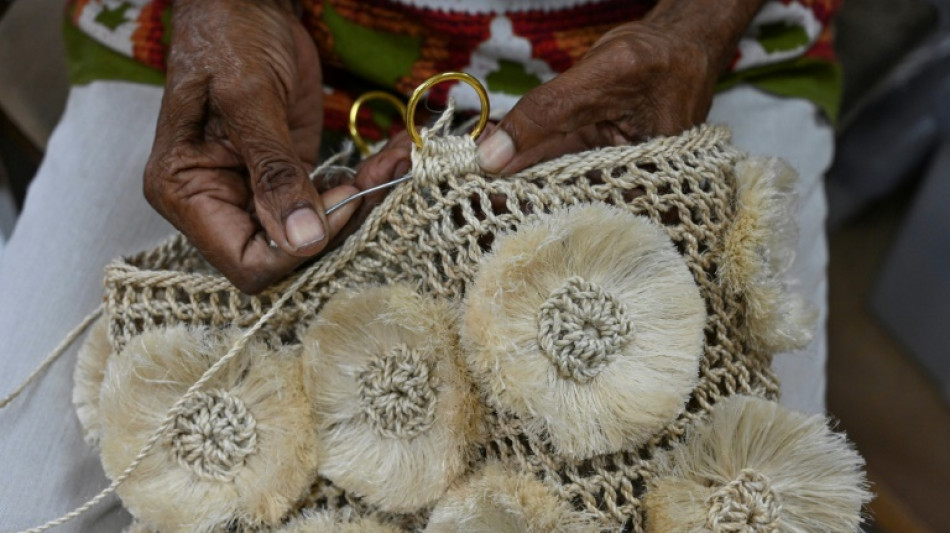
Papua New Guinea women weave their way to a living / Photo: © AFP

 8.3 mn refugees at risk due to 'severe' funding cuts: UN

 Stocks drop and oil rises as Hormuz hopes fade
 OpenAI cancels release of newest model due to safety concerns

 AI bosses head to White House as safety pressure builds
 Batista sacked as Costa Rica coach after six months

 Flooding, power cuts and evacuations as Hurricane Polo slams Mexico

 Dodgers eye three-peat, Red Sox face Yankees as MLB playoffs begin
 Certification of Boeing 737 MAX delayed by software bug

 Celine Dion wows Paris Fashion Week with surprise gig
 AMD buys firm founded by AI 'godmother' Fei-Fei Li
 Italy rebound in Turkey as France win late in Belgium

 Pope says concerns about AI 'should be taken seriously'

 Hurricanes to hoist title banner as NHL season begins

 Justice Alito steps aside from major US climate case

 Willis happy with England exile after retains Top 14 player award

 Spain housing protests keep heat on government as PM seeks new law

 Wissa spoils Zimbabwe homecoming as DR Congo win AFCON qualifier
 UK police release on bail five men held over airbase incident

 Ex-All Black Plummer 'sure' New Zealand will find Super Rugby solution

 Shein sees 1% revenue growth in first half of 2026

 Netherlands regrets Israel retaliation in settlements row

 Moscow seizes Russian assets of German food retailer Metro

 Bulgarian spirits inflamed by new rakia rules

 Documentary turns camera on architect Peter Zumthor
 UK police say releasing on bail five men held over airbase incident

Inside a compound in Papua New Guinea's capital, Betty Nabi is putting six decades of expertise to work, weaving traditional bags that can last a lifetime.
The boutique workshop in Port Moresby hosts a group of women who specialise in intricately lacing plant fibres together to make the roomy pouches known as bilums, a symbol of Indigenous pride.
The word bilum means "womb" in the local Tok Pisin language, and the women are giving the functional handwoven bags new life -- bringing them to an international audience in return for a steady wage in a country where about 40 percent live below the poverty line.
"You can put everything inside," said Nabi, a 70-year-old weaver at Bilum & Bilas, who earns a monthly paycheck of 1,000 Kina ($285), around 50 percent more than the country's minimum wage.
"Go to the store, put the kaikai (food) inside. The big one, you can put the baby."
Bilums can take weeks to make, and are dyed using colours unique to the maker's heritage.
Nabi and the three other weavers each craft up to five bilums a month, attracting customers as far away as Iceland.
- 'Makes us proud' -
Demand is growing, with international customers in North America, Europe and neighbouring Australia increasingly looking for authentic bilums, says supervisor Maureen Charlie, 34.
The bags have also drawn attention from the fashion world, with coverage of the patterned pouches and the techniques used to make them landing in top magazines such as Grazia, Harper's Bazaar and Vogue Australia.
Some are concerned the bag that serves as a pillar of Papua New Guinea culture is being misappropriated by Westerners for fashion and profit.
But the weavers say they have little issue with its export.
"It makes us proud, like, 'Oh yeah, there's something from PNG there'," said Charlie.
"It's special. It's part of who we are and it's part of our culture. We are still doing it, and my children will be doing it."
Bilums are often given to friends and family, or used in welcome rituals, sometimes being laid on the floor in front of guests.
But the women are capitalising on their increasing popularity to stitch together a living for their families and other weavers.
"In villages, women don't have any source of income. Sometimes they don't have time to come to the markets, or road access, so they just weave and store their bilums," said Charlie.
- 'Anytime, forever' -
At the lower end of the market, women in Port Moresby take their wares to stalls in shanty towns, risking the theft of stock in high-crime areas.
"It's a good income for my family. I make bilum and get income to sustain my daily living," said independent weaver Cathy Wariapa, 35, who sells her bags every weekend at a safer spot inside the grounds of a hotel.
"Sometimes we don't sell. When there are no buyers, we just take them back."
The bags are usually made and worn by women like Charlie, but Papua New Guinean men are increasingly donning them as pouches around their neck.
"If a woman doesn't wear a bilum... they say you're not a woman," said Charlie.
"When I carry a bilum, I feel like I'm a woman and I'm from Papua New Guinea."
So weaving the bags handed down to them by their mothers and grandmothers is about more than money.
"We can make bilum anytime, forever," said Betty Nabi.
"We will not stop."
W.Lapointe--BTB