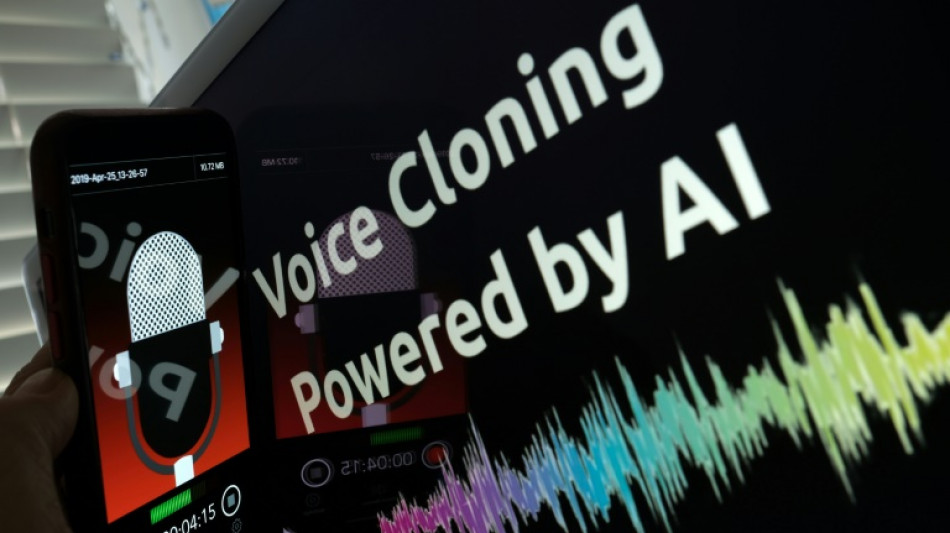
Can you trust your ears? AI voice scams rattle US / Photo: © AFP

 8.3 mn refugees at risk due to 'severe' funding cuts: UN

 Stocks drop and oil rises as Hormuz hopes fade

 OpenAI cancels release of newest model due to safety concerns

 AI bosses head to White House as safety pressure builds

 Batista sacked as Costa Rica coach after six months

 Flooding, power cuts and evacuations as Hurricane Polo slams Mexico

 Dodgers eye three-peat, Red Sox face Yankees as MLB playoffs begin

 Certification of Boeing 737 MAX delayed by software bug

 Celine Dion wows Paris Fashion Week with surprise gig

 AMD buys firm founded by AI 'godmother' Fei-Fei Li

 Italy rebound in Turkey as France win late in Belgium

 Pope says concerns about AI 'should be taken seriously'

 Hurricanes to hoist title banner as NHL season begins

 Justice Alito steps aside from major US climate case

 Willis happy with England exile after retains Top 14 player award

 Spain housing protests keep heat on government as PM seeks new law

 Wissa spoils Zimbabwe homecoming as DR Congo win AFCON qualifier

 UK police release on bail five men held over airbase incident

 Ex-All Black Plummer 'sure' New Zealand will find Super Rugby solution

 Shein sees 1% revenue growth in first half of 2026

 Netherlands regrets Israel retaliation in settlements row

 Moscow seizes Russian assets of German food retailer Metro

 Bulgarian spirits inflamed by new rakia rules

 Documentary turns camera on architect Peter Zumthor

 UK police say releasing on bail five men held over airbase incident

The voice on the phone seemed frighteningly real -- an American mother heard her daughter sobbing before a man took over and demanded a ransom. But the girl was an AI clone and the abduction was fake.
The biggest peril of Artificial Intelligence, experts say, is its ability to demolish the boundaries between reality and fiction, handing cybercriminals a cheap and effective technology to propagate disinformation.
In a new breed of scams that has rattled US authorities, fraudsters are using strikingly convincing AI voice cloning tools -- widely available online -- to steal from people by impersonating family members.
"Help me, mom, please help me," Jennifer DeStefano, an Arizona-based mother, heard a voice saying on the other end of the line.
DeStefano was "100 percent" convinced it was her 15-year-old daughter in deep distress while away on a skiing trip.
"It was never a question of who is this? It was completely her voice... it was the way she would have cried," DeStefano told a local television station in April.
"I never doubted for one second it was her."
The scammer who took over the call, which came from a number unfamiliar to DeStefano, demanded up to $1 million.
The AI-powered ruse was over within minutes when DeStefano established contact with her daughter. But the terrifying case, now under police investigation, underscored the potential for cybercriminals to misuse AI clones.
- Grandparent scam -
"AI voice cloning, now almost indistinguishable from human speech, allows threat actors like scammers to extract information and funds from victims more effectively," Wasim Khaled, chief executive of Blackbird.AI, told AFP.
A simple internet search yields a wide array of apps, many available for free, to create AI voices with a small sample -- sometimes only a few seconds -- of a person's real voice that can be easily stolen from content posted online.
"With a small audio sample, an AI voice clone can be used to leave voicemails and voice texts. It can even be used as a live voice changer on phone calls," Khaled said.
"Scammers can employ different accents, genders, or even mimic the speech patterns of loved ones. [The technology] allows for the creation of convincing deep fakes."
In a global survey of 7,000 people from nine countries, including the United States, one in four people said they had experienced an AI voice cloning scam or knew someone who had.
Seventy percent of the respondents said they were not confident they could "tell the difference between a cloned voice and the real thing," said the survey, published last month by the US-based McAfee Labs.
American officials have warned of a rise in what is popularly known as the "grandparent scam" -– where an imposter poses as a grandchild in urgent need of money in a distressful situation.
"You get a call. There's a panicked voice on the line. It's your grandson. He says he's in deep trouble —- he wrecked the car and landed in jail. But you can help by sending money," the US Federal Trade Commission said in a warning in March.
"It sounds just like him. How could it be a scam? Voice cloning, that's how."
In the comments beneath the FTC's warning were multiple testimonies of elderly people who had been duped that way.
- 'Malicious' -
That also mirrors the experience of Eddie, a 19-year-old in Chicago whose grandfather received a call from someone who sounded just like him, claiming he needed money after a car accident.
The ruse, reported by McAfee Labs, was so convincing that his grandfather urgently started scrounging together money and even considered re-mortgaging his house, before the lie was discovered.
"Because it is now easy to generate highly realistic voice clones... nearly anyone with any online presence is vulnerable to an attack," Hany Farid, a professor at the UC Berkeley School of Information, told AFP.
"These scams are gaining traction and spreading."
Earlier this year, AI startup ElevenLabs admitted that its voice cloning tool could be misused for "malicious purposes" after users posted a deepfake audio purporting to be actor Emma Watson reading Adolf Hitler's biography "Mein Kampf."
"We're fast approaching the point where you can't trust the things that you see on the internet," Gal Tal-Hochberg, group chief technology officer at the venture capital firm Team8, told AFP.
"We are going to need new technology to know if the person you think you're talking to is actually the person you're talking to," he said.
K.Thomson--BTB