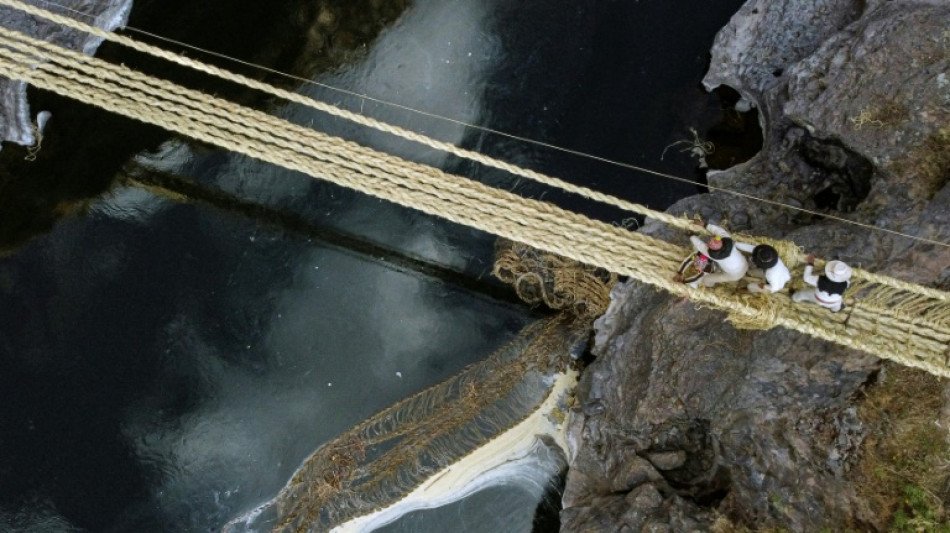
Gravity-defying: revamping an Inca rope suspension bridge / Photo: © AFP

 8.3 mn refugees at risk due to 'severe' funding cuts: UN

 Stocks drop and oil rises as Hormuz hopes fade
 OpenAI cancels release of newest model due to safety concerns

 AI bosses head to White House as safety pressure builds

 Batista sacked as Costa Rica coach after six months
 Flooding, power cuts and evacuations as Hurricane Polo slams Mexico

 Dodgers eye three-peat, Red Sox face Yankees as MLB playoffs begin

 Certification of Boeing 737 MAX delayed by software bug

 Celine Dion wows Paris Fashion Week with surprise gig

 AMD buys firm founded by AI 'godmother' Fei-Fei Li

 Italy rebound in Turkey as France win late in Belgium

 Pope says concerns about AI 'should be taken seriously'

 Hurricanes to hoist title banner as NHL season begins

 Justice Alito steps aside from major US climate case

 Willis happy with England exile after retains Top 14 player award

 Spain housing protests keep heat on government as PM seeks new law

 Wissa spoils Zimbabwe homecoming as DR Congo win AFCON qualifier

 UK police release on bail five men held over airbase incident

 Ex-All Black Plummer 'sure' New Zealand will find Super Rugby solution

 Shein sees 1% revenue growth in first half of 2026
 Netherlands regrets Israel retaliation in settlements row

 Moscow seizes Russian assets of German food retailer Metro

 Bulgarian spirits inflamed by new rakia rules

 Documentary turns camera on architect Peter Zumthor

 UK police say releasing on bail five men held over airbase incident

Dangling over a vertiginous gorge, the Apurimac River flowing around 10 stories below, Indigenous Peruvians show no fear as they repair a centuries-old Inca rope suspension bridge -- the world's last.
Every June, members of the Quechua Indigenous group come together to braid thick ropes made from a type of Andean straw, then brave the chasm without harnesses to replace worn parts of the Q'eswachaka bridge.
It is a ritual that connects communities to one another but also to their ancestors, according to Quechua belief.
"It is a matter of pride for us to (renovate) this bridge," Braulio Huilca, a 34-year-old student told AFP of his role in the annual rite.
Inscribed on UNESCO's list of Intangible Cultural Heritage 10 years ago, the bridge has become a key tourist attraction and source of income in the Peruvian region of Cusco -- also home to the Inca citadel of Machu Picchu.
"If we abandon this, the tradition would be lost, and there would... be no income," said Felipe Hanampa Huamani, 40.
- Jealous mermaids -
The bridge, made of fibers obtained from q'oya, a straw-like plant, was first built about 600 years ago.
Nearly 30 meters (100 feet) long and 1.2 meters wide, it hangs over a gorge around 28 meters deep.
For several weeks every year, residents of four towns in the province of Canas gather and prepare straw for rope-making.
With sickles, women in multi-colored skirts cut the q'oya and gather it in bundles that are soaked in a well and then crushed with stone.
They then braid the ropes, sitting in groups on the side of a dusty road.
Within hours, they have made thick ropes that men carry on their shoulders along winding paths and steep steps up to the bridge.
"If we don't renew it, (god) punishes us. We could have an accident or something could happen to us," said 54-year-old Emperatriz Arizapana Huayhua, a small-scale farmer in the region involved in rope production.
Crucial in the initial phases of the operation, women are not allowed to take part in the final steps: according to local beliefs, the mermaids of the river are jealous.
- Animal sacrifice -
To guarantee that "no accident happens during the reconstruction," a shaman sacrifices a lamb to the gods as part of the ritual.
As men in "chullos" -- colorful woollen caps with earmuffs -- tear down the old structure, worn and blackened braids plummet into the Apurimac river.
The hanging bridge has several thick ropes that serve as a platform, with two more for holding on on either side.
The replacement of the old ropes takes three days. Some of the workers chew coca leaves for energy.
There is a narrow metal bridge next to the rope structure that communities also use for trade and transport.
The work is finished when the two groups working from either side of the gorge meet in the middle.
Cries of "Haylly Q'eswachaka!" are heard in Quechua, signalling that the time has come for the celebratory festival.
Next year, they will do it all over again.
C.Meier--BTB