Ancient Egypt artists altered their work, study shows / Photo: © AFP

 Ruthless An makes history to retain Asian Games badminton crown
 Australian central bank lifts key interest rate to 15-year high

 Polo makes landfall in Mexico as Category 3 hurricane

 South Korea team latest to be bussed to wrong Asian Games venue
 Bears thrash Eagles 27-7 as third-string QB Keenum shines
 All Blacks name veteran Taylor captain as Mo'unga seizes 10 jersey

 Race against time as Asian Games cricket quarter-finals washed out

 India turns to corals and seagrass to shield against rising seas

 Manchester City's Premier League charges: What comes next?

 Brazil's cellphone crime: a security nightmare in every pocket

 Russia pummels Kyiv in latest deadly attack
 Akkodis and Biolevate Partner to Accelerate AI-Powered Scientific, Regulatory and Technical Documentation in Highly Regulated Industries

 Dodgers eye three-peat, Red Sox face Yankees as MLB playoffs begin
 Certification of Boeing 737 MAX delayed by software bug
 Celine Dion wows Paris Fashion Week with surprise gig
 AMD buys firm founded by AI 'godmother' Fei-Fei Li
 Italy rebound in Turkey as France win late in Belgium

 Pope says concerns about AI 'should be taken seriously'
 Hurricanes to hoist title banner as NHL season begins
 Justice Alito steps aside from major US climate case

 Willis happy with England exile after retains Top 14 player award

 Spain housing protests keep heat on government as PM seeks new law

 Wissa spoils Zimbabwe homecoming as DR Congo win AFCON qualifier
 UK police release on bail five men held over airbase incident

 Ex-All Black Plummer 'sure' New Zealand will find Super Rugby solution

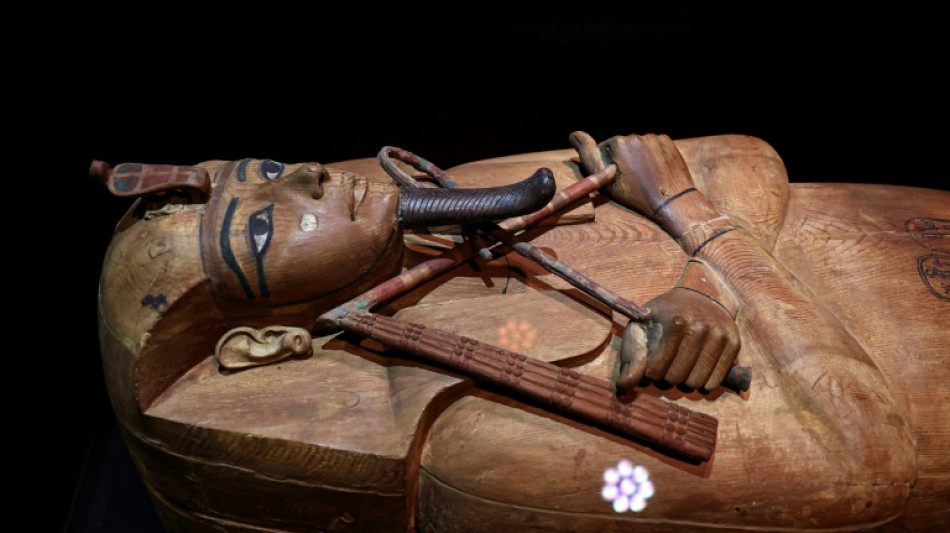
From subtly shifting the position of Ramses II's sceptre, to touch-ups on a necklace or headdress, ancient Egyptian artists were more creative than previously thought, according to a study published Wednesday.
Using new portable imaging and chemical analysis techniques, an international team of scientists took a fresh look at paintings in the Valley of the Kings -- a royal burial ground for pharaohs and other ancient Egyptian elites.
Egyptologists have until now considered art in these tombs to be very conventional, adhering to certain rules and using predefined patterns which were transferred onto walls.
However, a small robot moving in front of the painted walls used X-ray, ultraviolet, and infrared vision to "scrutinize" the art in-depth, much like a medical scanner, said Philippe Walter of the French centre for scientific research, CNRS, a co-author of the study published in the PLOS One journal.
On an image of Ramses II, decorating the tomb of the priest Nakhtamon, painted some 1,200 years BCE, the pharaoh is depicted in profile, wearing a necklace and headdress and holding a royal sceptre.
However image analysis revealed a different composition, hinting at efforts to touch up the original work.
"We didn't expect to see such modifications of a supposedly very formal representation of a pharaoh," meant to be frozen in time, said Walter.
Similar alterations were found on the tomb of the nobleman Menna, depicted with his arms stretched out towards the god of the dead, Osiris.
Analysis showed the position of one of the arms had been moved, while changes were made in the pigments used for skin colour.
It is unclear how many years passed between the alterations, or why they were carried out, but the scientists said it showed evidence of "freedom of creation."
Walter compared this "personal touch" to that seen from "the great painters of the Renaissance," who were shown to make adjustments to their work.
Philippe Martinez, the other co-author of the study with the CNRS, said that if this practice was shown to be commonplace, it would bring pharaonic art closer to our "modern aesthetic standards, nourished by Greco-Roman art".
M.Odermatt--BTB