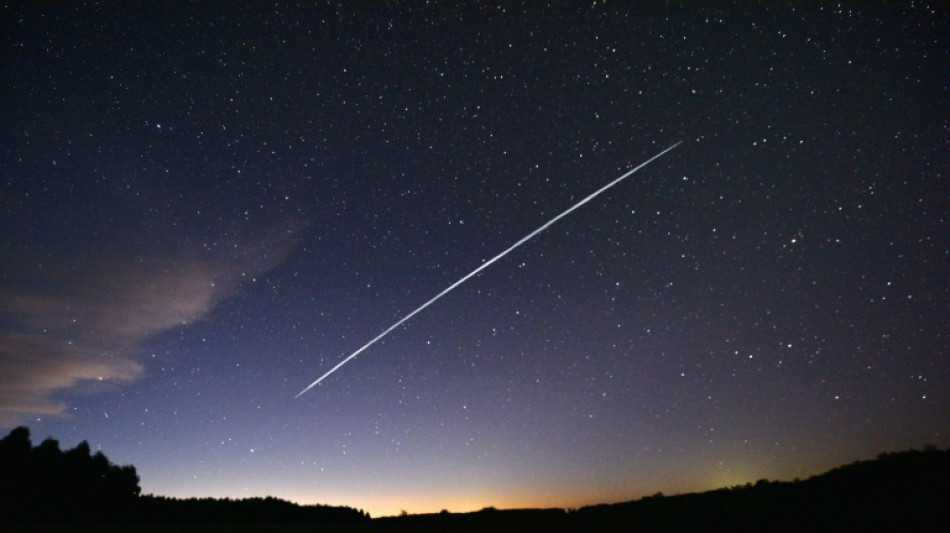
Uncertainty as internet reaches remote Amazon / Photo: © AFP/File

 Slovenia sees surge in '.si' sites after Trump hypes 'super intelligence'

 'Like a dream' for An as Games organisers 'sorry' for latest mix-up
 Tokyo suffers longest streak of rainy days on record

 Indonesia charges train driver over crash that killed 16 women
 Ruthless An makes history to retain Asian Games badminton crown

 Australian central bank lifts key interest rate to 15-year high
 Polo makes landfall in Mexico as Category 3 hurricane
 South Korea team latest to be bussed to wrong Asian Games venue

 Bears thrash Eagles 27-7 as third-string QB Keenum shines
 All Blacks name veteran Taylor captain as Mo'unga seizes 10 jersey
 Race against time as Asian Games cricket quarter-finals washed out
 India turns to corals and seagrass to shield against rising seas

 Manchester City's Premier League charges: What comes next?

 Brazil's cellphone crime: a security nightmare in every pocket

 Russia pummels Kyiv in latest deadly attack
 fiskaltrust launches e-invoicing across Europe

 NFL Giants obtain QB McCarthy from Vikings

 Deal for evicted Spanish pensioner as PM seeks new housing law

 Clippers apologize, warn fans of 'challenges' after Leonard scandal

 Turkish comedian convicted for Erdogan 'insult' freed pending appeal

 Trump announces 'biggest' US steel plant in battleground Iowa

 Olise wonder strike gives Zidane's France win in Belgium

 US stocks fall, bond yields rise as Middle East war drags on

 Trump denies offering to sell arms to China's Xi

 Wemby ready for NBA Spurs to move rivals in climb to top

Covered in tattoos resembling jaguar spots, an Indigenous man connects to TikTok for the very first time from a previously off-the-grid village deep in the Amazon.
He bursts out laughing at a video entitled: "If I were rich."
The man and other members of the Matses Indigenous group have just made a massive leap into modernity with the arrival of Elon Musk's Starlink satellite internet.
Their village of Nova Esperanca in the Javari Valley, a settlement of some 200 people, is more than 500 kilometers (310 miles) or three days by canoe from the closest town.
But now, they are instantly connected to the outside world by a massive solar-powered antenna perched on the roof of the only school in this area of northwest Brazil, near the borders with Peru and Colombia.
The Matses are one of seven Indigenous groups in Javari, Brazil's second-biggest Indigenous reserve, to have had contact with outsiders.
About another 19 groups remain off grid -- unfound or in voluntary isolation in the area of 8.5 million hectares (21 million acres).
The Matses are a nomadic, warrior tribe, which entered into communication with the modern world in the 1970s. Today, they still hunt and fish, as well as wear facial ornaments made of bone and ivory, despite having adopted Western attire. The eldest among them have facial tattoos.
But change is afoot.
On the day the antenna was installed, those with mobile phones -- mostly teens -- connected to TikTok, YouTube and sent voice messages on WhatsApp.
Among the converts was Bene Mayuruna, president of the General Organization of the Matses People (GMO) based in Atalaia do Norte, the nearest town.
Thanks to the internet, he will now be able to keep in touch with people in the region's dozens of villages without having to make long trips by motorboat, he told AFP.
"Nova Esperanca... is very far away, access is difficult, communication too," he said.
- Education and health -
The municipality of Atalaia do Norte financed the installation of the network at Nova Esperanca as part of a broader initiative that could revolutionize life for inhabitants of remote populations but also risks changing their traditional culture.
The council, which pays the subscription fees, has plans to expand the system to another 60-odd villages -- some 6,000 people.
For Cesar Mayuruna, the sole Indigenous councilor of Atalaia do Norte, the goal is above all to improve education.
"Now we have dreams for the future: to be able to train civil engineers, geologists, architects, lawyers, nurses..." Mayuruna -- a name that is common in the region -- told AFP.
The internet should also improve the response to health emergencies, often snake bites.
"Sometimes the (two-way) radio doesn't work, there's no battery, no solar panel... So this is a big step forward," said Fabio Rodrigues, a nurse with the SESAI health network that serves the community.
On the banks of the Javari River where illegal fishermen and miners, drug traffickers and pirates regularly attack locals, there are hopes Starlink will also improve security, even though the criminals, too, are known to employ the SpaceX satellite technology.
- Cultural concerns -
Some in Nova Esperanca, especially among the older generation, have concerns.
The antenna was barely installed before the elders called an emergency meeting.
They decided that after dark, the internet will be cut off for everyone except teachers, health workers and village leaders.
The same will apply on days of collective work, hunting, fishing or rituals.
"The internet means that young people are not interested in traditional activities, they are not helping their mothers," said Bene Mayuruna.
"When the mother does an activity, like gardening, she calls and they don't come because of the cellphone, because they are watching videos. This is worrying, isn't it?" he concluded.
T.Bondarenko--BTB