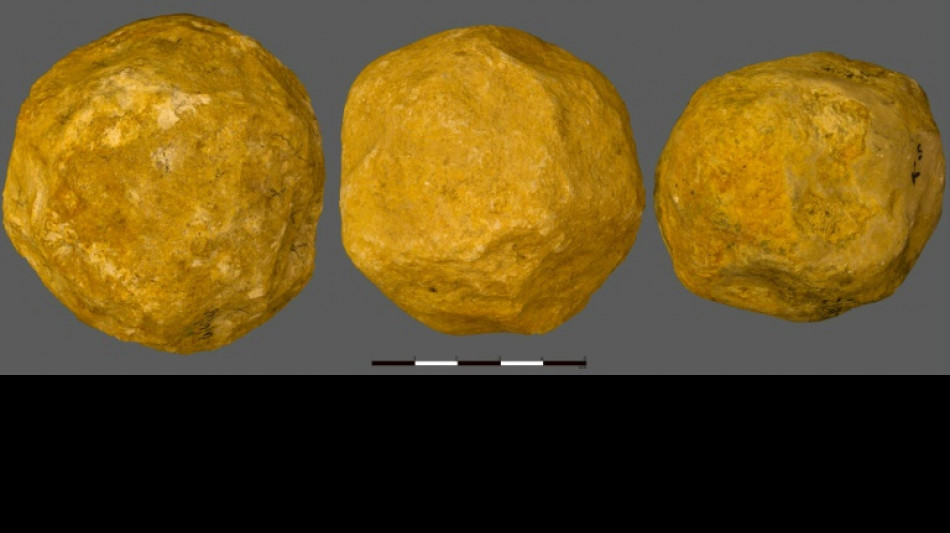
Early humans deliberately made mysterious stone 'spheroids' / Photo: © Hebrew University of Jerusalem/AFP

 Spain to cap gas price hikes, extend fuel discounts

 'We just need rain': Germany's Rhine river hits new low

 Yemen health system at 'breaking point': WHO

 Ireland undecided on second Israel match: coach

 France's Le Pen defiant after top ally hit by antisemitism claims

 Tom Cruise trades stunts for satire as toxic tycoon 'Digger'

 MEXC Unveils "WE SEE YOU" Brand Visual Refresh, Putting People Behind Every Trade in Focus

 Thai capital cleans up after deadly floods

 NATO, EU allies rally to Estonia after 'sabotage' blamed on Russia
 Families demand justice for Cameroon's 'nightmare' wave of murdered women

 Tebas says Man City should face 'most severe' sanctions if guilty of rule breaches

 Pochettino calls Man City success 'a period of deception'

 Settler attack on West Bank village injures Israeli forces, drawing rare rebuke

 Mystery over UK airbase scare after reports no explosives found

 Spanish govt races to adopt housing law under protest pressure

 Estonia slams Russian 'sabotage' after arson attack on defence company

 Slovenia sees surge in '.si' sites after Trump hypes 'super intelligence'

 'Like a dream' for An as Games organisers 'sorry' for latest mix-up

 Tokyo suffers longest streak of rainy days on record

 Indonesia charges train driver over crash that killed 16 women

 Ruthless An makes history to retain Asian Games badminton crown

 Australian central bank lifts key interest rate to 15-year high

 Polo makes landfall in Mexico as Category 3 hurricane

 South Korea team latest to be bussed to wrong Asian Games venue

 Bears thrash Eagles 27-7 as third-string QB Keenum shines

The early ancestors of humans deliberately made stones into spheres 1.4 million years ago, a study said on Wednesday, though what prehistoric people used the balls for remains a mystery.
Archaeologists have long debated exactly how the tennis ball-sized "spheroids" were created.
Did early hominins intentionally chip away at them with the aim of crafting a perfect sphere, or were they merely the accidental by-product of repeatedly smashing the stones like ancient hammers?
New research led by the Hebrew University of Jerusalem suggests that our ancestors knew what they were doing.
The team of scientists examined 150 limestone spheroids dating from 1.4 million years ago which were found at the 'Ubeidiya archaeological site, in the north of modern-day Israel.
Using 3D analysis to reconstruct the geometry of the stones, the researchers determined that their sphericalness was "likely to have been produced intentionally".
The early hominins -- exactly which human lineage they belonged to remains unknown -- had "attempted to achieve the Platonic ideal of a sphere", they said.
While the spheroids were being made, the stones did not become smoother, but did become "markedly more spherical," said the study in the journal Royal Society Open Science.
This is important because while nature can make pebbles smoother, such as those in a river or stream, "they almost never approach a truly spherical shape," the study said.
Julia Cabanas, an archaeologist at France's Natural History Museum not involved in the research, told AFP that this means the hominins had a "mentally preconceived" idea of what they were doing.
That in turn indicates that our ancient relatives had the cognitive capacity to plan and carry out such work.
Cabanas said the same technique could be used on other spheroids. For example, it could shed light on the oldest known spheroids, which date back two million years and were found in the Olduvai Gorge of modern-day Tanzania.
But exactly why our ancestors went to the effort of crafting spheres remains a mystery.
Possible theories include that the hominins were trying to make a tool that could extract marrow from bones, or grind up plants.
Some scientists have suggested that the spheroids could have been used as projectiles, or that they may have had a symbolic or artistic purpose.
"All hypotheses are possible," Cabanes said.
"We will probably never know the answer."
M.Odermatt--BTB