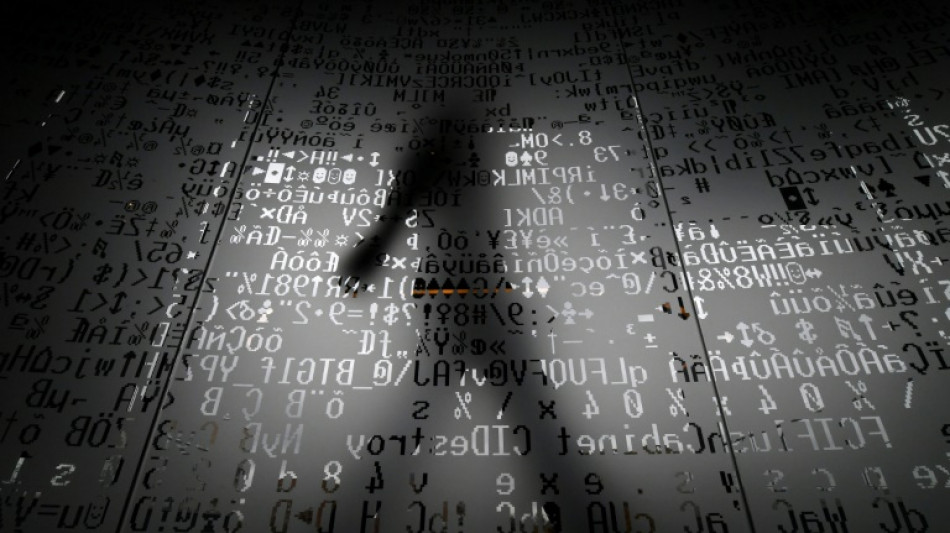
The battle to keep Russia's internet free / Photo: ©

 Man City could face 'drastic' sanctions after reported guilty verdict: ex-chairman

 Furious Fury says row between rival promoters could scupper Joshua bout
 'Invincible' 223cm teen basketball player stars as China win bronze

 Tenth woman found dead in South Africa's string of killings
 Japan schoolboy, 11, wins gold while empty seats blight Asian Games
 Japan organisers 'not satisfied' as empty seats blight Asian Games

 Canals full, roads submerged as Bangkok declares flood disaster

 China, US to open AI 'communication channel' after summit

 Nepal tunnel survivor wants to help post-flood rebuild
 New China sprint star, 17, vows 'no limits' after Asian Games gold
 Japanese 11-year-old wins Asian Games eSports gold

 TikTok agrees to teen limits in US settlement following Meta
 Venezuela's oil cradle pins hopes on US energy deals

 US, China buy time with trade truce as pressure builds

 'Leo, Leo': Young Catholics give pope rockstar welcome in France

 Lula bans sports betting days ahead of Brazil's election

 Guatemala ensures survival of vulnerable 'fossil' fish

 Mancini finds positives in Italy loss, accepts fans' jeers

 Alcaraz helps Europe into Laver Cup lead
 Six missing after building collapses in historic Athens district

 Mbappe scores but suffers knee injury as Zidane gets debut France win

 Mancini's Italy return spoiled by Belgium defeat

 Rodri confident in Man City innocence despite reported charges

 Jay-Z rape accuser says she made 'false accusations'

 Senegal draw first match under Vieira and Nigeria survive scare
Western powers have seized the yachts of Russian oligarchs and booted Russian banks out of the international system in response to the Ukraine invasion, but sanctions that limit access to the internet are proving highly divisive.
Ukraine has called loudly for a widespread boycott and Kyiv has even pushed for Russia to be cut off from the world wide web.
International sanctions have seen companies including big tech firms halt operations in Russia, and EU bans on Russian state media outlets have prompted the Kremlin to ban platforms including Facebook and Instagram.
Critics say all of this could well marginalise opponents of the Kremlin, boost the dominance of state media and even lead Russia to try to develop a sealed-off, local version of the internet.
"It's just severing the few remaining ties to the free flow of information and ideas," says Peter Micek of Access Now, an NGO that campaigns for digital rights.
A Kremlin crackdown on journalists has already drastically reduced independent sources of information, forcing many media outlets to close or scale back their operations.
Most international social networks are now available only through virtual private networks (VPNs), with figures for VPN downloads suggesting plenty of Russians are following this path.
But with web access being squeezed from the inside and the outside, many experts are now calling for the West to take a different approach.
- 'Hearts and minds' -
"Sanctions should be focused and precise," some 40 researchers, activists and politicians wrote in an open letter last week.
"They should minimise the chance of unintended consequences or collateral damage. Disproportionate or over-broad sanctions risk fundamentally alienating populations."
The letter called for military and propaganda outlets to be targeted.
Other experts point out that punishing Russia by closing off the internet is both technically and politically tricky.
Ukraine called global regulator ICANN to do just this on February 28, but the request was rejected.
"If you try to stop traffic from getting in through the window, it just comes through the cellar instead," explains Ronan David of Efficient IP, a firm specialised in securing computer networks.
For Micek, it is simply "counterproductive to the effort to win hearts and minds and spread democratic messages".
"Because the only counter-narrative, the only other narrative is coming from the Kremlin," he says.
Natalia Krapiva, a lawyer with Access Now, highlights that people exposed to those narratives may well conclude that "Russia is trying to help Ukrainians and is protecting itself".
In this context, Western sanctions may seem "completely unfair", she says.
- Fears of 'splinternet' -
The big fear is that the war and the deepening freeze in relations between Russia and the West will lead the Kremlin to develop its own internet.
China has already built a vast system of control around its internet, dubbed the "Great Firewall", which in effect cuts it off from the rest of the world.
Recent developments in Russia have led some commentators to speculate that the world faces the creation of a "splinternet", anathema to those who campaign for equal access across the globe.
"The Russians are quite capable of building a national internet," says Pierre Bonis of Afnic, the association that manages the .fr domain.
But he says it would be a pale imitation of the global internet.
"We must not break the universality of the internet, even if the Russians do unacceptable things," he says.
But China is not the only country to have invested heavily to build a closed internet.
Micek points out that Iran has spent a decade building its own controlled, censored version of the web.
"We feel that US sanctions are sort of encouraging Iran to build this functioning national internet by depriving Iranian businesses of basic Google, Amazon and other platforms and resources," he says.
And he can see a similar process at play with Russia.
"The people in Russia and Belarus have so little access to information that depriving them of internet services will send them further into Putin's fist," he says.
I.Meyer--BTB