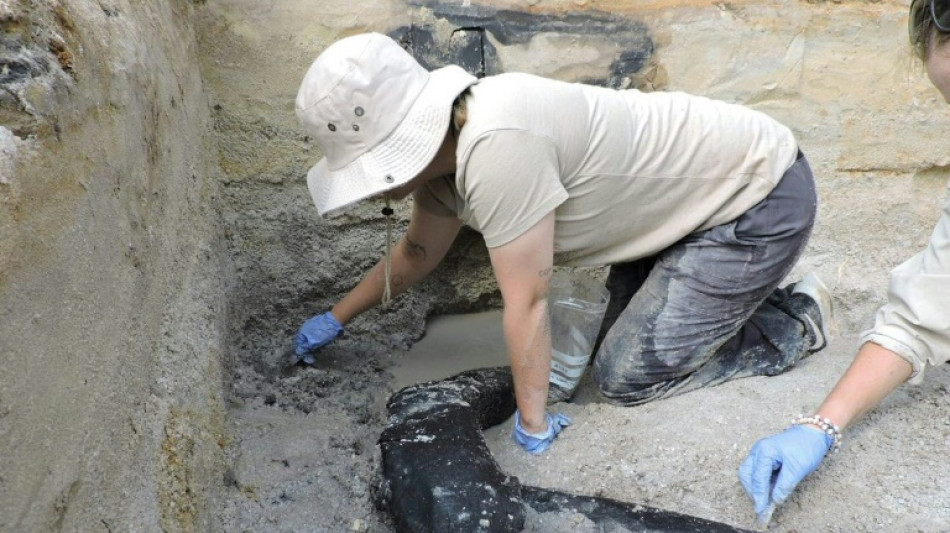
World's oldest wooden structure discovered in Zambia / Photo: © Liverpool University/AFP

 Stocks move lower despite oil prices dropping

 AI driving up innovation investment: UN

 UN Security Council extends Haiti mission by 6 months

 Man Utd do not deserve medals if Man City stripped of titles: Rooney

 Vana Completes Expanded Staking as Part of the Vega Upgrade, Publishes Expanded VANA Token Economics

 Spain to cap gas price hikes, extend fuel discounts

 'We just need rain': Germany's Rhine river hits new low

 Yemen health system at 'breaking point': WHO
 Ireland undecided on second Israel match: coach

 France's Le Pen defiant after top ally hit by antisemitism claims

 Tom Cruise trades stunts for satire as toxic tycoon 'Digger'

 MEXC Unveils "WE SEE YOU" Brand Visual Refresh, Putting People Behind Every Trade in Focus

 Thai capital cleans up after deadly floods

 NATO, EU allies rally to Estonia after 'sabotage' blamed on Russia

 Families demand justice for Cameroon's 'nightmare' wave of murdered women

 Tebas says Man City should face 'most severe' sanctions if guilty of rule breaches

 Pochettino calls Man City success 'a period of deception'

 Settler attack on West Bank village injures Israeli forces, drawing rare rebuke

 Mystery over UK airbase scare after reports no explosives found

 Spanish govt races to adopt housing law under protest pressure

 Estonia slams Russian 'sabotage' after arson attack on defence company

 Slovenia sees surge in '.si' sites after Trump hypes 'super intelligence'

 'Like a dream' for An as Games organisers 'sorry' for latest mix-up

 Tokyo suffers longest streak of rainy days on record

 Indonesia charges train driver over crash that killed 16 women

Archaeologists said on Wednesday they have unearthed the oldest wooden structure ever discovered, dating from nearly half a million years ago, which suggests that our ancestors may have been more advanced than previously thought.
The exceptionally well-preserved wooden structure was found at Kalambo Falls in the north of Zambia near the border with Tanzania.
It dates back at least 476,000 years, well before the evolution of Homo sapiens, according to a study describing the find in the journal Nature.
The wood bears cut-marks showing that stone tools were used to join two large logs to make the structure, which is believed to be a platform, walkway or raised dwelling to keep our relatives above the water.
A collection of wooden tools, including a wedge and a digging stick, were also discovered at the site.
The ancestors of humans were already known to use wood at this time, but for limited purposes such as starting a fire or hunting.
Larry Barham, an archaeologist at the UK's University of Liverpool and the study's lead author, told AFP that to his knowledge the previous record-holder for oldest wooden structure dated back around 9,000 years.
Barham said the structure was a "chance discovery" made in 2019 while excavating at the site located on the banks of the Kalambo River, above a 235-metre-high (770-foot) waterfall.
Discoveries involving such ancient wood are rare, because it tends to rot leaving behind little trace for the historical record.
But the high level of water at Kalambo Falls is believed to have preserved the structure over the centuries.
- 'Imagination and skills' -
Excavations at the Kalambo site in the 1950s and 1960s unearthed some wood, but it was not able to be accurately dated.
However this time around, the researchers used a new method called luminescence dating, which determines age by measuring the last time minerals were exposed to sunlight.
This revealed that the structure was much older than the researchers had thought, dating back at least 476,000 years.
The earliest evidence of Homo sapiens is from around 300,000 years ago.
But fossils of human relative Homo heidelbergensis, thought to have lived between 700,000 to 200,000 years ago, have been found in the region, Barham said.
The discovery of the wooden structure "changed how I thought about these people", Barham added.
"They transformed their surroundings to make life easier, even if it was only by making a platform to sit on by the river to do their daily chores," he said.
"They used their intelligence, imagination and skills to create something they'd never seen before, something that had never previously existed."
This suggests an abstract level of thinking and "probably language", he added.
Sophie Archambault de Beaune, an archaeologist at France's Lyon 3 University not involved in the study, said the structure "presupposes cognitive abilities such as planning and the ability to visualise the finished product."
But "these capacities were already assumed from the study of cut stone tools", she told AFP.
The authors of the study also said the discovery challenges the idea that human ancestors were nomadic, because the structure seems to be a permanent dwelling near the waterfalls, a perennial source of water.
Archambault de Beaune cautioned that this hypothesis had not yet been proven, because the structure could have been installed for the season, rather than permanently.
I.Meyer--BTB